Support New Jersey’s ospreys with donations matching a $12,500 challenge to help Conserve Wildlife Foundation purchase a boat.
by Ben Wurst, Habitat Program Manager
Surveying a nest on Long Beach Island in 2017, the last year we were able to utilize a state owned boat. photo by Northside Jim.
Ospreys are living barometers. They symbolize the resilience of life along the New Jersey coast. As a top tier predator who feeds exclusively on fish, their collective health is a direct link to the health of our coastal waters. Anyone can tell you that a healthy coast is essential to life at the shore. Clean water with abundant and healthy wildlife equals a booming shore economy. We have all benefited from actions and policy that have protected our air, land and water since the 1970s. Ospreys are no exception.
Mercer
County is now home to two pairs of bald eagles and their nests. The discovery
comes nearly three decades after the species nearly vanished from New Jersey.
“Bald eagles in particular were wiped out to
where we only had one nest in all of New Jersey as recently as the 1980s, and
it wasn’t even a successful nest. And now we have over 200 pairs of bald
eagles,” said David Wheeler, executive director of the Conserve Wildlife
Foundation of New Jersey.
Wheeler said pesticides and people led to the
near extinction of bald eagles.
Friday, bird watchers came
equipped with binoculars and cameras to catch a glimpse of one the nests
located at Mercer County Park.
“To
see the nature and the national symbol of the United States all right here
in Mercer Park is pretty neat,” said Flemington resident Graham
MacRitchie.
Nearly 70 people were part of a new educational
walking tour run by the County Parks Commission.
Banding osprey nestlings with red auxiliary bands at a nest off LBI. photo by Northside Jim.
If you live along or visit the coast, then it’s no surprise that ospreys continue to thrive in New Jersey. 2018 was yet another banner year for these coastal nesting raptors. Their large stick nests depict our rivers and estuaries while they indicate that we’re doing a good job of protecting our local environment along the coast. Today we’ve published results from last year’s nesting season in the 2018 New Jersey Osprey Project Report.
Eagle Viewing Event at Mercer County Park ~ Feb. 8 from 1-3pm
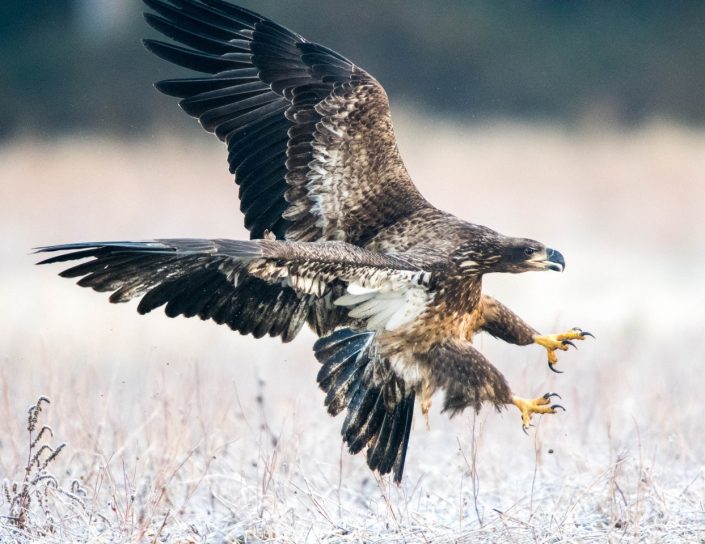
Bald eagle in flight. photo by Northside Jim
This breeding season, the Mercer County Park Commission is pleased to announce that two pairs of bald eagles have chosen County Parks for nest sites, continuing their expansion in New Jersey and the greater mid-Atlantic region. To celebrate the resident eagles, the Park Commission, Conserve Wildlife Foundation of New Jersey (CWF), PSE&G and the Wildlife Center Friends have launched a partnership to provide bald eagle-themed programs.
The first free public event will be at Mercer County Park at the West Picnic Area on Friday, Feb. 8 from 1 to 3 p.m. Participants will meet with naturalist staff and walk to the viewing site, where interpretation on eagle nesting will be offered. Attendees will also have the opportunity to view eagle activity through a spotting scope and binoculars.
…Let’s set aside a few minutes, shall we, and behold all the big birds and their continued resurgence in the Garden State.
Editorial by the (Bergen) Record / NorthJersey.com
Peregrine falcons have nested in Jersey City since 2000. photo by Ben Wurst
Exhibit One is the peregrine falcon, which in its swooping dive can reach speeds of 240 mph, and whose remarkable comeback was charted by NorthJersey.com and the USA TODAY NETWORK New Jersey environmental reporter Scott Fallon. He wrote of how state researchers and wildlife advocates had documented a record 40 nesting pairs in 2018, a near-miraculous feat considering the species had been all but left for dead in New Jersey beginning in the 1960s….
On Sunday January 13th, 2019 photographer, Bob Cook was taking photos of the ~20 eagles at a lake in a Mercer County park. He noticed that one of the eagles had a green tag on it’s right leg. After reviewing the photos it was established that the band was D/99.
D/99;1/13/19@ Bob Cook
D/99 is from the Duke Farms nest located in Somerset County. He and his two siblings grew up as a celebrities their every move being watched by viewers of the Duke Farms eagle camera. The three chicks were banded on May 12th, 2014. Measurements showed that there there were two males and one female, D/99 was the youngest male. All three fledged from the nest in June 2014.
chicks at Duke Farms nest 5/12/14. D/99 is in the middle.
Unfortunately, in August of 2014 we received a report that D/98, the oldest male, was found dead up in Maine. He most likely died of injuries that occurred during a fight with another eagle. This most recent sighting of D/99 is the first report of either of the two remaining chicks. D/99 will be five years old in April and reaching the age where he will be looking for a mate and establishing his own territory. It is always nice to know that a chick has survived to adulthood and most likely has come back to NJ to nest.
The Conserve Wildlife Foundation of NJ in partnership with the NJ Division of Fish and Wildlife, Endangered and Nongame Species Program, has released the 2018 NJ Bald Eagle Project Report.
“Two hundred-four nest sites were monitored during the nesting season, of which 185 were documented to be active (with eggs) and 19 were territorial or housekeeping pairs. Thirty new eagle pairs were found this season, 20 in the south, nine in central and one in the north. One hundred-twenty-one nests (66%) of the 182 known-outcome nests produced 172 young, for a productivity rate of 0.94 young per active/known-outcome nest. The failure rate was well above average with 61 nests (33%) failing to produce. The Delaware Bay region remained the state’s eagle stronghold, with roughly half of nests located in Cumberland and Salem counties and the bayside of Cape May County.”
The number of active nests has increased while the number of young eagles fledged has decreased since a high of 216 young fledged in 2016. During the 2018 eagle nesting season there was an abundance of cold, wet, windy and snowy weather which was the cause for a portion of the nest failures. As the eagle population increases, there are more eagles competing for territories. This can also be a contributing factor in nest failures. NJ is still in the range of 0.9 to 1.1 young per nest which is needed for population maintenance with a productivity rate of 0.94 young per known-outcome/active nest in 2018. The 2018 NJ Eagle Project Report has all the details on the project including telemetry, re-sightings and recoveries.
The success of the eagle project is due to the tremendous dedication of the NJ Eagle Project Volunteers. They monitor the nests in all types of conditions and education people about the eagles with enthusiasm.
Nearly 10 years ago, a US Airways flight out of New York’s LaGuardia Airport memorably ended up in the Hudson River after striking a flock of Canada geese and losing engine power just northeast of the George Washington Bridge.
The passengers and flight crew survived the so-called “Miracle on the Hudson.” But each year, thousands of planes meet up with birds and other wildlife, and those numbers are growing in New Jersey.
In 2017, there was 366 reports of wildlife strikes in New Jersey. That was up from 326 in 2016. Among those incidents included a September 2017 crash of an ultralight aircraft in Cumberland County, after its pilot was forced to bank hard after a flock of small birds entered his flightpath. A moment later, a larger bird struck the support cable on his right wing and he tried to touch down to check for damage. Hitting the ground hard, the kite-like plane was substantially damaged.
David Wheeler, executive director of the Conserve Wildlife Foundation of New Jersey, said the increasing number of bird strikes in New Jersey may be a matter of better reporting, as well as the increasing number of flights in the Northeast.
Story by Darci Palmquist, Conserving the Nature of the Northeast
A saltmarsh sparrow photographed in Delaware. Credit: Matt Tillett, creative commons.
Even if you’re not a birder, there are a lot of reasons to care about birds. There are of course their aesthetic qualities — beautiful, charming, euphonious — and their incredible feats of survival as small creatures in a big, ever-changing world.
But like the proverbial canary in the coal mine, when birds aren’t doing well it usually means their habitat is suffering in some way. And if the habitat isn’t functioning, people lose out too; on the benefits that nature provides, from clean air and water to storm defenses.
Here are stories of how restoration efforts are helping ensure a brighter future for three bird species — red knot, piping plover and saltmarsh sparrow.