Reporter James O’Neill covers the impacts on plants and wildlife from the unseasonably warm weather for New Jersey this winter in this story for The Record.
Big Brown Bat by Blaine Rothauser.
Bats, migratory birds, and other wildlife are challenged by earlier than usual spring-like conditions, says Conserve Wildlife Foundation’s David Wheeler.
Hundreds of red knots found to cap long day’s journey
By Larry Niles, LJ Niles Associates LLC
It took us long into the night to reach our next port. We went from the relatively populated area of Braganza to the dark heart of this coastal region of Viseu. In three trucks, we caravanned through a maze of remnant tropical rainforests, cattle pastures, and impenetrable second-growth woodlands. Along the rain-slicked, red clay road, small and desperate looking towns popped out of nowhere always looking like the past was a better day. The road cut through countless mangrove forests that define this region. We reached Viseu too late to do anything but find a place to stay the night.
A bridge across the many rivers from Braganca to Visiu, Brazil. Photo by Christophe Buiden.
By noon the next day, we boarded a Lancha boat named Garota Viseu (Viseu Girl). Local shipwrights craft these two-decker boats of about 50 feet in length, primarily to carry cargo and people from port to port. Today it will carry us into one of the most remote estuaries in the 250-mile coastline of this enormous mangrove and beach landscape. Our captain, 78-year-old Benedicto, with one crew navigated the coffee- colored Gurupi, a long river that cuts deep into the tropical coastline.
A nearly completed boat in a ship yard in Viseu.
Bene took his craft down the Gurupi within sight of the wind-tossed Atlantic Ocean. The trade winds blow constantly here, almost always at near gale levels. But then he turned into a small channel directly into the steamy mangrove forest. At first the path was wide, lined with a dense tangle of mangrove on either side. Whimbrels, scarlet ibis, semi-palmated sandpipers clung to tangles of roots as the high tide flooded the soft mud.
Captain Benedicto piloting his Lacho boat, the Garota Viseu.
Then he took the boat in a channel so narrow, the crew had to duck the whipsaw of mangrove branches. We slowly snaked our way through a tunnel of green until we reached another wide channel. Within a few minutes, we entered another narrow channel ultimately reaching the next bay. Here we felt the full force of the stiff winds and deep rolling swell of the Atlantic. An hour later we weighed anchor at the small community of Apiu Salvadore.
The Garota Viseu weaves its way through the narrow mangrove passage. Stephanie Feigin, Danille Paluto, Christophe Buiden and Yann Rochepault watch from the top deck of the boat.
Few people from the outside world come to this community of about 50 ramshackle huts and cabins and about 150 people. As the boat neared the shore with most of the team standing on the roof of the boat, scattered groups of the town’s people stood on the sandy bluffs overlooking the harbor as though we just landed from space. Ultimately, we found them welcoming but wary. Little good comes from the outside to these communities.
Over the next two days, we plied our craft of field biology. We needed to find small boats to take teams to the various shorebird habitats previously determined on our maps. Local craftsmen build these boats. Running about 20 feet in length, they use 10 to 20 horse power engines meant for something like a lawn tractor. Instead of driving a blade, the craftsmen power a long shaft that ends in a 8-inch propeller. The skipper can lift the engine and propeller according to the water’s depth. They suited our needs perfectly.
We fielded five teams in three in boats while Mandy, David Santos, Carmem and I surveyed Lombo Branco Island, about two miles from the Apiu Salvador. The sea shapes this island into a crescent, the inside protected from the restless waves. Nestled within, one could see in miniature, the whole ecological system that creates resources for shorebirds.
At the heart of the island grows a small and stunted mangrove forest and an apicum, or wetland that only floods during lunar tides or spring tides. These are the highest of the monthly cycle of tides but only occur on the full and new moon. Every day the tide moves in and out of this small system. Twice a month the tide floods the apicum for several days at a time.
We arrived on the day of a waxing moon, near full. The very high-high tides reached well within the small drainage flooding habitats that have not been flooded in a few weeks. Shorebirds carpeted the wet mud, searching for all the invertebrate life that flourishes in this habitat. But the productivity only starts there. Here the tidal flow is gentle because the island shields it from the wind tossed Atlantic from all sides except the leeward quarter of the island. This gentle tidal flow flushes sediments from the mangrove swamp, the nutrients of the apicum and the normal productivity of a sediment-rich sandy substrate, forming the base layer of a productive food chain that nurtures small clams and other invertebrate – all prey for shorebirds.
We found whimbrels, semi-palmated sandpipers, ruddy turnstones, short-billed dowitchers, black belly plovers, willets, semi-palmated plovers, sanderlings and collared plovers. In the lower reaches, we found 337 knots, a glorious find that will help our mapping model enormously.
Red knots, sanderlings, short billed dowitchers and other shorebird forage in the inter-tidal estuary of Morro Branco.
The following day we surveyed a second island, Coroa Criminosa. Why the sinister name we cannot say, but it supported a very similar esturary giving us another successful day. When the tide went out the small island of about 6 kilometers grew to over 20 kilometers. Intertidal sand flats spread out of sight in nearly all directions.
We left the island that night and arrived in Viseu just before dark. Once again we suffered the sway of the Atlantic. After weaving our way back through the mangrove and up the Gurupi River, we landed too late to go on. We were thankful for the modest rooms with showers, a good meal and beer!
It’s hard to imagine the difficulties of people living here at Latitude 37 Degrees North when arriving at the equator in northern Brazil. It challenges even the hardiest of biologists. However, after three days our team has not only acclimated but we accomplished surveys in two separate estuaries.
Ruddy turnstone multiyear flight recorded by a geolocator caught in Maranhoa, Brazil.
Low tide was cut short on our first day in the field, while high tide persisted longer than we expected which challenged our surveying since it must take place when birds forage. Shorebirds typically forage until 1 to 2 hours before high tide and start again 1 to 2 hours after high tide, usually resting and digesting the food consumed at the lower tides. Because we intend to understand the foraging habitats of shorebirds in the wintering area, we must focus on the lower tides. This is always difficult due to logistical issues such as renting boats, equipment failures, and long distance from the ports present an array of complications. Still, we were able to go out in the field and collect some data.
The next day we did marginally better, each team member faced different problems. Our boat engine failed and we had to paddle back to port, another boat took so long to get to the shoal we intended to survey that it had already been covered by the tide. But this is the nature of field work anywhere.
Yann and Christophe paddle our boat back to port after the engine failed.
No matter the complication, it is important to stick to our rigid protocols. Our goal is to determine the best places for shorebirds in this area. We must work with the shorebird’s behavior because each tidal stage creates different value. In a wild place such as this, they will choose to roost as close to the foraging areas as possible. In fact most will just roost then feed as the tide recedes then feed as the tide rises and then roost again. So locating the feeding areas will usually indicate the roosting areas.
But things can go awry. In human dominate habitats like New Jersey, birds find it hard to roost near foraging areas. Most often the high tide forces them into people jogging, dog walking or enjoying flushing shorebirds. So the shorebirds must leave, unnecessarily burning valuable fuel and suffering greater danger from avian predators.
The night-time roost creates the real threat here in Brazil and everywhere. At night many dangers lurk. Ground predators, such as owls, feral cats, raccoons, and even people will take advantage of any unwary or sickened bird. It is worse when birds are forced to use areas that are less secure than others. This can happen naturally at spring tides, for example, when the very highest high tides force them closer to the dangers lurking in the dunes or mangrove forests. In places like Hereford, New Jersey, people often force birds to use more dangerous areas.
Larry Niles surveying.
So our goal here is to map all the areas of importance – foraging, day-time roosts and night-time roosts. But we hope to do it with remote sensing; satellite maps that are trained by a mathematical model, that are, in turn, trained by our field data. We count birds, photograph the surrounding habitats, precisely locate the sites, and even look at the substrate. Is it mud, sand, muddy sand, sandy mud and so on?
Doing this in New Jersey is difficult. Doing it in the northern coast of Brazil presents untold challenges. One cannot easily access the coast here. We have to rent boats to take us out to the birds, conduct surveys then get back before dark. Sometimes we go out for days and stay in remote fishing villages, sometimes with only a floor to sleep and no facilities or power. Imagine unrelenting heat, mosquitoes, persistent blowing sand, copious sweat, and trying to conduct a scientific investigation. That would be demanding in any environment.
So this is the challenge of our crew – and they do it aplomb! Last year one of the boats sank in 55 feet of water 8 miles out to sea. We all made it to land safely but we lost much of our equipment. The day after was grim, wondering if we should we go on or go home? Without hesitation, not only did the crew go on to complete the survey but we ended up capturing twenty-two geolocators from ruddy turnstones tagged two years earlier. A good crew is hard to put together and stay productive in these conditions. A good spirit is the most important thing.
Our team chooses areas for the next day’s surveys. Beer is essential!
So we completed two days of surveys at the western end of our 150 miles long study area. Today we prepare for three days out to a remote area, accessible by boat only. As I write, the team prepares for food, water and all the necessities of spending three days with minimum comfort. We hope to camp in a fishing village, maybe a house, but we won’t know until we get there. We must prepare for all possibilities.
Our understanding of the inner workings of the Brazilian Extractavista reserve system grows every day. This system I believe holds great hope for us in the United States because it serves both the wildlife and fish and the people living in the landscape. Pretend, for example, on Delaware Bay, the rural towns and the residents get first crack at the sustainable management of resources, not the companies exploiting them without regard to the future, as it is now. Instead of few people earning a good living off Delaware Bay resources, many would. Rural American would be transformed. This is what ICMBio hopes to achieve in this much poorer area.
Two members of our team are managers of the seven reserves in Para, our study site. They told us, for example, ICMBio (Chico Mendes institute), the federal agency in charge of the extractive reserves, pays a subsidy for local fishermen in exchange for helping manage the fishery resources. But the subsidy is limited to existing residents, not people within new reserves because of the new conservative government. One can see right away the challenges of two people managing seven reserves covering a coastline the size of New Jersey. Budget cuts have taken away all equipment funds. They must even clean their own offices as most nonessential staff has been cut under the new conservative government, a government accused of unfairly deposing the most popular liberal party.
This should resonate in the United States because it could be coming soon to a wildlife reserve near you.
Wintering knots in roost.
Dr. Larry Niles has led efforts to protect red knots and horseshoe crabs for over 30 years.
We leave a cold and dark New Jersey with mixed feelings for our destination to tropical Brazil. It will be warm and sunnyish – though forecasts predict drenching thunderstorms threatening us every day of our trip. We will explore a very new place, the ocean coast of Para, a largely unsurveyed coast known to be a wintering shorebird mecca. At the same time, we will undergo trials experienced by few biologists. Zika is prevalent in Para, but recent cases of malaria are equally alarming. Of course, one must be ever vigilant for food and water pathogens. Last year, I developed food poisoning ending me up in a rural hospital, with a room full of very sick people. On arrival, I wondered what comes next?
A small part of the sprawling city of Sao Jose de Ribamar.
The contrast of poverty and the truly wild can jar a Jersey biologist’s sensibility. People fall into poverty here because it’s the common condition. Poor sanitation, terrible roads, and nearly non-existing law enforcement plague those who live in coastal Brazil. The economic crisis and the ever-expanding corruption scandal in the federal government rob people of hope for the future and anchor them to a life of poor education and wages, and widespread filth. In the cities, the water churns with rubbish and contamination is ubiquitous.
Yet few people populate the ocean coast sites where we will survey. There, the sea teams with fish and shellfish beyond measure. Walking through a fish market is like going to a fish museum for all the species, exotic and common. Hundreds of small villages, most with only occasional power, perch precariously on the edge of this wonderful and largely uncontaminated sea or nestle deep in a vast mangrove forest, one of the largest in the world. In many ways it’s a biologist’s wonderland.
Only a few hundred miles away snakes the many channels of the Amazon River and surrounding it lies one of the world’s last great tropical forests. It’s the home of one of the great battlegrounds of environmentalism. The new U.S. administration will probably support the wealthy families cutting away valuable timber for cattle ranching, destroying carbon capturing and oxygen producing trees and, at the same time, the livelihood of native people who eke out a bare existence from rubber, nuts and the diverse wildlife that share the forest with them.
An illegal forest cut in the Brazilian rainforest in the state of Para.
But our government has a lot to learn from the Brazilians. They have created a novel conservation system, one unknown to us in the U.S.
They call them extractive reserves. The federal agency in charge, ICMBio, struggles to save these reserves, not for tourists or rich residents, as we do in New Jersey, but for the people who live within. They stop the ranchers from destroying the forest. In the same way, they stop the international fishing fleets from decimating the fishery in Para. Staff of the agency die every year doing their job. One just recently in the state of Para, not far from our destination.
There are seven extractive reserves in our coastal study site in Para, Brazil. This map was created by Dan Merchant and Rick Lathrop CRSSA.
Our project aims to help. Our team, sponsored by Conserve Wildlife Foundation with Neotropical Migratory Bird Conservation Act, will survey birds, measure habitat, and ultimately map this coast with state-of-the-art GIS system developed by Rutgers Center for Remote Sensing and Spatial Analysis. We intend to provide ICMBio staff with better GIS tools than are available in the U.S.
Over the next three weeks, we will be reporting on our research investigation. We will also explore the threats to the extractive reserves in our study area, everything from disturbance to shrimp farms.
For my part, however, I will also investigate if this system captures the best conservation envisaged by most religious leaders, including Pope Francis. Despite the political rhetoric of the old politicians that fill our media, most of the world’s religions speak openly about supporting climate change action. They envisage an “integral ecology”, in the word of Pope Francis, a union of the need to heal the earth and the plight of the poor. Even Southern Baptist have adopted this position that the impact of climate change falls on the poor. This is as true in Brazil as it is in Delaware Bay. Perhaps in Brazil lies a better way.
Dr. Larry Niles has led efforts to protect red knots and horseshoe crabs for over 30 years.
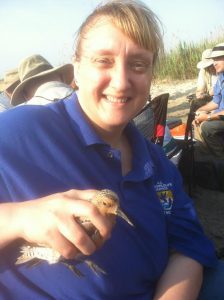
As a Senior Fish and Wildlife Biologist at the United States Fish and Wildlife Service, 2016 Women & Wildlife Leadership Award Winner Wendy Walsh has proven herself invaluable in the endangered species field for her work with wildlife such as the piping plover, swamp pink, and seabeach amaranth. Her most notable work is with the red knot. Ms. Walsh took the species lead in the middle of the federal listing process. Her tireless efforts coordinating, analyzing and interpreting data, particularly detailing the effects of changing climate on these long-distance migrant shorebirds has made her work widely acclaimed as the final rule. From biology to policy, she has an uncanny ability to grasp important information and translate it for any species she finds herself working with. She has created partnerships with additional organizations to accelerate conservation efforts. In such collaborations, Ms. Walsh’s open-mindedness to others’ expertise makes for effective planning and implementation of the vision she has to one day recover all threatened and endangered species.
CWF asked Wendy a few questions about what working in wildlife rehabilitation means to her:
What motivates you to get out of bed each morning and go to work?
“Engagement with the work. Of course there are those mundane tasks we all have, but in general I find my work highly engaging. Sometimes when I’m at home, I’ll think of some new resource or approach to a conservation problem I’ve been working on — then I can’t wait to bring that idea to the office and try to apply it. When it works, my job can also be very rewarding.”
What is your favorite thing about your job?
“I love that I’m constantly learning something new. Over the years, I’ve had the chance to learn about and observe so many species, and I’ve had the chance to really get to know a few in particular — piping plovers, seabeach amaranth, bog turtles, swamp pink, and red knots. And I’ve had the opportunity to work on such a wide range of issues — utility lines, transportation, mitigation, stormwater, beach nourishment, bird collision, volunteer programs, restoration, fishery management, listing, and most recently aquaculture. I’m very fortunate to have a job where there is always a new learning opportunity on the horizon.”
Do you have a New Jersey wildlife species that you like best? Why?
“From a non-scientific point of view, I love watching dragonflies and wading birds with my kids, and taking the family to count and tag horseshoe crabs. But professionally, I’m partial to the beach species I’ve worked on — piping plovers, red knots, seabeach amaranth. I enjoy the beach ecosystem, and I feel a responsibility to these beach-dependent species that face so many challenges along New Jersey’s human-dominated coast.”
What interests you the most about New Jersey’s wildlife?
“I’m fascinated at the contrast between New Jersey’s really remarkable habitats and ecosystems in the context of our equally remarkable human population density. Generations of pioneering conservationists from past decades have allowed our State’s wildlife to persist even with so many people. I view our generation — and my kids’ — as stewards of that conservation legacy.”
What is your favorite thing to do when you aren’t working?
“I love spending time with my family, such as taking trips with my husband, Mac, and two daughters, as well as time with extended family — Mom, brothers, cousins. I enjoy working with my kids’ Girls Scout troops and helping at their schools.”
We are excited to recognize the leadership and inspiration they provide for those working to protect wildlife in New Jersey. Women & Wildlife will also celebrate the timeless and inspiring journeys of wildlife migration in New Jersey and beyond.
Under the sweltering September sun, our team discovers the earth at our fingertips. We ready the manure, topsoil, and mulch, wield the pickax and trowel, and labor the wheelbarrow through the trees and up the slope of a tidal berm.
We plant 250 native shrubs and 580 native herbaceous plugs. We hammer in nest boxes, install pollinator houses, construct mounds of brush for local and migrating wildlife, and create nesting habitat for northern diamondback terrapin, an at-risk turtle species.
We lose ourselves in nature for the day.
A migrating butterfly flits past leisurely and I look up from the soil to wipe my brow. Suddenly I remember exactly where this newly vibrant natural ecosystem is. Nearly overhead, I can watch never-ending streams of commuters and tractor trailers motor past over one of the busiest bridges in the nation – the Newark Bay Bridge. Just across the bay, I can see heavy industry. Out beyond the fence, more industry – ancient, tireless, modern progress marching forward.
Yet on this morning, and those that follow, we now have ecological progress here as well, in a place that was written off entirely not so long ago. The Newark Bay region has suffered a century and a half of environmental degradation at the hands of industry and unbridled development.
This active industrial site is home to Firmenich Inc., one of the largest manufactures of fragrances in the world. We have transformed the land today to invite wildlife partners to help balance the scales of the region’s damaged ecology.
Green Darner dew laden on Echinacea.
These partners are vital to our environment, to our health, to the world around us. They are the butterflies and bees, the wasps and beetles, the flies and moths that make up an army of pollinators that in coordinated effort provide humanity with the lungs of our planet. Without these pollinators, native plants could not sink carbon dioxide and impart oxygen to our surroundings, every minute of every day. Without these pollinators, the bread baskets of the world would wither away, no longer filled with grains, fruits, and vegetables.
The natural partnerships don’t stop with the pollinators born forth from meadow creation. These partners extend to migrating songbirds and mighty raptors, small mammals and diamondback terrapins.
“If we give nature an inch, it’s going to take a yard. Give it a chance and nature will return,” says biologist Blaine Rothauser, who is directing the restoration for GZA Environmental. “Wildlife just needs an opportunity.”
Immature night heron with crab.
Nature’s inspiring return builds upon decades of ecological recovery in the region. Thanks to President Nixon’s Clean Water Act of 1973, the water began to get cleaner. Improving the water quality reanimated the food chain from the bottom up – phyto- and zooplankton, invertebrates and crustaceans reappeared. In turn, a fishery was reborn, which ushered in the return of herons, ibis, osprey, turtles, and even harbor seals – seen sunning on the banks of tidal shores in winter!
Yet much of the land around the water’s edge is still wanting.
“The restoration site is an important buffer habitat to a large portion of undeveloped tidal bay directly adjacent to the Firmenich complex,” says Rothauser. “Today we have 60 people planting a native community of shrubs, trees and plants on a formerly sterile lawn and an unnaturalized earthen berm. It is vital work that makes a real difference.”
The team has also created opportunities for rare species to nest. Above our heads, an osprey platform has been installed, empowering this magnificent fish-eating raptor to continue its recovery along Newark Bay and many other New Jersey waterways, industrial and remote alike.
A barn owl box offers one of our most mysterious nighttime predators the opportunity to set up shop in a beneficial area – where there is no shortage of rabbits and field mice to help control.
Close up of a barn owl.
Across the pond, a purple martin condominium-like house offers the ample space necessary for these communal swallows to reside, a home base where they can feast on flying insects.
With the first phase of the project almost complete, the second phase will seek to transform the site’s holding ponds into ecologically productive floating wetlands, bringing herons and egrets and other wading birds.
Ultimately, this project is envisioned as one that can be replicated just about anywhere along Newark Bay – or any industrial waterfront for that matter. All it takes is the willingness to look at a site’s land from a different perspective – and in so doing, to understand that the ecological benefits of bringing back many wildlife species aren’t negated by losing economic tradeoffs.
Instead they can mean parallel economic benefits. Natural pest control. Fewer landscaping and pesticide costs. Increased employee morale and productivity, with a newfound opportunity to recharge body and mind with a rejuvenating break outside, enjoying natural beauty and the engagement of your senses.
Images above from left to right – Killdeer, 12 Spotted Skipper, and American Kestrel.
New Jersey has long served as a primary engine for America’s industry and commerce – and in return has often been derided as the “Which exit?” land of nothing but turnpike and smokestacks. The Meadowlands just to the north of here bore the brunt of that reputation, yet in recent decades has made a mind-blowing ecological recovery to become a wildlife – and ecotourism – destination.
The waters flow south from the Meadowlands along the Hackensack and Passaic Rivers, and they come together in the Newark Bay. Now, that next wave of wildlife recovery and habitat restoration has arrived just downstream – along the Newark Bay waterfront.
For wildlife, it’s where the action is.
David Wheeler is the executive director of Conserve Wildlife Foundation and author of the book, Wild New Jersey: Nature Adventures in the Garden State.
The fall is a great time of year to spot a bald eagle anywhere in New Jersey. Eagles that nest and live further north are migrating south. Many will be staying to spend the winter months in NJ where there is usually warmer weather, open water and a supply of food. We’ve had a report of an eagle with an orange band sighted in Burlington County, NJ. The orange band means that the bird was banded in Massachusetts and the plumage shows the bird to be a first year bird banded this past season.
NJ nesting pairs are here year round and we’ve had reports of pairs already sprucing up their nests for the nesting season.
Adult bringing stick back to Nest 10/23/16@Alex Tongas
New Jersey eagles also travel out of state, a green banded eagle (NJ) was spotted down at High Rocks Lake in North Carolina October 16th by Carolyn Canzoniere. The code on the band wasn’t readable, but going by the plumage the bird was banded in 2013. This bird hasn’t yet reached sexual maturity, perhaps it’s checking out the area for future nesting in North Carolina.
NJ Banded eagle 10/16/16, High Rocks Lake, NC@Carolyn Canzonieri
Telemetry
CWF and NJ ENSP have been tracking two eagles outfitted with transmitters. The telemetry maps on the CWF website are currently being updated and redesigned to allow for easier viewing of “Nacote” and “Oran’s” movements. We hope to have the new maps up and running in the next few weeks.
Nacote D/95 continues to spend time around Cape May and Atlantic Counties.
He was photographed by Peggy Birdsall Cadigan on 10/23/2016 at Forsythe NWR, near his old nest site.
“Nacote” 10/23/16@ Peggy Cadigan
“Oran” E/17: From July 18th until September 21st Oran was out of cell range. His last known location was near the Quebec/Maine border and then on the September 21st came back into range along the Maine coast. He made his way back down to southern New Jersey and was at Dennisville Lake, Cape May County on October 3rd. Mid-October he made a trip to Delaware and came back to NJ a day later and has been foraging and roosting in Cumberland County.
“Tiny” has another successful nesting season in Connecticut
By: Larissa Smith: CWF Biologist
C/94 “Tiny” keeps a watch over nest in CT; 6/3/2016@ C.Pratt Didan
In 20015 we were contacted by Cyndi Pratt Didan regarding a pair of nesting eagles she has been observing in CT about 150 miles from Duke Farms. She was able to get a reading of the green band on the male C/94. It turns out that C/94 is a Duke Farms eagle from the 2009 nesting season. In 2009 there were three chicks in the nest and all were male. C/94 was the youngest and considerable smaller in the beginning as he was a week younger than the oldest chick and got the nick name “Tiny”.
May 18, 2009, C/94 after banding with siblings @M.Valent
His mate is also a banded bird from Massachusetts banded on June 11th, 2008. The pair nested in 2014 fledged two chicks and fledged one chick in 2015.
Cyndi reports that the pair built a new nest seven miles away from their old nest. This nest is in a pine tree on an island in a Reservoir. This season they fledged two young birds.
We thank Cyndi for keeping us updated on this NJ bird. It’s always good to get news about one of “our” chicks.
“Tiny” with one of the chicks 6/3/2016@ C.Didan Pratt
For those of us who call New Jersey home, we’ve all likely witnessed the impact human activities have on our environment and the species who thrive here. Although habitat loss, illegal poaching and invasive species can be equally devastating to an ecosystem, the presence of plastic pollution around our state is a threat that almost every individual can be found personally culpable.
A jellyfish & a plastic cup cover – which is which? It’s easy to see how a sea turtle could get confused and accidentally swallow plastic. Photo by Mike Davenport.
Although many forms of pollution impact our native species, the summer months at the Jersey Shore often result in a surge of plastic debris that are left behind or improperly disposed of. Plastic pollution impacts millions of wildlife species globally, and the diverse number of species in New Jersey are no exception.
The plastic pollution that accumulates in our waterways and elsewhere around New Jersey poses a serious threat to native species. Single-use plastic products like plastic bags, bottles, bottle caps, wrappers, straws, and even balloons are not only unsustainable, but particularly dangerous for the animals that may become entangled in them or accidentally ingest them.
A few years ago, CWF’s Habitat Program Manager Ben Wurst and his dedicated group of volunteers who monitor the osprey nests along the coast began to hold onto the trash and debris collected in and around the nests. While it may not be the most visually appealing educational resource, it made the growing problem of plastic pollution personal for Ben, in a way that words aren’t always able to convey.
Plastic bags, one of the most common single-use plastic products, were overwhelmingly prevalent in many of the nests. And osprey aren’t the only wildlife species facing this threat. Seals, terrapins, shorebirds, fish, whales, sharks and dolphins can also be impacted by plastic debris.
The presence of plastic in our daily lives is interminable and difficult to eliminate completely, but there are a number of things we can do to minimize the impact our habits may have on our wildlife!
Clean up after yourself:
Whether you’re spending the day at the beach, having a picnic by a lake, or tubing down a river, make sure you take any trash with you before leaving and recycle what you can.
Be mindful of your surroundings:
If you’re out and about and notice that someone left some trash behind, take a moment to throw it away.
Reduce your consumption:
A number of small changes from millions of people can make a big difference. For starters, invest in reusable shopping bags and water bottles. And cut down on the number of miscellaneous throw away plastics you use, including straws and plastic wrappers.
Donate:
Consider donating to CWF to support our conservation projects and ensure our biologists and our volunteers are able to continue surveying and aiding species in need.