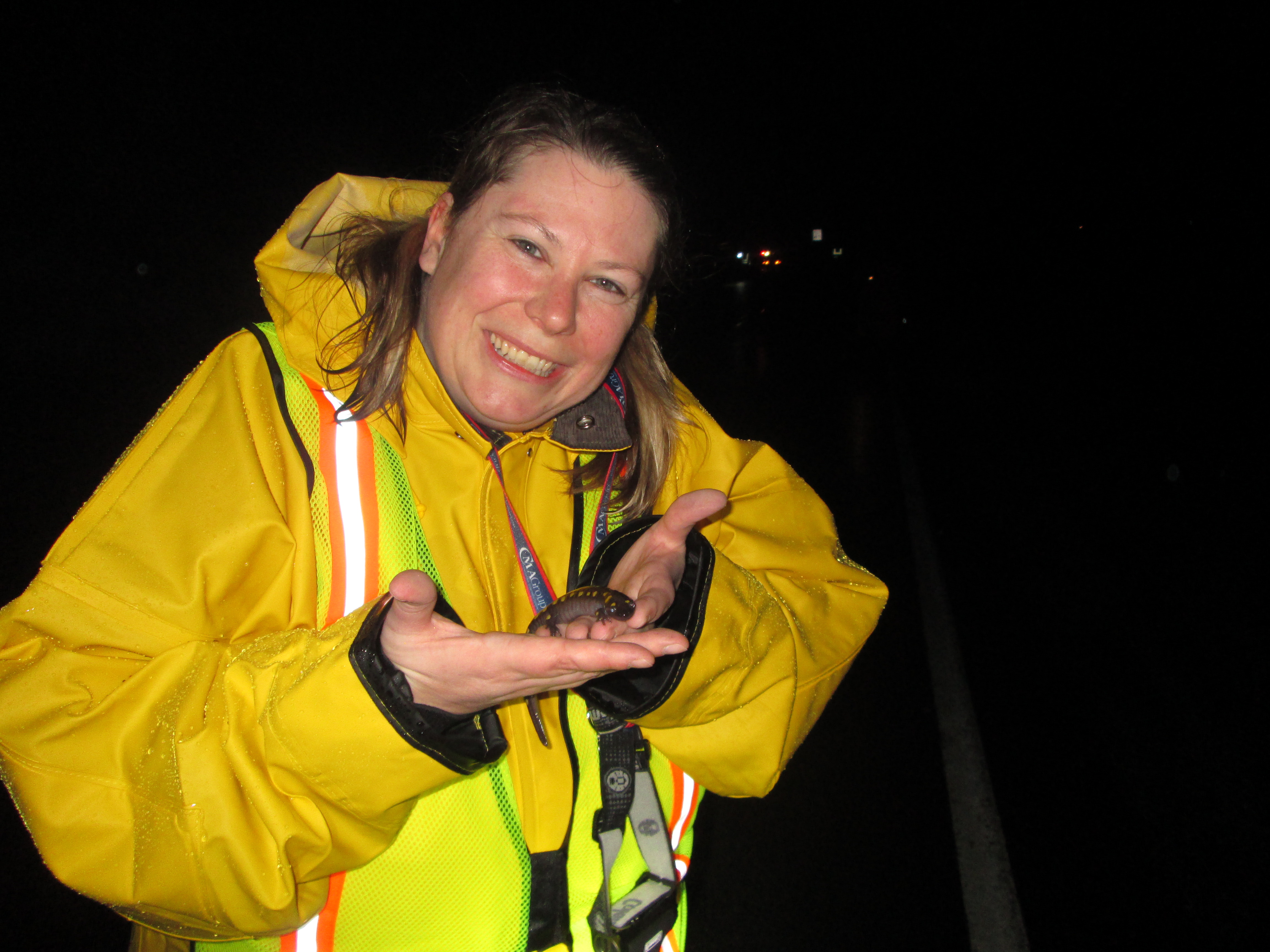
A spotted salamander after being rescued after attempting to cross a road. (c) CWF
Conserve Wildlife Foundation of New Jersey was profiled in a recent article in the The Record about our efforts to protect migrating amphibians.
One of the lesser known signs of spring arrived Monday night on Clinton Road in West Milford: A steady trickle of frogs and salamanders crept through an icy rain in search of love. If not for the teams of volunteers who waited to prod them across the winding road, many would meet a quiet end under the wheels of a passing car. Every year in early spring, champions of the tiny amphibians spend several hours at this spot and dozens like it throughout the Northeast so they can witness — and do their small part to continue — a natural phenomenon that goes largely unnoticed by the greater population. Read more…
On the first rainy nights in Spring, Beekman Road in East Brunswick is closed to vehicle traffic to allow migrating amphibians safe passage between their upland habitat and their breeding vernal pool habitat (c) Friends of East Brunswick Environmental Commission
The temperatures might not be what they should be for this time of year but don’t tell that to the salamanders and frogs that are beginning their migrations to their natal vernal pools to reproduce. I went out on a cold, dark, rainy evening to the town of East Brunswick to be a part of this magical experience.
Every year around mid to late March into early April, these little creatures get ready to begin their annual journey to their breeding pools. Usually the temperatures need to be above 40 degrees Fahrenheit, and on this night activity was a little slow going until the rains came. Vernal pools are an important part of salamander and frog reproduction as they provide the perfect hatchery to lay eggs in shallow water undisturbed by predatory fish. David Moskowitz leads the effort to safely monitor the amphibian migrations with Friends of East Brunswick Environmental Commission, a not-for-profit which provides many earth friendly programs throughout the year. The study area, Beekman Road, is a long winding country road surrounded by woods that runs between the amphibians’ upland habitat and their breeding grounds. The road is closed, thanks to the work of the East Brunswick Environmental Commission, on nights when the migration might occur, allowing the animals to cross the road safely and preventing roadkills. David explained that most of East Brunswick used to be covered by vernal pools, but since development has occurred, the land around Beekman Road is one of the last wildlife refuges in the area so it warrants protection.
A spotted salamander crosses the road to travel to vernal pools for breeding. (c) Sean Grace
All the conditions have to be right for these amphibian migrations, and it seems that tonight is going to a “big night” as families with flashlights in hand gather on Beekman Road by the bunches. David’s enthusiasm is contagious, as he runs around the woods like a little kid, turning over logs to look for spotted salamanders, explaining to onlookers about their biology, diet, and breeding. He leads us on a trail marked with pink flags to the vernal pool to listen to spring peepers calling in the night. At this vernal pool, you will also find Northern gray treefrogs, wood frogs, chorus frogs, and other frog, toad, and salamander species. As the rain begins to get heavier, I begin to notice more spotted
salamanders crossing the road and I save one from being crushed. This leads me to think about CWF’s Amphibian Crossing Project led by Mackenzie Hall, Private Lands Biologist, and I know she must be out in the Northwestern part of the state, doing exactly the same thing, helping these small, yet incredibly important animals, survive in our ever more developed world.
We have begun another season of headstarting eastern tiger salamanders with the Cape May County Zoo. Mature larvae will be released into our constructed ponds in early summer to help establish new, robust populations above anticipated sea-level rise.
Last week, we released 16 eastern tiger salamander larvae from our headstart program with NJ Division of Fish and Wildlife and the Cape May County Zoo.
Eastern tiger salamander Headstart Program at Cape May County Zoo
Headstarted eastern tiger salamander larva
These larvae were released into newly constructed pools as part of our vernal-pool habitat restoration project to create new vernal pools above anticipated sea-level rise to mitigate for climate change. This project is part of a larger goal to create a stronghold for eastern tiger salamanders in New Jersey.
by MacKenzie Hall, Amphibian Crossing Project Coordinator
Karen Ruzycki gives a salamander a lift. Photo: M. Hall
Easter Sunday is a celebration of rebirth, resurrection, springtime, life. And this Easter Sunday – right on cue – a warm day turned into a mild night, the mild night met with rain, and together they gave rise to lots and lots of life. The amphibian migration was underway…in a big way!
Our teams were ready. Despite heavy bellies and a long day with family, at least 50 trained volunteers came out to “guard” the animals at road-crossing hot spots. From nightfall to around 11:00 pm we escorted, ferried, and tallied more than 3,000 salamanders and frogs across! (Numbers are still coming in from other teams.)
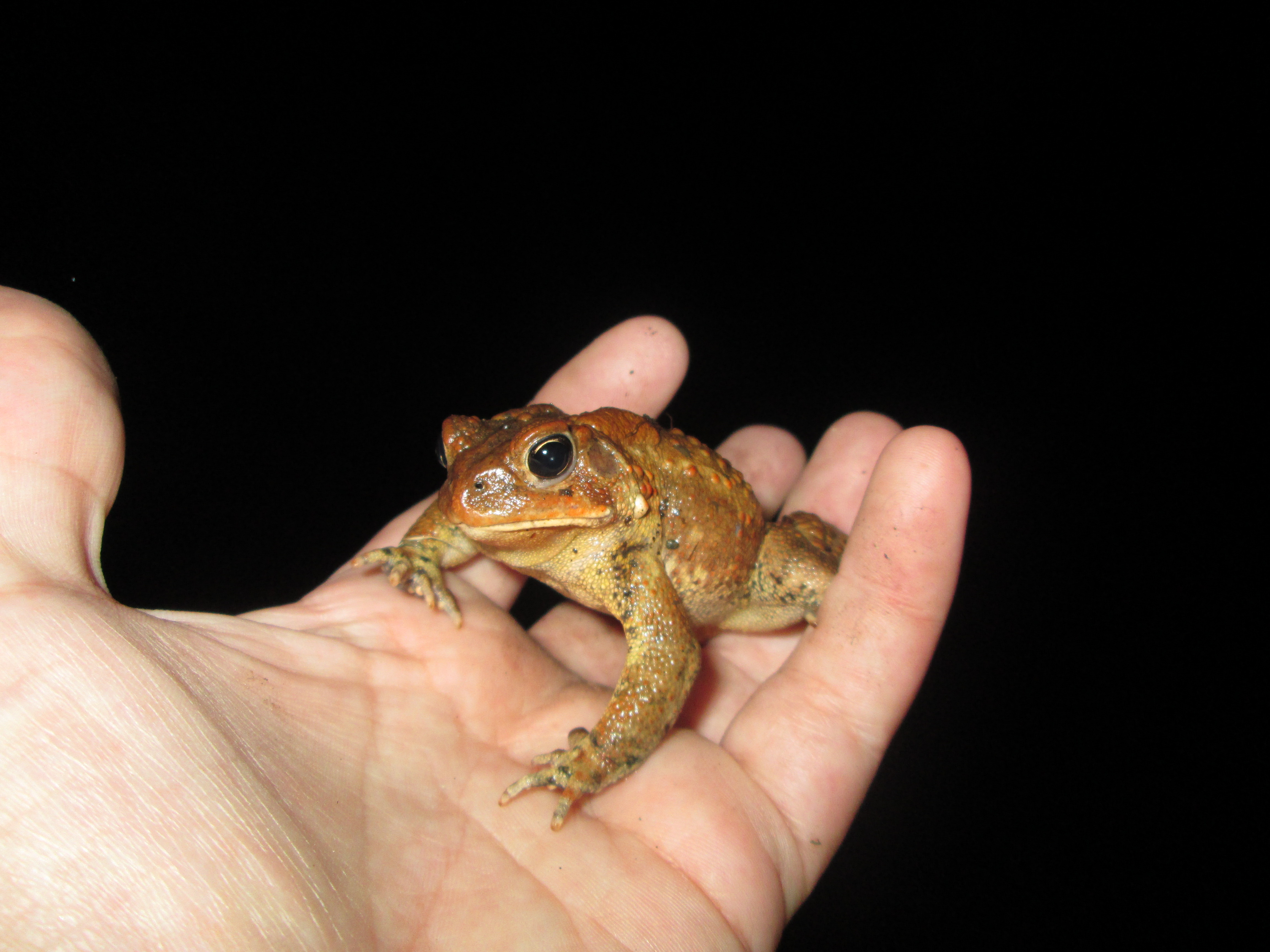
American toad in transit. Photo: Karen Ruzycki
It was a heart-pounding pace, often with multiple animals entering the roadway at once. They didn’t seem to understand the danger, but we humans were darting in and out, racing against car tires and grabbing up slippery critters as fast as slippery critters can be grabbed…while still being safe, orderly, and polite to passing motorists. A lot of drivers stopped to see what all the speed-walking was about. One woman said “God bless!” when I showed her a fat female spotted salamander and told her about the migration. Another guy must have been a local because he just asked “how many tonight?”
Everyone had an exhilarating night – the kind of migration night we plan for but don’t often get. It was a lot of fun and we saved a lot of lives. From the vehicle count, most of those little animals wouldn’t have stood a chance. A few still didn’t.
Before heading home from the site where I was working, I took a midnight stroll down to the vernal pool. It’s so neat to watch salamanders swimming around. Especially the big spotted salamanders. They spend almost their entire year underground in the woods, yet they are graceful and natural in the water. They even look excited to be there, swirling around each other in contest and attraction. I felt lucky to know about this wonderful thing. It felt great to have made some of it possible. Look at those gorgeous animals! And their impossibly bright yellow spots! They are colors lost in the night, but not by our watchful lights.
They made it! Spotted salamanders in the pool. Photo: M. Hall
Following Monday’s all-night amphibian foray – and the prolonged terror/adrenaline rush of playing real-life Frogger – I drove home through a rainy sunrise on Tuesday. According to a weather app on my phone, the rain would keep falling all day and end (wouldn’t you know) right around sunset. “You gotta be kidding me,” I think is what I slurred.
Warm nighttime rain is the simple cue for mass movement, like what we had before dawn that day. But nature is seldom that simple, so the task of monitoring an amphibian migration can get hairy. The warm, soaking daytime rain would get the attention of those slumbering frogs and salamanders. Even if it stopped before dark, the wet ground and road would entice some of them to move. Maybe a lot of them? And right at the time when nighttime traffic would be heaviest on the roads.
So we sided with caution and rallied the teams to hit the streets at dusk. I went back to Byram to lead a group of volunteers there while others covered different hot-spots.
The rain did end early – earlier than expected even – and by nightfall our team was spreading out over a damp road. It was a relief to see that a migration was happening anyway, albeit at a slower pace. And the cars were filing through our setup (cones and signs, buffered by police) in threes and fours…99 vehicles in the first hour! Basically, there was a car for every salamander that dared to cross the white line.
We did our best to stay ahead of the traffic. By 11:00 pm the temperature was dropping, the road was drying, traffic was slowing, and so were the amphibians. We paced the road below a starry sky with Orion front and center. We had tallied another 175 spotted salamanders, 41 Jefferson’s salamanders, and 52 spring peepers. Despite the heavy car flow early on, more than 85% of those animals made it to the safe side of the road – and eventually to their breeding pool below – with a little help from some friends.
The ingress migration to the pools is probably close to half-over across much of NJ, so we’ll be out few more times yet!
THANKS to all the dedicated people who have helped so far. It’s a diverse group of heroes, from long-time amphibian crossers like George Cevera and Carl Bernzweig, to new volunteers like Karen Ruzycki. We have help from local partners like Margaret McGarrity of Byram Township, and engineering students from NJIT who want to help design solutions to the roadkill problem. A couple reporters came out this week to cover the story and ended up shuttling amphibians, too. We thank the Sussex County Division of Engineering for issuing us the permit to assemble on their road. Thanks also to the Byram Police Department for their willingness to provide traffic control and their respect for our project, which I’m sure seems a little unusual. And that’s just at one location. Great job, everyone!
by MacKenzie Hall, Amphibian Crossing Project Coordinator
The past week has been like a wild trip through biomes and time zones. A half-foot of wet snow buried NJ on Friday, but it didn’t stand a chance against a sunny weekend above 50˚F and the valiant arrival of Daylight Savings Time. Bam! Spring. Suddenly birds were singing, crocuses were blooming, and salamanders were stretching their hamstrings for the journey ahead.
Throughout the day on Monday (March 11) a long wall of rain crept eastward across the US. It couldn’t possibly miss NJ, and the temperature would hold around 50˚F overnight – excellent predictors for a migration. The question was when the rain would hit and whether a rainfall starting very early in the morning would trigger many amphibians to move. There seem to be almost unlimited permutations for how the important factors of ground thaw, temperature, rainfall, date, and time of night can converge, and after almost 10 years with the Amphibian Crossing Project I still learn new and surprising things.
Snapshot of a Jefferson salamander being helped across the road.
A handful of us chose to wait out the rain at one of our big road-crossing sites in Byram (Sussex Co.). At least 3 hours before the rain even started, someone noticed a salamander crossing the dry road. We spread out to cover more ground and kept counting. By the time the first raindrops hit we had already tallied (and ferried) 190 salamanders and 20 frogs across the asphalt threshold dividing their forest habitat from the breeding pool below. We were all pretty surprised and excited by what we were seeing.
The rain came around 2:30 am, and in the 4 hours before dawn the road was swimming with frogs and salamanders. We did our best to keep up with the count, and the rescue, especially as vehicle traffic picked up toward dawn. Eight cars per hour around 3:00 am, then 10 cars per hour, then 26. By 6:15 it was hard for the last of us – Bob Hamilton and I – to keep our feet on the pavement as the vehicle count crested 100 per hour. We also started to lose the battle against roadkill – as many animals were getting hit as we could save. Luckily it was just a short period, and at dawn the migration would pause. Our totals for that night: 1,119 salamanders and frogs, 954 of which made it to their destination!
Our “scouts” all across northern & central NJ had similar reports. A big migration had happened before dawn, and there was some roadkill as evidence. But you can listen for a happier kind of evidence – the honking and peeping of those who made it to their pool. The harbingers of spring are arriving.
by MacKenzie Hall, Amphibian Crossing Project Coordinator
This small vernal pool in Hopewell is ready for things to start hoppin’.
For the 98 volunteers signed on to help with this year’s amphibian road-crossing efforts, yesterday brought on the first flurry of excitement. Forty degrees! The promise of nighttime rain! Saturday’s soaker had helped to get the ground thawing, though many of the amphibians’ breeding pools were still capped in ice. The conditions weren’t going to be perfect, but surely some eager salamanders would be enticed to come out from their winter burrows and set off on migration. And when their tiny feet hit the pavement of peril, we were gonna be there gosh dernit!
So our “scouts” got ready for night (and rain) to fall, to go check on a dozen or so road-crossing hot-spots in northern and central NJ. Then, as volunteer Phil Wooldridge of Warren County put it, we experienced a little deja-vu. The rain started later, the temperature was colder. North of Route 80, snow and sleet fell instead. We amphibian crossers have gotten used to the shakiness of weather forecasts, and to the somewhat complex combination of triggers that set an amphibian migration in motion. At any rate, we basically got skunked last night.
The only sign of life came from Hampton, in Sussex County, where Sharon and Wade Wander found a single Jefferson salamander crossing the road to his ice-covered breeding pool. Tough little salamanders, those Jeffs. Our first one of 2012 came out during a wet snowfall, too, around 2:00 am on February 24th.
The town of East Brunswick was also counting on last night’s forecast when they decided to close Beekman Road – a town road bisecting an amphibian migration path. The town’s Environmental Commission has coordinated the closure for the past 10 years to protect the spotted salamanders, wood frogs, and other migrants on 4 to 10 nights every spring (read about it here). Even there, only one male spotted salamander was seen making his way to the pool.
So, we’ll keep doing our best to predict the amphibian migration and to be in the right places when it happens. Clearly the big long nights are still in front of us.
To learn more about our Amphibian Crossing Project and experience the migration through video, please visit our “Amphibians Crossing!” webpage.
Every spring, vernal pool breeding amphibians migrate from upland wintering habitats to their spring breeding pools. Many of these ancestral migratory paths are bisected by roads, creating a barrier that not only disrupts natural migration and fragments habitat but often proves impenetrable, limiting gene flow and disconnecting populations. Our Amphibian Crossing Project works to protect these migration corridors through coordinated volunteer rescue efforts that move amphibians safely across the road during these annual mass migration events. Currently, our efforts are focused on select sites in northern New Jersey but we want to expand our database to document these migratory paths across the state.
Four-toed salamander (c) MacKenzie Hall
If you would like to report an amphibian crossing near you, please email us with:
-Location of the crossing marked clearly on a map
-List of species seen crossing or DOR (dead on road)
-Date(s) of occurrence and any other pertinent information you may have
*We ask that you only report known crossings and do not attempt to locate more by driving around on rainy spring nights. Increased vehicular traffic will increase mortality of amphibians during their annual spring migration!