Cold Water Stops Horseshoe Crab Spawning along Delaware Bay

One of a Series of Updates on the 20th Year of the Delaware Bay Shorebird Project

By: Dr. Larry Niles, LJ Niles Associates LLC

Shorebirds and no horseshoe crabs along the Bay.

It’s well known that the Delaware Bay shorebird stopover depends on horseshoe crabs, but few know that Delaware Bay is a near perfect horseshoe crab habitat.


There are many places on the eastern seaboard where horseshoe crabs breed. Most are too small to provide sustenance for energy-starved shorebirds. Places like Cape Romain Refuge in South Carolina have enough horseshoe crabs so that one breeding female unearths eggs of another and thus lays out a tidy meal for shorebirds. But the areas are small and at this time unimportant to the population of shorebirds. Most of the others are too small to have eggs reach the surface. Its only in Delaware Bay where crab numbers reach into the millions and spawn in such great numbers that they spread like a carpet over nearly all beaches from Gandy’s Beach to Villas, approximately 20 miles of spawning habitat. The number of eggs and ultimately hatched young reach staggering numbers.

Horseshoe crabs breeding at night.

The huge population of horseshoe crabs on the bay is no accident. The bay almost seems built to suit the crabs. Crabs need beaches with large and deep sand flats, allowing just enough water to sufficiently oxygenate the eggs without drowning them.  They need the sea floor to gently rise into breeding beaches, allowing easy access. While breeding, crabs have to eat small bivalves, which they find in abundance in the bay’s extensive intertidal and subtidal flats.

Horseshoe crab eggs.

The most important aspect of the bay is its quickly warming waters in the spring. On Delaware Bay, horseshoe crabs don’t breed until waters reach 59 degrees. You won’t see this temperature on the Atlantic Coast until June. Not so on Delaware Bay!  Although the bay has deeper water, mostly in sloughs that snake under the surface out to its mouth at Cape May, most of the water is relatively shallow  usually less than 18 feet. That may sound deep, but keep in mind the Chesapeake has 100 feet water for most of its length and deeper water throughout. The shallow water of Delaware Bay allows it to heat up soon after the air temperature rises.


Unfortunately, it also cools down quickly and because of this the crab spawn has stopped. The bay’s water temperature went up dramatically in late March and April, so much so that we worried it might reach the critical 59 degree threshold in April long before the birds arrived in May. But then the warm weather stopped and the bay temperature dipped than rose, several times in fact. By early May, it had gotten just above the threshold, heating up to about 61 degrees at the Cape Henlopen marine buoy. We hoped for the best. Crabs started to breed in good numbers on a few beaches, like Reeds Beach, but were thin elsewhere. We had about 20,000 shorebird relying on the spawn and the eggs that were brought to the surface.

chart-13

Than the bay cooled down again. A nasty western wind and cold front enveloped our area over the weekend and the cool weather followed. By Monday, the temperature went down again and the crab spawn stopped. This is bad.


When the spawn stopped the birds hovered up the remaining eggs in a few days. Then they started wandering to find eggs in odd places, under houses, along bulkheads. Some even went to areas like the oyster aquaculture racks to find eggs to the delight of the people trying to expand aquaculture. But what they saw was desperation.

Herring gull hunting red knot, Cooks Beach, New Jersey. Photo by Jack Mace.

Worse the Black Back and Herring Gull that feed on eggs and overturned crabs couldn’t find eggs and started eating shorebirds. By the end of Thursday (May 19) we found 8 dead red knots. These gulls can swallow small sanderling and semipalmated sandpipers like gum drops, so we really don’t know how many shorebirds died.

Herring gull hunting red knot, Cooks Beach, New Jersey. Photo by Jack Mace.

Relief might be in sight though. Thursday, Friday and today will be warmer. The bay’s temperature is back up over 60 degrees. Thursday night we had a fairly good spawn. Hopefully we will be back in business soon.


Learn More:


Dr. Larry Niles has led efforts to protect red knots and horseshoe crabs for over 30 years.

Early, Good News from the Delaware Bay Shorebird Project Team

A Series of Updates on Year 20 of the Delaware Bay Shorebird Project

By: Dr. Larry Niles, LJ Niles Associates LLC

Our team trapped over 500 shorebirds over the weekend including several hundred red knots in two catches on May 12th and 14th! Most of the caught birds, knots, ruddy turnstones and sanderlings arrived in good condition, which is always a relief at this early stage in the season. Ruddy turnstones returned in better-than-average condition, weighing in at 5 grams higher than normal arrival weights.

wieghts ruddy turnstones

P1020719 C duncan rutu banding
Team banding ruddy turnstones on Reeds Beach.

The condition on arrival is an important focus of the project. In some years, knots struggled to get to the bay, coming in at average weights of 105 grams, 15 grams lighter than this year. One poor soul practically fell onto the beach with only 84 grams of weight, dangerously burning muscle to get here.


To really understand it best you must put yourself in the birds’ shoes (in a matter of speaking). We can do this because we have been attaching small tracking devices called geolocators on knots and turnstones for the last 5 years. Geolocators must be recovered to download the data, and we did this with a knot banded with the inscribed flag TVV in 2015. The map of that bird’s heroic journey can be seen below.

LogDbY7Htrack

Delaware Bay, New Jersey, USA

Follow TVV’S path from Delaware Bay to its Arctic breeding area, then down to its Chilean wintering area, then back to Delaware Bay. It spent less than one month in the Arctic but over 6 months in its Tierra Del Fuego winter quarters. The rest of the time was spent flying or resting between flights. It’s flight from Southern Brazil to Delaware Bay was truly awe inspiring!


Imagine you are TVV and about to fly from balmy Brazil to Delaware Bay, 5,000 miles away. Most birds will leave near nightfall, when the weather is settled and usually when there tends to be a favorable wind. Once aloft you have no idea of the conditions you will face for the next 6 days. Some birds have an easy time of it, some get caught in opposing winds, others get blown off course and must struggle to return. This is the reason for the varying weights on arrival.

redknots
Red knot photo by Al Janerich.

So what did the birds find when they arrived this year? So far, the horseshoe crab spawn has gone well. It started early in the month, so that by the time birds like TVV arrived, they found a nice concentration of eggs for the taking on Delaware Bay beaches. At first, the birds poured into the bay.  Last Thursday May 10th, we had about 1,000 knots on the New Jersey side of the bay. By Saturday, the number has grown to 8,000 knots – and our two catches proved they were gaining weight at a good clip.


All that changed on Sunday when a complicated cold front hit the bayshore. For two days we have had strong winds from the west, creating breaking waves on much of the New Jersey bayshore. The crab stopped spawning in most places. The winds blow as I write this blog and is certainly holding up birds from arriving, some may have stopped migrating others are fighting this merciless 30 mph wind.

IMG_1442 (1)
Early morning on Pierce’s Point in a 30 knot wind from the west, blowing directly on shore and stopping all horseshoe crab breeding.

In our next post, learn how the winds affected the birds over the last few days.


Learn More:


Dr. Larry Niles has led efforts to protect red knots and horseshoe crabs for over 30 years.

International Migratory Bird Day Series: Red Knot

CWF is Celebrating International Migratory Bird Day all Week Long

by Lindsay McNamara, Communications Manager

CWF’s blog on the red knot is the third in a series of five to be posted this week in celebration of International Migratory Bird Day (IMBD). IMBD 2016 is Saturday, May 14. This #birdyear, we are honoring 100 years of the Migratory Bird Treaty. This landmark treat has protected nearly all migratory bird species in the U.S. and Canada for the last century.

Red Knot photo by Mark Peck.

The iconic red knots have returned to New Jersey! These famous, mid-sized shorebirds are state endangered and now federally threatened — the first bird ever listed under the Endangered Species Act with climate change cited as a “primary threat.”


Red knots are only 10 inches long but are among the world’s most extreme long distance flyers  traveling vast distances  some over 18,000 miles in the course of their annual migration from Tierra del Fuego, Argentina all the way up to the Canadian Arctic (and back again). During their trip, the red knots make a vital stop at New Jersey’s Delaware Bay.

This map shows the flight path of a red knot that was banded and fitted with a geolocator along New Jersey's Delaware Bay.
This map shows the flight path of a red knot that was banded and fitted with a geolocator along New Jersey’s Delaware Bay.

Each spring in Delaware Bay, throughout the month of May, the largest concentration of horseshoe crabs in the world comes onshore to spawn. At the same time, tens of thousands of shorebirds arrive at the Bay, thin and spent from what has been a non-stop, four-day flight from South America. They are en route on a remarkable round-trip journey from southern wintering grounds to Arctic breeding territory, and Delaware Bay is their most critical stopover on this 8,000-mile trip. The shorebirds need to quickly double their weight to complete their migration north and breed successfully. To refuel at such capacities and in only a ten-day window, high-energy horseshoe crab eggs provide essential nourishment. In recent years, countless horseshoe crab eggs have been lost because of the devastating storms that swept away the beaches they depend on.


In the wake of Hurricane Sandy, Conserve Wildlife Foundation and American Littoral Society worked with the U.S. Fish and Wildlife Service, the New Jersey Division of Fish and Wildlife and the New Jersey Recovery Fund to remove 8,000 tons of debris and added 45,000 tons of sand to the beaches just before the annual spring arrival of the red knot in 2013. Additional work after 2012 restored another mile of shoreline, including two new beaches of poor quality even before Sandy. To date, the groups have placed over 85,000 cubic yards of sand and restored seven beaches along New Jersey’s Delaware Bayshore.


To restore one of the beaches, Thompsons Beach, our team removed debris from the area, removed rubble from the road leading to the beach, and placed over 40,000 cubic yards of sand onto the beach. We were delighted to learn that in the spring of 2015, Thompsons Beach had the highest abundance of horseshoe crab egg clusters out of all the beaches that our team monitors on Delaware Bay.

Horseshoe crabs spawning at Thompsons Beach in May 2015. Photo by Joe Smith.

But since the early 1990s, there have been major declines in both the number of adult horseshoe crabs and their eggs. The cause is an exploding crab harvest that grew from only tens of thousands in 1990 to over 2 million in 1996. With the decline of their critical food source, shorebird numbers also plummeted  the Delaware Bay shorebird populations remain around 26% of its historic population size. Over 25,500 red knots were seen in 2015 versus over 90,000 in 1989.


Conserve Wildlife Foundation and the Endangered and Nongame Species Program (ENSP) of the New Jersey Department of Environmental Protection’s Division of Fish & Wildlife have partnered for 20 years, working to conduct research on Delaware Bay shorebirds in order to prevent further decline. Each year, CWF’s Larry Niles and ENSP’s Amanda Dey lead a team of shorebird experts from around the world – from countries as far as Argentina and New Zealand – to conduct research on shorebirds during their stopover. These experts also follow shorebirds to other locations along their migration, including South America and the Arctic. With scientific research and concerted conservation efforts, our hopes are that someday Delaware Bay’s skies will be once again filled with shorebirds.

Red Knot photo by Mark Peck.

Last year, nearly every red knot left the bay in good condition, with over 77% reaching weights exceeding 180 grams, the threshold weight required for a successful flight to the Arctic breeding areas. The improvement in the number of red knots reaching 180 grams is a milestone for our shorebird project. The birds left in the best condition recorded since 1998, just as horseshoe crabs were being overharvested. This good news must be tempered by the continued low numbers of birds and horseshoe crabs. We report no improvement in horseshoe crab numbers, so the improvement in the number of red knots making weight is likely a consequence of the restoration of horseshoe crab habitat on Delaware Bay beaches.


Because shorebirds don’t only spend their time in Delaware Bay, shorebird scientists must study them throughout the Atlantic Flyway to get the best understanding of their unique ecology. This year, shorebird project team was awarded a 2-year grant to create detailed shorebird habitat maps in the states of Maranhão and Pará, Brazil. This project will set the foundation for conservation planning and action for decades to come at a shorebird wintering site of hemispheric importance that has received little conservation and research attention with regard to shorebirds thus far.


Over the last 6 years, CWF also has partnered with the USFWS Monomoy Refuge to develop a better understanding of migratory shorebird use on Cape Cod and at the Refuge. Cape Cod, like Stone Harbor and Brigantine, New Jersey, is an important southbound stopover for red knots. At each location, red knots come from their Arctic breeding areas and either build up weight for a flight to South America, or remain to molt and replace vital primary feathers before moving onto shorter distance wintering areas in Florida and Cuba.

Banded Red Knot photo by Mark Peck.

Another important piece of CWF’s shorebird research has been the attachment and recovery of geolocators, small devices that track movements through one to two years of battery life. The migratory tracks from recovered geolocators have greatly expanded our understanding of red knot migratory behavior. In CWF’s last two years of research, we focused on capturing juveniles, which move through the Cape in early September. Red knot juvenile #254 was a recapture two years after release on Delaware Bay. It first left Cape Cod and wintered in North Carolina. In their first year, juvenile red knots don’t go to the Arctic to breed and so #254 flew back to Cape Cod to summer. The following fall, it flew to Cuba to winter, then to North Carolina, then to the Arctic. This was the first known track of a juvenile red knot and one of only a few of any avian species! CWF is continuing our geolocator project this year, so follow along on our blog and social media channels to receive updates on cutting-edge red knot research!


Learn More:


Lindsay McNamara is the Communications Manager for Conserve Wildlife Foundation of New Jersey.

International Migratory Bird Day Series: Piping Plover

CWF is Celebrating International Migratory Bird Day all Week Long

by Lindsay McNamara, Communications Manager

CWF’s blog on the piping plover is the second in a series of five to be posted this week in celebration of International Migratory Bird Day (IMBD). IMBD 2016 is Saturday, May 14. This #birdyear, we are honoring 100 years of the Migratory Bird Treaty. This landmark treat has protected nearly all migratory bird species in the U.S. and Canada for the last century.

Piping plover. © Steve Byland
Piping plover photo by Steve Byland

The piping plover – a small sand-colored shorebird that nests in New Jersey as part of its Atlantic Coast range from North Carolina up to Eastern Canada –weighs only one to two ounces and is about six to six and a half inches long. These tiny shorebirds migrate all the way to their wintering grounds along the coast of eastern Mexico and on Caribbean islands from Barbados to Cuba and the Bahamas.


Migrants can be seen in New Jersey from early March to late April and again from mid-July to the end of October. Females are the first to leave the breeding grounds, followed by males, then juveniles. Breeding plover “hot spots” in each coastal county of New Jersey are Gateway National Recreation Area – Sandy Hook Unit, Barnegat Light, North Brigantine Natural Area and Stone Harbor Point.


We see a number of migratory piping plovers in New Jersey because the Garden State is roughly in the middle of their breeding range. Todd Pover, CWF’s beach nesting bird project manager, reasons that we have a high number of Eastern/Atlantic Coast Canadian breeders that stop in New Jersey — based on band resights — albeit usually for just a day on their way north to breeding grounds. Therefore, New Jersey may play an important role in the piping plover life cycle not just for breeding, but for migration as well, which emphasizes the importance of protecting shorebirds in all phase of their lives or “full life-cycle conservation”.


Piping plovers face a number of threats, including intensive human recreational activity on beaches where they nest, high density of predators, and a shortage of highly suitable habitat due to development of barrier islands and extreme habitat alteration.  Sea level rise and increased storm activity related to climate change will also likely lead to more flooding of nests.


Federally listed as a threatened species in 1986, piping plovers have since recovered in some areas of the breeding range. Yet piping plovers continue to struggle in New Jersey, where they are listed by the state as endangered. For more information about piping plover nesting results in New Jersey, please read Conserve Wildlife Foundation’s 2015 report.

Piping plover chick, photo credit: Asbury Park Press/Nancy A. Smith

CWF, in close coordination with NJDFW’s Endangered and Nongame Species Program, oversees piping plover conservation throughout New Jersey. Staff and volunteers help erect fence and signage to protect nesting sites, monitor breeding pairs frequently throughout the entire nesting season from March to August, and work with public and municipalities to educate them on ways to minimize impacts. Although conservation efforts on the breeding ground remain the primary focus, in recent years, CWF has also begun to work with partners all along the flyway, in particular on the winter grounds in the Bahamas, to better protect the at-risk species during its entire life-cycle.


We are working hard to link students across the piping plover’s flyway through our Shorebird Sister School Network, where we pair up schools in New Jersey and the Bahamas, one of the most important wintering areas for Atlantic Coast piping plovers. Now, we are hopefully recruiting some Canadian students as well.


Conserve Wildlife Foundation will continue to find innovative ways to save the small migratory shorebird. In 2015, 108 pairs of piping plovers nested in New Jersey, a 17% increase from 2014. What will 2016 bring? Follow us on social media to learn more about the tireless efforts of a team of passionate, dedicated biologists working to save the iconic coastal species.


Learn More:


Lindsay McNamara is the Communications Manager for Conserve Wildlife Foundation of New Jersey.

Piping Plover Population Rebounds from Historic Low in New Jersey

Conserve Wildlife Foundation of New Jersey releases 2015 report

by Todd Pover, Beach Nesting Bird Project Manager

Photo by Northside Jim

Conserve Wildlife Foundation today released the 2015 Piping Plover Breeding Report, highlighting the number of nesting pairs, pair productivity, and coast-wide distribution for this endangered shorebird, from data collected by New Jersey Division of Fish and Wildlife (NJDFW) biologists, CWF biologists, and other partners.


“The rebound in New Jersey’s piping plover breeding population and a second consecutive year of robust chick productivity was a much needed outcome,” said Conserve Wildlife Foundation Beach Nesting Bird Project Manager Todd Pover. “We need to continue our intensive management for a number of years to sustain any recovery, but we were very pleased to have finally broken the recent cycle of low nesting success and the record low number of nesting pairs in 2014.”


The piping plover – a small sand-colored shorebird that nests in New Jersey as part of its Atlantic Coast range from North Carolina up to Eastern Canada – face a number of threats, including intensive human recreational activity on beaches where they nest, high density of predators, and a shortage of highly suitable habitat due to development and extreme habitat alteration.


Federally listed as a threatened species in 1986, piping plovers have since recovered in some areas of the breeding range. Yet piping plovers continue to struggle in New Jersey, where they are listed by the state as endangered.


“As a species dependent on natural beach habitat, piping plovers face a particularly daunting challenge along New Jersey’s heavily developed and dynamic coast,” said Conserve Wildlife Foundation Executive Director David Wheeler. “Our dedicated scientists, partners, and volunteers are working tirelessly to ensure piping plovers remain a beloved and healthy presence along the Jersey Shore and beyond.”


CWF, in close coordination with NJDFW’s Endangered and Nongame Species Program, oversees piping plover conservation throughout New Jersey. Staff and volunteers help erect fence and signage to protect nesting sites, monitor breeding pairs frequently throughout the entire nesting season from March to August, and work with public and municipalities to educate them on ways to minimize impacts. Although conservation efforts on the breeding ground remain the primary focus, in recent years, CWF has also begun to work with partners all along the flyway, in particular on the winter grounds in the Bahamas, to better protect the at-risk species during its entire life-cycle.


2015 Report Highlights:


  • The population of breeding piping plovers increased 17% to 108 pairs in 2015, as compared to 2014. Despite the increase, the population still remains below the long-term average (118 pairs) since federal listing in 1986 and well below the peak.
  • The statewide fledgling rate, which includes data collected by partners at 19 active nesting sites throughout the state, was 1.29 fledglings per pair, down slightly from 2014 (1.36 fledglings/pair), but still one of the highest statewide levels since federal listing. Furthermore, both years were above the 1.25 fledgling rate believed necessary to maintain the range-wide Atlantic Coast population of piping plovers.
  • Statewide pair-nest success, the percentage of pairs that successfully hatch at least one nest, was high at 79%, well above the average since federal listing. Although population and productivity are ultimately the most important measures of recovery success, hatch success is an important metric to demonstrate the effectiveness of on-the-ground management.
  • Northern Monmouth County, as a region, continued to account for the largest percentage of pairs in the state (55 pairs or 51%), with Gateway National Recreation Area – Sandy Hook Unit accounting for most of those pairs.
  • The region comprised of North Brigantine Natural Area and the Holgate and Little Beach Units of the Edwin B. Forsythe National Wildlife Refuge accounted for the other significant concentration of breeding pairs in the state (43 pairs or 40% of the statewide total).
  • Holgate had the largest jump in abundance for any individual site, doubling its breeding pairs to 24 in 2015 (up from 12 in 2014). This increase was the result of highly suitable overwash habitat created at the site by Hurricane Sandy and the high breeding success that helped spur.
  • Cape May County, the southernmost region of the state, consisting of Ocean City to Cape May Point, continued its long-term downward trend, accounting for just 8 pairs in 2015, compared to 11 pairs in 2014 and 43 pairs in 2004 at its peak.


Learn More:


Todd Pover is the Beach Nesting Bird Project Manager for Conserve Wildlife Foundation of New Jersey.


Happy World Shorebirds Day!

American Oystercatcher
American Oystercatcher. © Jim Gilbert

On behalf of our friends – the piping plovers, red knots, American oystercatchers, least terns, ruddy turnstones, black skimmers, and many others – Conserve Wildlife Foundation wishes you a happy World Shorebirds Day.

  • For your viewing pleasure, check out our brand new Oystercatcher Story Map.
  • To learn more about our beach nesting birds work, click here.
  • You can click here to learn about our migrating shorebirds work.
  • And if you haven’t seen the Delaware Bay beach restoration video yet, enjoy it here!

Finally, you can help support our shorebirds work with a donation, or through volunteering on one of our shorebird projects.

Click here to make a donation to our shorebird work here!


One other fun way to cozy up to a bird this fall is to visit Unreal Birds, and consider making a purchase of those adorable birds. A portion of every purchase benefits CWF!

News from the International Shorebird Project

Red knot shot while on migration
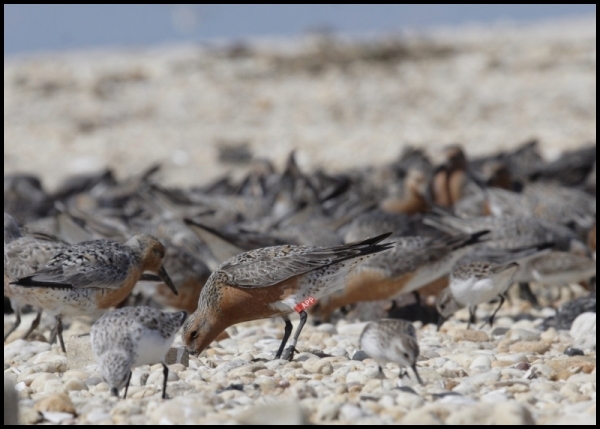
A banded red knot searches for food on a Delaware Bay beach.

Bandedbirds.org is an effort to collect data on shorebirds throughout their range from the southern tip of Chile to the Canadian arctic. This effort has been underway for many years and has an international network of volunteers reporting re-sightings data on shorebirds. 

The following was shared with the shorebird community by Jeannine Parvin, administrator for bandedbirds.org.

The bird being discussed was banded in NJ in May 2005.  It seemed to return to NJ each year, having been resighted most years up to 2010.  The bird seemed to be heading back up to NJ for the 2011 Spring shorebird season, when it was shot and killed in French Guiana.  Illegal hunting is still a big issue for shorebirds.  Paired with loss and degradation of habitat, and pollution, these birds face major threats.  Read more about CWF’s work to monitor and protect shorebirds here.

A red knot identified as FL(PPM) was shot in French Guiana by a hunter.

The data was submitted by Alexandre Vinot from French Guiana. He regularly reports to bandedbirds.org and is a volunteer with GEPOG.

His comments state: “shot in Mana Ricefield – flag given to Antoine Hausselman, who gave me the data”.

5.651519 -53.670960 approximates this location along NW coast of French Guiana. Continue reading “News from the International Shorebird Project”

Shorebird Stewards

Helping to protect shorebirds on the Delaware Bay

By Larissa Smith, Assistant Biologist

Visitors to Reeds Beach discuss the shorebird season with Shorebird Steward Jim May.

One part of my job that is quite enjoyable is getting to spend time on the Delaware Bay beaches in the spring and working with the Shorebird Stewards.  As the CWF volunteer manager I organize the Shorebird Steward program which is part of the International Shorebird Project. During the two week period that stewards are on the beaches I try to get out and check on the beaches and meet with the stewards as much as possible.  This season there were 26 stewards and 23 of those had worked as stewards during a previous season.

The main part of the steward’s job is to educate people about the shorebirds and horseshoe crabs, but they do a lot more than that in a day.  Stewards also keep people from going into the closed areas of the beaches so that the shorebirds can feed undisturbed.  They give directions and send people to the beaches where the most birds have been sighted that day.

Shorebird Steward Rochelle Gimmillaro points out shorebirds to visitors to Cook’s beach.

If they have time they also count the number of shorebirds on the beaches and if possible record any banded birds that they see. Stewards deal with all types of people and situations. Some beaches are much busier than others, such as Reed’s beach where there is a viewing platform.  On many days there is a constant stream of people coming to the view the shorebirds and horseshoe crabs.

This season there were very few problems on the beaches and it is directly due to the shorebird stewards hard work and dedication to the project.

I look forward to getting back on the beaches next shorebird season and working with such a great group of volunteers.