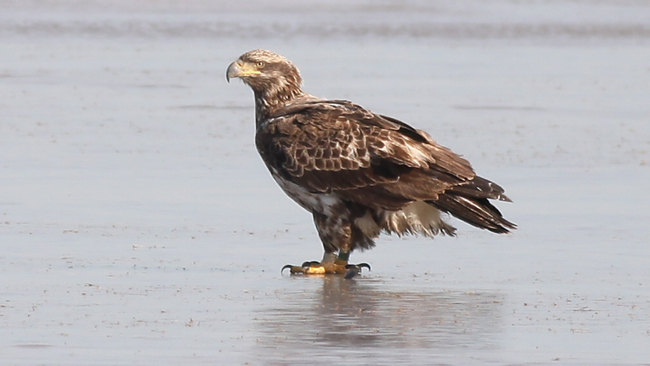
In 2012 a new record high of 135 eagle pairs were monitored during the nesting season. One hundred and nineteen of those were active which means they laid eggs. A total of 165 young were produced this year and fledged (left the nest). That is 46 more than 2011’s 119 young produced. Twenty-seven new eagle pairs were found this season, 15 in the south, 2 in central and 10 in northern NJ. While all of these numbers are good news for NJ eagles they still need protection. The two major threats that bald eagles in NJ face today are disturbance and habitat loss.
The NJ Bald Eagle Project has a dedicated group of volunteers who monitor nests throughout New Jersey. They help to prevent disturbance at nest sites by educating the public about eagles. The success of the eagle project is directly related to these wonderful volunteers.
Marine debris (specifically plastics) have become a serious problem in coastal areas throughout the world, especially in the Pacific Ocean where gyres create large floating “garbage patches.” I work out on the back bays and salt marshes throughout the coastal region of New Jersey as I help to monitor and manage ospreys and their nesting platforms. Every time I’m out I encounter trash. Most of it accumulates along the wrack line on the higher portions of the marsh where storm surges, high winds, and during spring tides (during full and new moon phases) push it onto the marsh. This debris then makes its way into the nests of ospreys because this is where they collect most of their nesting material.
By now most ospreys are back from their wintering grounds in Central and northern South America. Generally the older more experienced birds return first and the younger inexperienced adults follow. Over the past month I’ve been very busy with platform repairs and installations throughout coastal New Jersey. You may not be aware but I maintain a huge number of nesting platforms. In just the past couple weeks I’ve worked as far south as Avalon (where I lead a group of students and their parents from Collingswood to replace an existing platform) and as far north as Bayonne (where I installed 3 platforms with local middle and high school students). Both were memorable experiences for both myself and many of the students. Most of them had never been on a boat or ever had the chance to walk on the saltmarsh.
Maintenance of existing platforms is critical to the continued recovery of ospreys. Over time (and in some cases, not much time) the condition of these nesting platforms is degraded, mainly by the environmental conditions where they’re placed. For the most part the fasteners are what go first from contact with high levels of moisture in the air, after that, the wood decays (unless a pressure treated or cedar wood is used). One way to help prevent the decay of platforms is to use marine grade stainless steel screws, galvanized bolts, and treated lumber. If we were to lose a large portion of the available nesting platforms in a given year then the population would suffer, so it’s important to make sure existing platforms remain in good condition.
Last week I got out to the “Wildlife Drive” at Forsythe NWR in Oceanville to repair a platform. The platform top had lost a side and could no longer hold nesting material. I built a new top out of salvaged wood that I collect and installed it on Thursday afternoon. The next day a male osprey began to place nesting material in the freshly repaired platform. Talk about perfect timing!
If you’re interested in helping us to maintain osprey nesting platforms, contact me about our new program to “Adopt a Platform.”
It’s hard to believe that in another 6-7 weeks ospreys will be back in New Jersey and ready to begin another nesting season. Over the next few weeks we’ll be busy making repairs to existing nests, moving platforms to more suitable locations, and installing new nests to replace old derelict platforms. We maintain a huge portion of the available nest platforms along the coast and do so with no state funding! All of our funding comes from private donations from individuals, foundations, or grants. Since our osprey project began in 2006, we have installed more than 100 nesting platforms throughout New Jersey. What’s new? This winter we have plans to install three new structures in Bayonne with local high school students. This will be the furthest north that we have ever worked with ospreys. It’s a new and exciting endeavor for CWF. If you enjoy viewing ospreys during your visits to coastal areas of New Jersey during the summer, please consider making a donation today by sponsoring the placement of a platform or by adopting an existing platform.
Volunteers, CWF staff, and biologists with NJ Fish & Wildlife recently completed osprey nesting surveys throughout coastal areas of New Jersey. Each year these “osprey banders” complete “ground surveys” (referred to as ground surveys because they are surveying nests by land/sea, not by helicopter) that cover around 70% of the state population. I survey colonies on Barnegat Bay, Little Egg Harbor, and Absecon. The surveys are meant to keep track of the population and determine its health. During the surveys the banders access nesting areas mainly by boat since most ospreys nest in coastal areas or by water (their source of food). We use ladders to access nests where we count the number of young produced and then place an aluminum band on each of the young. For the past two years we have also been collecting feather samples for a study being conducted by the Academy of Natural Sciences in Philadelphia where they are analyzing the stable isotopes to determine what ospreys are eating and how their diet has changed over time. More specifically they’ll be looking for changes in the isotope profiles across the local range of ospreys – something that has never been done before.
In one area, Sedge Island WMA, that I’ve surveyed for the past few years I surveyed 27 nests. 22 of those nests were occupied and produced a total of 47 young. 34 of those young were banded for future tracking. From the survey I can calculate the productivity or reproductive rate which is a measure of how healthy the population of that colony is. The productivity rate for Sedge Island is 2.14 young/active(known-outcome)nest this year which is the highest ever recorded (see chart at right for more details). These awesome results are the result of calm and mild weather conditions this spring and summer, high availability of prey, and possibly the increased amount of experienced breeding birds. Another factor that has surely helped to give the population a boost is the increased availability of suitable nest sites along the coast. Since 2004, I’ve helped to install more than 100 nesting platforms. Many of these platforms replaced old dilapidated structures and now give ospreys a better chance at successfully raising young that will eventually return to New Jersey to reproduce.
The New Jersey midwinter eagle survey takes place each January and is part of the National midwinter eagle survey to monitor population levels. Another benefit of the midwinter eagle survey is that new eagle nests and nesting pairs are often located. The target dates for the 2011 survey was January 8th and 9th. Approximately 75 volunteers participated throughout the state. This year the snowy winter weather on Saturday did effect the count due to the heavy snow fall at times and low visibility. Sunday was clear and sunny which allowed volunteers to get out and survey.
Preliminary results:
194 eagles – southern NJ
24 eagles – northern NJ reservoirs
17 eagles – Delaware Water Gap
A total of 235 eagles were observed this year.
This total is lower than 2010s count of 333 eagles which is in large part due to the weather. Full results will be released soon.
Thank you to all the volunteers who braved the snow, cold and windy weather!
Kestrels are the smallest falcon (about the same size as an American Robin) in North America. Its plumage is striking with rufous coloration its back and tail. Although the American kestrel is widespread, meaning they live year round throughout much of the United States, the northeastern kestrel population is declining. Today the kestrel is listed as a Species of Special Concern in New Jersey (not yet endangered or threatened but on its way).
Kestrels are found in open, grassy habitats – especially ones that have cavities for nesting and perches for hunting. Kestrels can be seen hovering in grasslands, pastures and parklands or perched along the road on telephone lines. The decline of kestrels in New Jersey is likely due to destruction of grasslands from development. Also, nesting cavities are lost. As we clean up our fields, we remove trees with nest cavities the kestrels use.
Researchers have not determined the exact reason for kestrel declines but, we do know that the availability of cavities for nesting appears to be a limiting factor. Conserve Wildlife Foundation of New Jersey, in partnership with the Endangered and Nongame Species Program implemented a nest box installation and monitoring program in 2006.
Over the past few weeks volunteers and biologists have been performing ground surveys to help determine the health of the osprey population in New Jersey. The surveys are part of the NJ Division of Fish and Wildlife, Endangered and Nongame Species Program, Osprey Management Project. Ospreys are listed as a threatened species in New Jersey. They were originally listed as endangered in 1974 after only 50 nesting pairs were found in 1973. By 1986, their status was upgraded to threatened after their population rebounded to 100 nesting pairs. Today there are over 450 pairs of ospreys that we help to monitor in New Jersey.
Ospreys are highly dependent upon humans to provide artificial nesting structures for them and they are highly susceptible to many different heavy metals and persistent organic pollutants like DDT, DDE, PCBs and more recently brominated fire retardants (PBDE) that bio-accumulate in the food chain.
Surveys are performed each year during summer when osprey nestlings are old enough to band (3-6 weeks old) but not old enough to fly. They cover all major nesting areas including, the Delaware Bay, Raritan Bay south to Cape May, and inland. During ground surveys nestlings are banded with USGS aluminum leg bands for future tracking. I survey areas from Great Bay in Little Egg Harbor north to Fort Monmouth in Oceanport and Mantoloking along the Atlantic Coast.
The data we collect (whether or not a nest is active and the # of young produced) is used to calculate the productivity rate. Ospreys need a productivity rate of at least .8 young/nest to sustain the population. In the past 5+ years they have had more than double this rate. The population has grown by 21% from 2006 to 2009. Last year there were 485 nesting pairs in New Jersey. This year we expect there to be even more. Last years results are summarized in the 2009 Newsletter.
Last year was a record-breaking year. Before the effects of DDT, habitat loss and persecution decimated the population in the mid-1900’s there were over 500 nesting pairs. Since the mid-1970’s, when the project began the population has slowly risen to its current level. Each year more platforms are damaged by harsh winter weather and the extremes of being located in saltmarshes. Work is continual and never ending. Repairs to existing platforms occur during the “off” season or non-breeding season from late August to the end of March. New platforms (built with stainless and galvanized hardware, that are meant to last) are placed in areas where suitable habitat exists where little to no available nest sites occur. It is our goal to help the population recover to historic numbers.
Preliminary results show that some areas fared very well this year. The colony from Little Egg Harbor to Atlantic City had 25 active nests that produced 57 young. Last year, 36 nests produced 55 young. The climate has been optimal for ospreys, except for the occasional thunderstorm with high winds. Temperatures have been above normal and precipitation has been below normal. Full results from the season will be available this fall once the survey results are collected and summarized.
Our work would not be possible without the support of our members and volunteers. Thank you!
On May 13th, I got the chance to visit a peregrine nest site to perform a “nest check.” The purpose of the visit was to count the number of young, determine age and sex, and check for any other issues (like infestations of a wingless parasitic fly).Over the past few years, the wingless flies have caused nests to fail to produce young. Over the winter, we treated gravel at nest sites to help get the parasites in check. I only observed 3 parasites on the nestlings.
There were three nestlings at the nest site. They are approximately 17 – 20 days old. Age can be determined by the size and feather development of the young. Sex can be determined by the size of the nestlings and the length of the culmen (upper mandible or bill). It looked like there were two males and one female.
Most peregrines nesting in New Jersey are resident birds that remain near the nest site throughout the entire year. Peregrine nests, known as an aerie, have a simple depression in a gravel substrate, called a scrape. Peregrines nest in urban areas on buildings, under bridges and on old “hacking” towers along the Atlantic Coast of New Jersey.
The young are totally dependent upon their parents until they are ready to fly in approximately seven weeks after hatching. Upon fledging, or leaving the nest, the young remain dependent, to a degree, on the adults until they master their flight and hunting skills.
You can view the live interactions of a pair of peregrines at a nest site in Jersey City by tuning into our Peregrine Cam. Check it out today!