by Larissa Smith, Wildlife biologist/Volunteer Manager
2013 was a good year for the New Jersey bald eagle population. A total of 148 nests were checked during the season and 119 were found to be active (with eggs). A record high of 177 young were produced. Eagle nests can now be found in all but two of New Jersey’s 21 counties.
As we wrap up the 2013 season eagle pair’s are already reported to be working on nests for the 2014 nesting season. I would like to thank all of the dedicated eagle project volunteers as well as all others involved in the eagle project.
Peregrine falcons are the largest falcon in New Jersey. They are found world-wide and are the fastest bird. They were once extirpated from the state (and all areas east of the Mississippi River) by 1964, after DDT decimated their population. A recovery program spearheaded by The Peregrine Fund helped to re-establish the eastern population by releasing captive bred birds. The birds were “hacked” on towers on the coastal saltmarsh where prey was readily available and predators (great horned owls) were minimal. The program was successful and by 1980 the first wild nesting of peregrines occurred at Edwin B. Forsythe National Wildlife Refuge in Oceanville. Since then the population has steadily increased because of the dedicated biologists and volunteers who help to monitor and manage them. Continue reading “Jersey City’s Peregrine Falcons”
We continue following the movements of the female that had the transmitter placed on May 29th, 2012. She spent the winter down at the Delmarva Penninsula in coastal Virginia and then headed up north and spent a large portion of the summer in Maine. She is starting to head south and on September 2nd was in Connecticut.
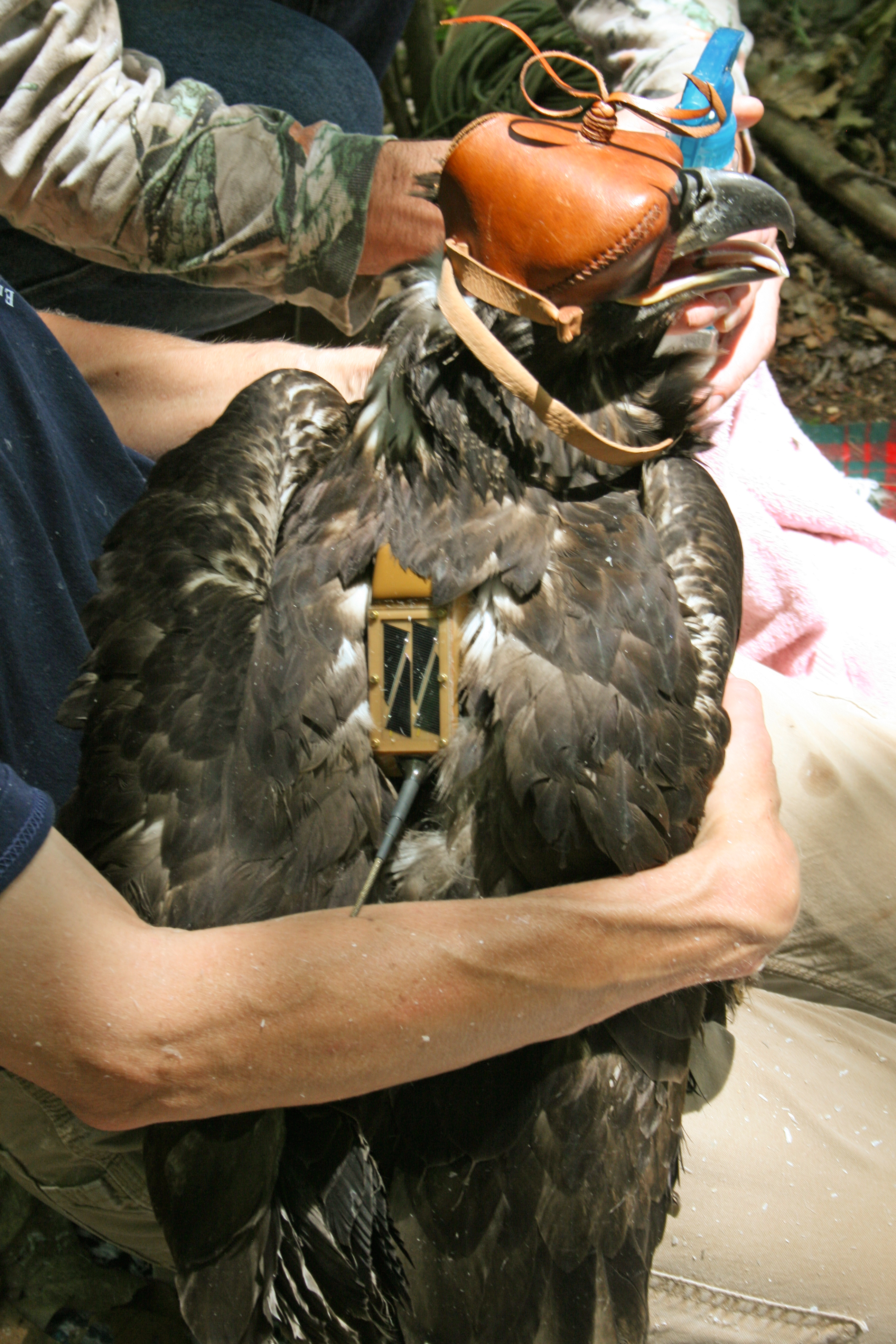
On May 31, 2013 the largest of three chicks at the Merrill Creek Reservoir nest, a female, was fitted with a transmitter.
Merrill Creek chick with transmitter May 29th, 2013
This transmitter is different than the ones previously used in that it uses GSM technology. Instead of using satellites to pick up the bird’s location, the transmitter will transmit data via cell phone towers. The data is then transmitted over the internet and delivered as an email to a mobile device or computer. This new technology transmits more data, costs less and allows users to have instant access to the data through smart phones or computers. Since fledging this bird has been on the move spending time in NY, PA and back to NJ and as of September 3rd was back near the nest site.
Eagle Project Volunteer Tom McKelvey captured this photo of one of the juveniles that fledged from the Shark River eagle nest in mid-June. So far this nesting season 157 young eagles have fledged from NJ nests. The juveniles will remain in the nest area for the next few months while they develop their flight and hunting skills.
So far twenty-one eagle chicks have fledged from nests in NJ. Eagle Chicks take their first flight around 11-12 weeks of age but weeks before that they’ll start stretching their wings, flapping and hopping around the nest. These activities help to strengthen the muscles they’ll soon need for flight. The next step is to start “branching” which means they they’ll hop from the nest to the branches of the nest tree. They’ll then take short flights to nearby branches to gain strength and confidence. After fledging they’ll remain in the area of the nest tree for several weeks to learn to hunt and practice flying.
If you haven’t noticed, we now have three healthy osprey nestlings at the nest at Edwin B. Forsythe National Wildlife Refuge in Oceanville, as viewed by our Osprey Cam. The first chick hatched on May 25th, the second on the 26th, and the third on the 28th. The eggs hatched in the order they were laid, referred to as asynchronous hatching. The incubation period was ~38 days for all three eggs (average is 35-37 in NJ; 32-43 throughout their range). With the cooler temperatures the longer period is expected. Osprey young are born semi-altricial, or are downy and require close parental care to survive. The male osprey has been very busy foraging and catching more prey to feed all the hungry mouths. Have you tried to identify the prey that they’ve brought in?
Last year 26 nesting pairs of peregrine falcons were monitored in New Jersey. The core of the state population nests on towers (old hacking towers) and on buildings in urban areas. Each spring we assist NJ Division of Fish & Wildlife’s Endangered and Nongame Species Program to help monitor the core of the population by performing nest checks and by installing a remote, motion-activated “spy” cam in nests to record the adults as they enter and exit nests. The footage captures the legs of peregrines. Why? Many peregrines are banded before they can fly with a federal USGS bird band and a state bi-color, alpha-numeric band. The state bi-color band can be read from the video captured by the camera. The information that these identifications provide is immensely valuable for relating peregrine origin and age to nest success, site fidelity and turnover rate in the population.
Here is a short clip from a nest site in Ocean Gate and the bird in the video was identified as a male (*8/*5, black/green) that was banded in 2005 at Sedge Island.
Single use plastic bag wrapped around ospreys neck…
by Ben Wurst, Habitat Program Manager
We had quite a scare last week, on April 30th around 12:30pm, after getting a report from an observer of our Osprey Cam on our Facebook page. A single use plastic shopping bag had gotten wrapped around the neck of the incubating female. After getting the report we started to monitor the situation to see how it would unfold. The bag was loosely wrapped, so we hoped she would be able to free herself…which she did after an hour.
Here you can see the single use plastic bag around her neck.
A lot of viewers and FB fans were asking why we weren’t going out to remove the bag from her neck. We answered each and every question to help make sure people knew that we were doing everything we could to protect her safety. First, we couldn’t just walk out to the nest (which is out in the middle of the salt marsh) without the female reacting to us and flying off the nest (with the plastic bag around her neck). Her flying off the nest with the bag around her neck would have only caused even more harm to her. She could have gotten snagged on a piece of nesting material and in the struggle could have choked to death or she could have fractured one of her eggs… Second, if she would have been tied down to the nest, then we would have enacted a plan to go out to the nest (after a certain amount of time) and released her. Our policy is that we will only intervene if it is a life or death situation. When we enter their nest sites we introduce stress to the birds which can ultimately do more harm than good. Finally, at least we have a camera to monitor the nest! Think of all the other 500+ nests in New Jersey where we only go out to monitor them once or twice during the nesting season. So much plastic winds up in osprey nests that it is a serious concern. People need to be more aware of their surroundings and do their best to make sure waste is properly disposed of.
There are ways you can help make a difference:
Reduce the amount of stuff you buy and the amount of trash you produce
Reuse what you can, recycle what you can’t
Pick up litter when you see it. There is a great movement in Australia called “Take 3” and their message is simple: “Take three pieces of rubbish with you when you leave the beach, waterway or… anywhere and you have made a difference.”
Stop or reduce your dependence on single use plastics
Use reusable shopping bags
Don’t release balloons!
The female struggles to get free of the bag.
Statistics for plastic recycling are dismal… According to the U.S. Environmental Protection Agency “In 2010, the category of plastics which includes bags, sacks, and wraps was recycled at almost 12 percent.” We’re lucky that she was able to free herself. This just proves that ospreys do not have an easy life. There are many threats to ospreys and they have very high mortality rates, which are around 80%.
On the positive side, the female and male continue to incubate three eggs at Edwin B. Forsythe NWR. We should start to watch for hatching around May 19-20th. We have been writing nest news with other life history information on a weekly basis on our Osprey Cam page.
I must admit, I’ve been anxious for the return of this pair of ospreys (and all others for that matter). The return of ospreys is a sign of spring, regrowth, and of recovery (from the effects of Superstorm Sandy) as we watch them rebuild their nests as we have helped to repair and replace many of their nesting platforms throughout our coast.
Over the past 6 weeks I had the task of installing a new remote/solar powered/high definition camera system on the coastal salt marsh of New Jersey. The camera system was installed inside Edwin B. Forsythe National Wildlife Refuge in Oceanville next to an existing osprey nesting platform. The camera system streams live video 24/7 from the nest to the Visitor’s Center at Forsythe and on our website. Since the system has been installed we’ve had crows, peregrine falcons (one that was a juvenile who was ID’d by her leg band and originated in Delaware), and a great horned owl (not good since owls are predators of osprey young) perch on the platform.
The nesting pair of ospreys arrived back from their wintering grounds on Friday, March 29th. We don’t know anything about the breeding pair other than neither is banded with USGS bird bands. The female has a very heavily streaked and prominent “necklace” of brown feathers on her breast. The male is smaller and has a bright white breast. Since arrived they have already been copulating (breeding) on the nest and will continue to do so over the next few weeks until the female will lay eggs in late April. For now they will continue to spruce up their nest and the male will perform courtship displays, after a successful hunt or while carrying nesting material, near the nest to help strengthen their pair bond.
There is a microphone out at the nest and it works. Some issues have come up with pairing the sound and video feeds and we are working on getting that sound online. I will be writing a weekly “Nest Cam News” journal on the Osprey Cam page with information about osprey reproduction, life history and other cool facts about ospreys! Some other great news is that the Wildlife Drive at Forsythe NWR will be open this weekend!!
The male eaglet was fitted with the transmitter in July 2011. In September 2011, the male flew as far west as Harrisburg, PA, and in January 2012 spent a few days in the upper Chesapeake Bay in Maryland. After that he spent the majority of his time in New Jersey and eastern Pennsylvania.
In early January, 2013, biologists became concerned when the signal from the transmitter was not moving. A team of biologists from the ENSP’s Clinton office went out to search the area but were not able to locate the bird. Another attempt was made on January 18th and the bird was found dead in the shoulder of the highway. The carcass was saved for later examination to determine the cause of death, though we suspect it was struck by a vehicle. The transmitter was still attached to the bird, and it will be refurbished and placed on another eaglet this nesting season.
So far, two out of the three eaglets outfitted with transmitters have not survived. Juvenile eagles have a high rate of mortality as they learn to live on their own and aren’t yet the most skilled hunters or fliers. We are learning a lot about these young eagles and their habitat choices and migratory movements. Unfortunately, we are also learning that they face many perils in the wild, as we have seen with the first eagle infected with West Nile virus, and the second struck by a vehicle.
In May, 2012, a transmitter was placed on the largest of three eaglets in the Merrill Creek nest. She fledged in July and remained in the nest area until September 10, when she took a quick flight south. She continues to be tracked around the southern tip of the Delmarva Peninsula in coastal Virginia, a favorite wintering area for many immature eagles. To follow her movements (and to see the movements of the other eagles) go to: http://www.merrillcreek.com/eagletracking.html.