Visitors to Reeds Beach discuss the shorebird season with Shorebird Steward Jim May.
One part of my job that is quite enjoyable is getting to spend time on the Delaware Bay beaches in the spring and working with the Shorebird Stewards. As the CWF volunteer manager I organize the Shorebird Steward program which is part of the International Shorebird Project. During the two week period that stewards are on the beaches I try to get out and check on the beaches and meet with the stewards as much as possible. This season there were 26 stewards and 23 of those had worked as stewards during a previous season.
The main part of the steward’s job is to educate people about the shorebirds and horseshoe crabs, but they do a lot more than that in a day. Stewards also keep people from going into the closed areas of the beaches so that the shorebirds can feed undisturbed. They give directions and send people to the beaches where the most birds have been sighted that day.
Shorebird Steward Rochelle Gimmillaro points out shorebirds to visitors to Cook’s beach.
If they have time they also count the number of shorebirds on the beaches and if possible record any banded birds that they see. Stewards deal with all types of people and situations. Some beaches are much busier than others, such as Reed’s beach where there is a viewing platform. On many days there is a constant stream of people coming to the view the shorebirds and horseshoe crabs.
This season there were very few problems on the beaches and it is directly due to the shorebird stewards hard work and dedication to the project.
I look forward to getting back on the beaches next shorebird season and working with such a great group of volunteers.
A student at Unity Charter School shows off his bald eagle sculpture (c) Maria Grace
Recently, I went to Unity Charter School in Morristown to give a presentation to the 3rd and 4th graders about NJ’s endangered wildlife.The students in Julia Kelly’s class raised over $100 for Conserve Wildlife Foundation as part of a unit on endangered species.
These students impressed me with their breadth of knowledge and genuine passion to try and protect NJ’s rare wildlife. Ms. Kelly did a fantastic job using New Jersey wildlife as a focus to teach about the global issue of endangered species.Each student selected an endangered species that lives in NJ (there are 73 currently listed as either endangered or threatened). They did some research about its habits and habitats and wrote a report.
But as a finale to their projects, each student created a sculpture of their animal in its preferred habitat.I was overwhelmed by these sculptures and completely amazed by the students’ attention to detail and their comprehensive knowledge of their chosen animal. They really wowed me with their art creations and I wanted to share it with the masses in the hopes that these students will move more of us to support the work of Conserve Wildlife Foundation.
The Delaware Bay beaches are a busy place right now and not with sunbathers and beach goers, but with horseshoe crabs and birds! The horseshoe crabs are coming up onto the beaches to spawn and the shorebirds are arriving to feed on their eggs. It’s a great time to take a trip to the beaches to watch all the activity. The Delaware Bay is the Western Hemisphere’s second-largest spring concentration of shorebirds. The shorebirds arriving on the beaches include red knots, sanderlings, ruddy trunstones and semipalmated sandpipers. People come from all over the world to view this natural phenomenon taking place right here in NJ.
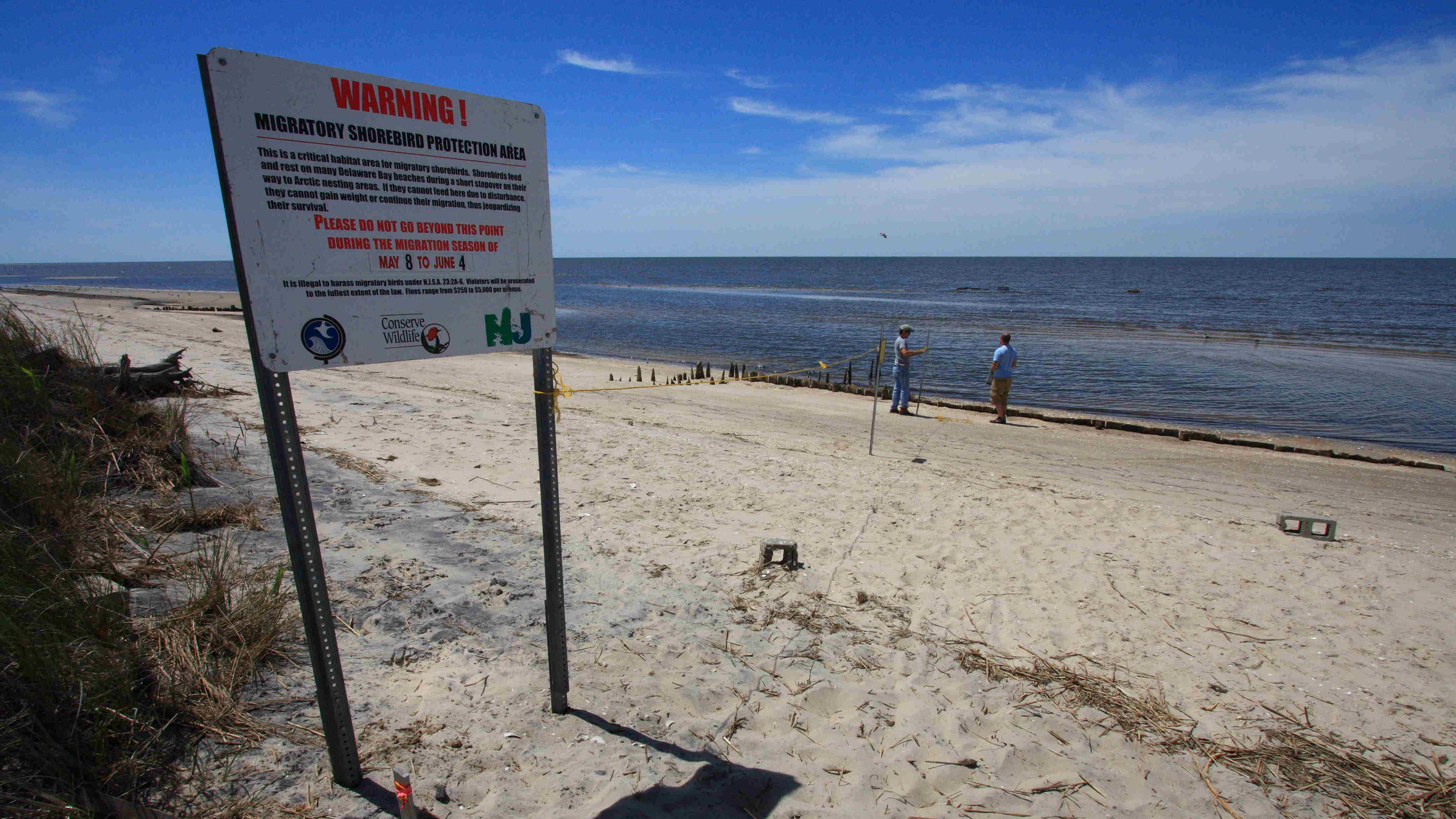
Beach access is restricted on critical beaches from May 8th through June 4th to allow the shorebirds to feed undisturbed. But there are still plenty of viewing areas. In Cape May County Reed’s Beach has a viewing platform that has a great view down the entire beach. Cook’s, Kimbells, Norburys and the Villas beaches all provide areas for viewing the shorebirds. In Cumberland County, Fortescue is another wonderful viewing spot. Please use the designated viewing areas and bring binoculars or a telescope so you can get a good look at the birds.
While you are out visiting the beaches you might run into one of CWF’s shorebird stewards. These dedicated volunteers are located at the closed beaches educating the public about the shorebirds. CWF had a new brochure printed this year, Spotting Shorebirds, Along the Delaware Bay, be sure to ask the steward for a copy of this so you can practice your shorebird ID. The stewards can also let you know on which beaches shorebirds have recently been spotted.
It really is worth the trip to see this spring migration, you won’t be disappointed. To find out the best beaches to view migratory shorebirds, check out our exclusive Wildlife Viewing Map.
On May 13th, I got the chance to visit a peregrine nest site to perform a “nest check.” The purpose of the visit was to count the number of young, determine age and sex, and check for any other issues (like infestations of a wingless parasitic fly).Over the past few years, the wingless flies have caused nests to fail to produce young. Over the winter, we treated gravel at nest sites to help get the parasites in check. I only observed 3 parasites on the nestlings.
There were three nestlings at the nest site. They are approximately 17 – 20 days old. Age can be determined by the size and feather development of the young. Sex can be determined by the size of the nestlings and the length of the culmen (upper mandible or bill). It looked like there were two males and one female.
Most peregrines nesting in New Jersey are resident birds that remain near the nest site throughout the entire year. Peregrine nests, known as an aerie, have a simple depression in a gravel substrate, called a scrape. Peregrines nest in urban areas on buildings, under bridges and on old “hacking” towers along the Atlantic Coast of New Jersey.
The young are totally dependent upon their parents until they are ready to fly in approximately seven weeks after hatching. Upon fledging, or leaving the nest, the young remain dependent, to a degree, on the adults until they master their flight and hunting skills.
You can view the live interactions of a pair of peregrines at a nest site in Jersey City by tuning into our Peregrine Cam. Check it out today!
On April 17th, volunteers helped install 4,000 feet of barrier fencing along Great Bay Blvd. to prevent Northern diamondback terrapins from being struck by motor vehicles. This initiative is similar to those found along other coastal roads in southern New Jersey in Margate, Ocean City, and Stone Harbor.
Terrapin conservation is new to Conserve Wildlife Foundation of NJ. It was easy to establish a need for the conservation work. Terrapins are listed as a Species of Special Concern in New Jersey. Several scientific studies have documented the threat of motor vehicles to terrapins and their impact on the local population. And it is heart-wrenching to see a large female terrapin that was struck by a motor vehicle.
Terrapins begin nesting activities in mid-late May. In the coming weeks we will be installing more “Terrapin Xing” signs along the road with help from Little Egg Harbor Township. A brochure is in the works and will be finished soon.
Over the past two weeks in New Jersey, the hills have awakened! This is the time of year when a quiet resurgence of frogs, salamanders, and toads takes place as the ground finally thaws, releasing them from their subterranean slumbers. They’ve spent nearly half a year in hibernation, and the amphibians are anxious to begin the serious business of breeding!
The earliest amphibians to head above ground are the ones that breed in temporary springtime (vernal) pools. In north Jersey these include the spotted salamander, jefferson salamander, wood frog, and the endangered blue-spotted salamander. The females emerge full of eggs…as many as 2,000 per frog and around 200 per salamander…and a lot is riding on those eggs. They are the next generation. They are our algae- and insect-eaters. They are food for other animals like garter snakes, thrushes, and bears; members of the web of life.
Helping Frogs and Salamaders Cross the Road
In areas where roads divide the woods from the water, traffic can take a huge toll on these amphibians every year. We’re doing what we can to identify amphibian road-crossing “hot spots” and to help our small, slow, slimy friends make it safely to their destinations.
Across most of NJ, the 2010 amphibian migration began on Friday, March 12th, with the first post-snowmelt rain storm of the season. The nor’easter came in early on Friday and
pummelled us with chilly rain until Monday the 15th…while we humans were holed up in our houses, those frogs & salamanders were celebrating the weather they’d been waiting for.
At one high-density crossing site in northern Warren County, we worked in teams of 5-10 people throughout Friday night to usher amphibians across the road and record what we saw (this project has been active since 2002, when the Conserve Wildlife Foundation, NJ’s Endangered and Nongame Species Program, and NJ Audubon Society partnered to create the volunteer-based effort). Over the course of 9 hours, we tallied more than 1,800 amphibians! The procession included 405 spotted salamanders, 644 wood frogs, and 742 spring peepers, with a few other species in the mix. A total of 59 vehicles passed through during that time; by reasonable estimate as many as a quarter or more of those road-crossing amphibians might not have made it without our help.
Ten of us braved the whipping storm on Saturday, March 13th, to again chaperone amphibians across the road. We stayed for a few hours (about 7:00-10:00 pm, to cover peak traffic time) and counted nearly 400 more amphibians. The vast majority of them were spring peepers, cute little tree frogs only an inch or so long. Despite the storm – with flood warnings and 40 mph wind gusts – people were still on the roads, and 27 vehicles traveled through our corridor during the 3-hour rescue survey.
After the storm finally passed, we sun-loving people got a sweeeeeeet reprieve with 6 days of bright skies and basking-quality temperatures in the 60s & 70s F. I just didn’t even know what to do with myself, I was so excited (…shorts? flip flops? laying in the grass? happiness overload!!!). The point is, whatever snow had been left in far northern NJ, and whatever ground was still frozen in the hills, wasn’t anymore.
Volunteers Count Our slimy friends
So as the next rain storm rolled in on Monday, March 22nd, another round of amphibians were ready to move. Our “drive-around” survey volunteers in Sussex, Passaic, and northern Warren & Morris Counties all reported big amphibian migrations in their areas and collected data that will help us identify the spots that warrant protection – whether in the form of rescue surveys, road closures, or an attempt at installing amphibian culverts. At our Warren County rescue site, one hardy & heroic volunteer offered to check things out around dark, and ended up staying until 1:30 in the morning when he found that amphibians were again moving in mass (you’re awesome, George!!). He tallied around 600 more amphibians, including 154 spotted salamanders, 56 American toads, countless peepers, a handful of four-toed salamanders, and even a brown snake! All of the 67 wood frogs he saw were moving away from the wetlands – their breeding and egg-laying were complete.
Amphibians will continue to be present on the wet roads all spring and summer. You can help keep them safe by limiting your driving on rainy nights and by keeping a watchful eye when you are on the road in those “froggy” conditions.
If you know of a spot where amphibians cross the road in large numbers, or if you’d like to volunteer for our project next year, please email MacKenzie Hall.
If you enjoy spending time on the beach, bird watching, and interacting with people while helping to make a difference, then the shorebird steward project might be the right volunteer opportunity for you! The Delaware Bay in the spring time is a great place to be!
In 2003, New Jersey began restricting beach access on critical shorebird feeding beaches. With fewer horseshoe crab eggs available it is more important than ever to protect shorebirds as they search for food on Delaware Bay beaches. Shorebirds are very
sensitive to disturbance. If birds are disturbed while they are resting on the beach or feeding, they may not build-up the necessary fat reserves to make it to their Arctic breeding grounds.
Shorebirds at Fortescue Beach on the Delaware Bay, Cumberland County. (Monica Pepe)
The shorebird steward project was put in place to have a presence at these closed beaches during the three-week closure period in May through early June. In 2009 thirty-three stewards patrolled nine beaches along the Delaware Bay in Cape May and Cumberland Counties. Their main goal was to ensure that resting and foraging shorebirds were not disturbed. As beach goers are encountered, stewards engage them in conversation, and distribute brochures and other educational materials. Stewards direct people to designated viewing areas. People visiting the Delaware Bay leave with a better understanding of biodiversity, species interaction, and an understanding of what they can do to help.
In 2010, stewards will be needed the following dates: May 8th, 9th & May 15th through 31st.
Interested applicants must be available to work at least two full days, 7-8 hours a day. A shorebird steward training will be held on May 1st.
If you are interested in learning more about the program please contact Larissa Smith at (609) 628-0402 or Email.