NEW, WEEKLY UPDATES FROM NEW JERSEY’S BEACH NESTING BIRD PROJECT TEAM
by Todd Pover, Beach Nesting Bird Project Manager
Beach nesting bird chicks, such as this black skimmer – New Jersey’s first skimmer chicks hatched this weekend – are especially vulnerable to the extra large crowds and fireworks on the beach during July 4th celebrations and other busy summer weekends. Photo courtesy of Jean Hall.
While the July 4th holiday weekend is the celebratory peak of the summer season for beachgoers, it is not a joyous time for beachnester staff or beach nesting birds. The holiday brings an extra crush of people out on the beaches at the most critical time for our endangered nesting shorebirds. Nearly all the species – piping plover, least tern, black skimmer, and American oystercatcher – are at the peak of their breeding seasons in late June/early July so the holiday is sometimes a “make it or break it” day or in the case this year a long weekend.
So our beachnester staff went into overdrive this weekend, working extra hours to guard and monitor nesting sites, both day AND night. Fireworks, the symbol and heart of any July 4 celebration, are especially problematic. The disturbance from the fireworks themselves can be an issue, but the extra large crowds (and typically extra boisterous behavior) on the beaches at night can be a deadly combination for the beach nesting birds. Personal fireworks in proximity to nesting colonies also have to be “policed” by our staff and volunteers.
With this year’s holiday now just passed, it looks like our efforts largely paid off. There were areas where protective fence was vandalized and had to be restored, and some minor bird losses were documented this weekend, but it was fortunately minimized this year. With that in mind, we are sending an extra special thanks out today to the dedicated beachnester staff members and volunteers, not just in New Jersey but across the entire breeding range, for their hard work this weekend and throughout the season.
The bird’s still have several weeks to go before we’ll know if the season was a success overall (stay tuned for that news), but “holding down the fort” on July 4 is one more challenge that is now in the books for this year.
A Traveling Biologist’s Favorite Honduran Wildlife Species
by Kelly Triece, Wildlife Biologist
As a final chapter to the Honduras blog series, I will be sharing with you some of my favorite wildlife experiences from the trip as a traveling biologist. The country of Honduras has a very diverse landscape including tropical forests, dry deserts, the Caribbean Sea and the Atlantic Ocean. Luckily, during our trip we were able to travel to all of these locations and that meant we were in a new location almost every night! Our accommodations varied from rustic to very rustic. Hot water was often in short supply, but hot meals and hot coffee were always on the menu and wildlife was plentiful. Honduras is a country of much scenic beauty and many local lodges and accommodations are beginning to attract tourists and travelers from across the world.
Emerald Hummingbird (Amazilia luciae) by Greg Homel
One lodge that we visited has over 100 hummingbird feeders! Hummingbirds travel from around the tropical forest to taste the sweet water and are welcomed by many eager photographers and nature lovers. Honduras has one endemic hummingbird, the Honduran emerald (Amazilia luciae), known only to a few special locations in the country. The Honduran emerald lives in dry scrub habitats of open, arid deciduous thorn forests. The species is declining due to loss of habitat from cattle grazing and development. However, local conservationists including the Honduran Corporation for Forestry Development (COHDEFOR) – a forestry agency, private landowners and non-profits are attempting to work with ranchers to preserve patches of thorn forest amongst pasture land. Through the integration and communication of conservationists and land users (ranchers), conservation has the potential to bring positive results for all end-users. If the Honduran emerald can survive on a mixture of scrub and pasture, then we may have a true success story.
While traveling through these various landscapes and working with the local Hondurans who are looking to bring community and wildlife together we were able to see some other great wildlife include leaf-nosed bats and boa constrictors! This boa constrictor (Boa constrictor) was found in a tree near a Neotropic cormorant (Phalacrocorax brasilianus) rookery. This boa likely feeds on the cormorants living nearby. Boas can reach up to 13 feet long and feed mostly on mammals and birds. Truly a sight to see!
Boa constrictor (Boa constrictor) photo by wizscience
We also discovered Leaf-nosed bats, tucked in palm leaves in the pine forest. Leaf-nosed bats are found throughout central and south America. Leaf-nosed bats are among the most diverse family of bats in the world and vary in diet, ranging from insects to fruits. The bats pictured here are tent-making bats (Uroderma bilobatum) that make shelters out of palm leaves. These bats are frugivores, but may also eat insects, pollen and nectar. The bats make the tent shelters by biting the mid-section of the leaf to create a V-shape. After the lead dries up, a new shelter must be made. The palm leaves provide shelter from heavy rains, sun and wind. This adaptation allows bat to travel to new locations in search of ripe fruit and to escape predators.
Tent-making bats (Uroderma bilobatum) photo by Kelly Triece
Throughout the trip our group had the opportunity to meet with many local leaders in conservation as well as golden-winged warbler researchers. It is clear that a multi-faceted approach to conservation is necessary in order allow for education, passion and protection to the many landscapes and wildlife of Honduras. It is through a partnership with educators, researchers, professionals, farmers, children and all locals alike that we can work to help promote the beauty of Honduras while preserving its beautiful landscapes and wildlife. These far-reach effects can be seen not just in Honduras, but in North America as well, as many of these species call both North and Central America home.
NEW, WEEKLY UPDATES FROM NEW JERSEY’S BEACH NESTING BIRD PROJECT TEAM
by Todd Pover, Beach Nesting Bird Project Manager
Least tern photo by Northside Jim.
Piping plovers tend to garner most of our attention on the beach nesting bird project because they are so critically endangered. American oystercatchers and black skimmers are visually striking and very charismatic, so they are popular with the public, as well. That sometimes leaves the least tern as the “forgotten stepchild” of our beachnesters.
Their protective behavior of dive-bombing and even pooping on beachgoers who get too close to their nests or young doesn’t help their reputation. Yet, they are a fascinating species to watch and their chicks rank high on the cute scale.
Because they are a colonial species, and the colonies often take up large areas of the beach, they are a special challenge to manage and protect. But they do need protection – they are listed as endangered in New Jersey. Over the past decade, their population has remained low but stable. On one hand that is good, it means they aren’t declining further, but it also means they aren’t recovering either.
This week, we completed the latest of our bi-monthly surveys with a total of about 1200 individuals counted. This is below our peak a little earlier in the month, but in line with our typical statewide population. To date, we have recorded 24 active colonies along the coast from Sandy Hook to Cape May this year. That is within our average annual range of 20-25, although several of those colonies have already failed due to intense predator pressure.
It is too early to say whether this will be a good or bad year for least terns. We are in the peak period for chicks, so the next two weeks or so will determine if we successfully produce enough young to the fledgling stage. In the meantime, now is the time to get out to see these cuties, but remember to view them from a safe distance and share the shore with all our beach nesting birds.
This story marks the first of six blog stories spotlighting New Jersey’s shark species – and educating people about why shark populations are in danger throughout the world.
CONSERVE WILDLIFE FOUNDATION IS INITIATING CONSERVATION EFFORTS DIRECTED AT THE SHARKS, RAYS, AND SKATES WHICH OCCUR IN NEW JERSEY WATERS.
By Michael Davenport, Wildlife Biologist & GIS Manager
Sharks, rays, and skates are cartilaginous fish within the subclass Elasmobranchii. Elasmobranchs predate the dinosaurs by hundreds of millions years, having first appeared in the fossil record during the Devonian Period approximately 400 million years ago. They are a very diverse group, with over 350 species of sharks and over 500 species of rays and skates currently existing worldwide.
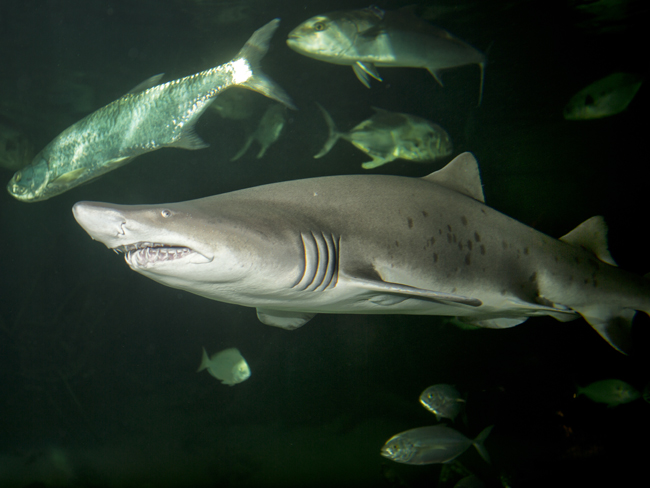
A sand tiger shark. Photo courtesy of Gerald Walters & Jenkinson’s Aquarium.
Sharks and rays are highly specialized and occupy a wide variety of habitats. Some species are slow-moving bottom feeders which prey on crustaceans while others are fast-swimming predators of marine mammals. Many shark and ray species are apex predators, at the top of many food chains. They play a critical function within the marine (and occasionally freshwater) ecosystem preying on the weak, sick, or injured and maintaining a balance within their environment.
Sharks and rays are frequently misunderstood and feared as a result. Sharks have been portrayed in movies as man-eating monsters which target humans as a meal. Rays are also feared due to their appearance and because many species do, in fact, carry defensive barbs on their tail which have been known to injure or even kill people.
Because of their bad reputation, sharks are often targeted by recreational fishermen as trophy catches. However, the greatest threat to sharks and rays comes from commercial fishing for several reasons: (1) directed fishing for sharks, especially for their fins; (2) capture as bycatch during other fishing activities; and (3) overfishing of prey species.
Degradation of habitat is another threat to sharks and rays. Many species give birth within inshore coastal waters and those same areas are a nursery for the young. Pollution and/or development of those areas represent a threat to those species during a critical stage of their life. Climate change and its impact on food resources of sharks and rays is another potential major threat to sharks and rays which is poorly understood at this time.
Due to the biology of sharks and rays, these many threats are worsened by the fact that fewer individuals are replaced than are killed. Sharks and rays are generally long-lived species which don’t reach sexual maturity often until they’re in their teens or older. Then, they may give birth to as few as two young every two or three years.
Follow our blog posts throughout the week to learn more about some of the shark species which occur in New Jersey waters.
At 8:00 PM on October 29th, 2012, Hurricane Sandy made landfall in Brigantine, New Jersey, only about 30 miles from New Jersey’s Hidden Coast – the Delaware Bayshore. The storm was devastating for the people of the area, many of whom lost their homes and livelihoods. It was equally hard on the area’s wildlife, bringing many species, including the famous horseshoe crab and red knot, perilously close to extinction.
A new episode of our video series “New Jersey’s Hidden Coast” will air every two weeks throughout the summer! Catch a glimpse of the bay, the horseshoe crab at the center of the bay’s system, and the incredible relationship between horseshoe crabs and migratory birds, like the red knot. We will reveal the real value of horseshoe crabs, the challenges to the ecosystem, and the potential for a thriving regional economy along the Bayshore. We will show Hurricane Sandy as a catalyst for decisive action and the work being done to rebuild the area for both people and wildlife.
Over the next several weeks, we will explore the use of “living shorelines” instead of bulkheads and the central importance of marshes to the marine ecosystem. We will discover the on-the-ground, grassroots efforts of the community to build oyster reefs alongside veterans. And we will examine the future of the Bay and the work that needs to be done to preserve our conservation successes thus far.
NEW, WEEKLY UPDATES FROM NEW JERSEY’S BEACH NESTING BIRD PROJECT TEAM
by Todd Pover, Beach Nesting Bird Project Manager
Amazing transformation of a piping plover from tiny chick to fledgling in just 25 days. Both photos by Northside Jim.
The highlight of this past week was our first piping plover fledglings of the season. This means the first group of chicks has reached the stage where they can fly, which is our metric for success. Hatching the chicks is always great, but our goal is population recovery and the primary way we can increase our low population in New Jersey is to produce more fledglings to come back in future years to breed here.
The doubly exciting news is ALL four of the chicks that hatched at Barnegat Light reached the flying stage. This is notable because typically, on average, we only fledge about one chick per pair in New Jersey. This is not enough to grow or sustain our long-term population. Population modeling tells us we need to fledge about 1.5 chicks per pair range-wide to grow the population and about 1.25 chicks per pair to sustain it.
Of course, not all our piping plover pairs will fledge four chicks, in fact, some may not fledge any. So the Barnegat Light news was a good way to kick off our fledgling season and hopefully it is a sign of above average productivity this year.
Spotlight on the Bald Eagle’s All-American Comeback in New Jersey
by Lindsay McNamara, Communications Manager
Photo by Northside Jim.
In 1985 — just 31 years ago — a single bald eagle nest remained in the state of New Jersey. In 2015, CWF and partners monitored 161 nests throughout the Garden State. Just this year (as of June 20, 2016), over 50 young eagles have already fledged from their nests! What sparked this All-American comeback of the United States’ National Bird?
DDT use was banned in the United States in 1972. That ban combined with restoration efforts by biologists within the NJ Division of Fish and Wildlife’s Endangered and Nongame Species Program (ENSP) resulted in 25 bald eagle pairs by 2000.
Since then, CWF and ENSP biologists have worked together to not only conserve New Jersey’s existing bald eagle population, but help young eaglets in the state thrive. We manage the New Jersey Bald Eagle Project, a network of passionate, dedicated volunteers that monitor bald eagle nests and help reduce human disturbance in eagle habitats. These incredible volunteers, like the late Elmer Clegg, have been an integral part in the recovery of bald eagles throughout the Garden State.
CWF and ENSP have even begun tracking bald eagles to see where they travel and to learn more about their behavior! During the summer of 2014, two juvenile bald eagles were fitted with a GPS tracking device (a wearable backpack). Our team of biologists chose one eagle from Atlantic County (a male) and one from Cumberland County (a female) to be tagged in this telemetry study. Then in May 2015, a juvenile male from a nest in Cumberland County was fitted with another GPS transmitter. You can follow the journey of “Nacote” and “Oran” on our website.
CWF also partners with Duke Farms on a webcam that provides a live look at a bald eagle nest in Hillsborough, New Jersey. During the eagle nesting season (late January-July), the EagleCam allows viewers an up close and personal view into the lives of a pair of bald eagles as they breed, incubate, and raise young. Between the general public and classrooms up and down the east coast, the EagleCam has many fans – over 11 million viewers and growing! This year, CWF’s eagle expert Larissa Smith launched a new citizen science program to engage these viewers in gathering scientific data on the eagles’ diet.
Today, American Eagle Day, we celebrate the hard work of the biologists, volunteers and concerned citizens throughout New Jersey that have made a difference for the birds and contributed to their comeback.
The bald eagle was selected as the central image of the Great Seal of the United States by the Second Continental Congress on this day, June 20, in the year 1782. For 234 years, the bald eagle has served as the living symbol of freedom, courage, strength, spirit, democracy, independence, and excellence. Today, we celebrate the recovery of the bird and the All-American comeback the population has made in the Garden State.
Throughout the entire country, there are an estimated 14-15,000 bald eagle pairs! Though the bald eagle was removed from Endangered Species Act protection in 2007, it is still protected under the Bald and Golden Eagle Protection Act of 1940 and Migratory Bird Treaty Act.
The 501(c)(3), not-for-profit American Eagle Foundation (AEF) of Tennessee has been a major proponent and organizer in establishing and promoting “American Eagle Day.” The AEF is celebrating its 30th year of protecting and caring for bald eagles and other birds of prey. CWF thanks AEF for their support of our work in New Jersey!
“On American Eagle Day, and every day, let us continue to treasure and protect the Bald Eagle all across this great land for future generations to enjoy,” says AEF Founder and President Al Cecere, who has been spearheading the American Eagle Day effort for two decades.
NEW, WEEKLY UPDATES FROM NEW JERSEY’S BEACH NESTING BIRD PROJECT TEAM
by Todd Pover, Beach Nesting Bird Project Manager
Least tern photo by Northside Jim.
The beach nesting bird field staff is firing on all cylinders now, frantically trying to keep up with nesting activity. In some regions of the New Jersey coast, piping plovers and American oystercatchers are still laying eggs, while at other sites there are chicks on the beach, even one site (Barnegat Light) where the chicks are already approaching their “fledgling” stage when they will be able to fly.
CWF Field Technician Jesse Amesbury busy conducting annual piping plover census at Edwin B. Forsythe NWR.
Most of the least tern and black skimmer colonies are now established, with least terns starting to hatch chicks and black skimmers just laying eggs. Counting the colonies is one of the most challenging parts of the job, imagine trying to count 1,000-1,500 birds at a time in some instances!
After helping with the winter segment of the International Piping Plover Census in the Bahamas, CWF switched gears this week to help conduct the breeding portion in New Jersey.
All the normal beachnester tasks are keeping us busy, but the main focus this past week was the annual piping plover “window” census, where field biologists all along the Atlantic coast count the number of birds present between June 1-9, so we can get a range-wide breeding population estimate. As for New Jersey, it looks like our population will go up, at least slightly, for the second year in a row. Although this is still a very preliminary estimate, it looks like we have weathered the statewide low in breeding pairs we recorded in 2014, thanks to good productivity the past two years.
Of special note is a spike in Monmouth County (outside Sandy Hook), where we have gone from 2 pairs the past several years to 12 pairs this year. Although a smaller bump, we also went from 1 pair to 4 pairs within Barnegat Inlet, an area we have long hoped for more pairs. It takes a tremendous effort to realize even small gains in our piping plover recovery effort, so we are especially excited about this news!
Our work is never done…CWF Wildlife Biologist Emily Heiser posting a new nesting area for endangered least terns.
Technology has proven to be vital to Conserve Wildlife Foundation’s work protecting rare wildlife species over the years. Our biologists depend greatly on modern technologies to band, track, and share online the journeys of wildlife. Our webcams broadcast the most intimate behaviors of nesting birds and bats across the web. And we seek out ever-evolving communications technologies to spread the word about the inspiring stories of wildlife, from social media and infographs to e-books and Story Maps. These technologies offer newfound abilities to share complex data on multiple levels, while still incorporating the awe-inspiring photography and videos that bring wildlife’s stories to life.
Conserve Wildlife Foundation of New Jersey is excited to offer our 2015 Annual Report in a unique format that utilizes one of those technologies – Story Maps. In the past year, we have explored the lives of seals, eagles, and freshwater mussels with Story Maps – and the annual report allows all of our projects to be highlighted in this interactive format as well.
Visit the multiple pages within this Story Map to learn about Conserve Wildlife Foundation’s many projects and partnerships in 2015, and the imperiled wildlife species in need of our help. Find examples of the innovative and dedicated leadership of our biologists and volunteers. And take an online journey across the state to learn how our projects made a difference in all corners of New Jersey in 2015 – a great year for wildlife in the Garden State!
Horseshoe crabs may be one of the most unusual animals in the world, but they’re also one of the most extraordinary. They’ve been around for hundreds of millions of years, and we’re only now starting to understand just how important they are – not just to the natural world, but also to the world of medicine. Discover the real value of horseshoe crabs, found throughout New Jersey’s Hidden Coast – the Delaware Bayshore.
A new episode of our video series “New Jersey’s Hidden Coast” will air every two weeks throughout the summer! Catch a glimpse of the bay, the horseshoe crab at the center of the bay’s system, and the incredible relationship between horseshoe crabs and migratory birds, like the red knot. We will reveal the real value of horseshoe crabs, the challenges to the ecosystem, and the potential for a thriving regional economy along the Bayshore. We will show Hurricane Sandy as a catalyst for decisive action and the work being done to rebuild the area for both people and wildlife.
Over the next several weeks, we will explore the use of “living shorelines” instead of bulkheads and the central importance of marshes to the marine ecosystem. We will discover the on-the-ground, grassroots efforts of the community to build oyster reefs alongside veterans. And we will examine the future of the Bay and the work that needs to be done to preserve our conservation successes thus far.