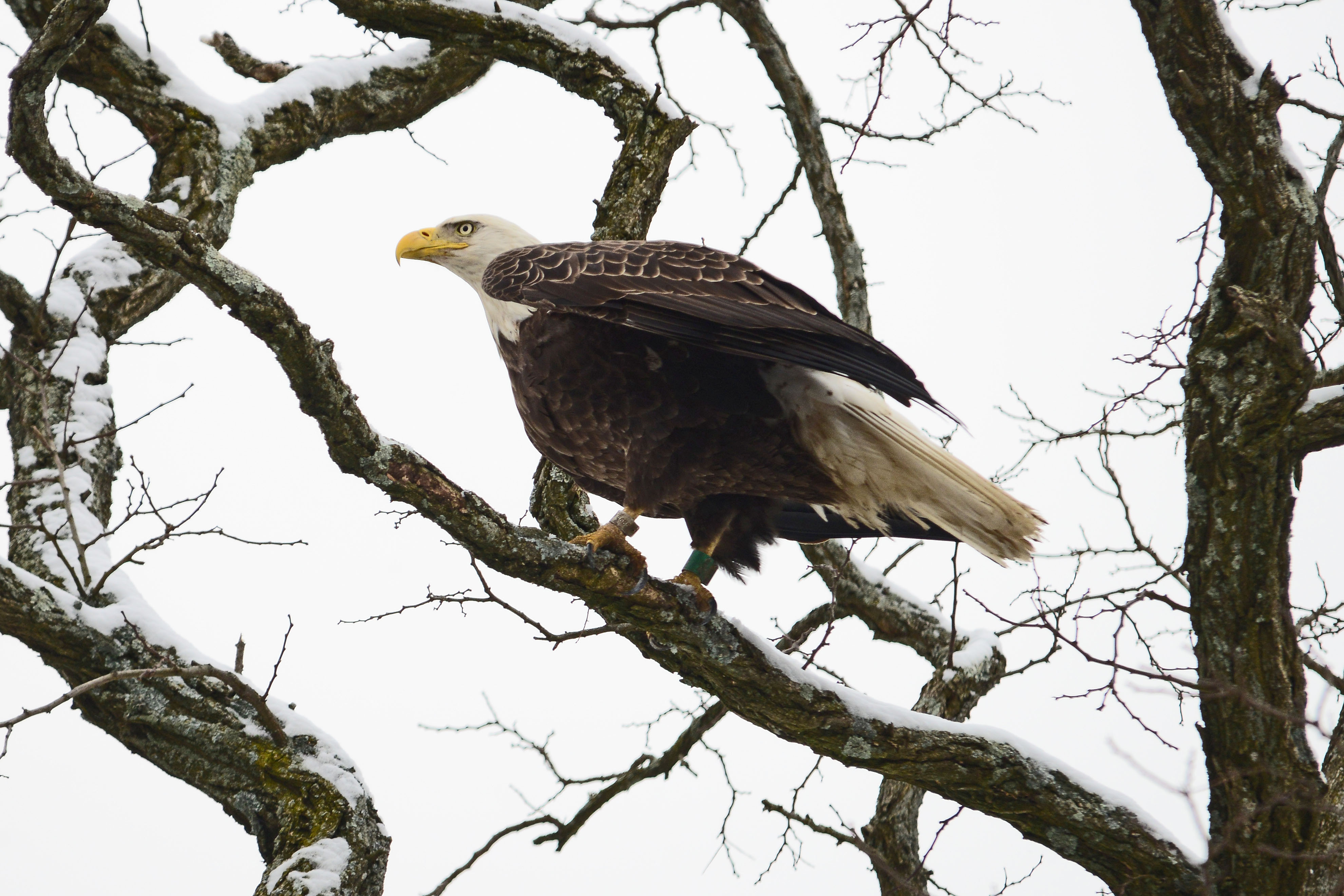
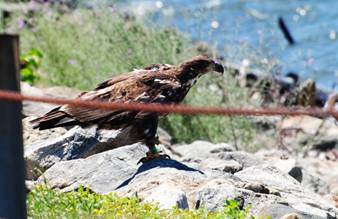
Eagle Project Volunteer Tom McKelvey captured this photo of one of the juveniles that fledged from the Shark River eagle nest in mid-June. So far this nesting season 157 young eagles have fledged from NJ nests. The juveniles will remain in the nest area for the next few months while they develop their flight and hunting skills.
So far twenty-one eagle chicks have fledged from nests in NJ. Eagle Chicks take their first flight around 11-12 weeks of age but weeks before that they’ll start stretching their wings, flapping and hopping around the nest. These activities help to strengthen the muscles they’ll soon need for flight. The next step is to start “branching” which means they they’ll hop from the nest to the branches of the nest tree. They’ll then take short flights to nearby branches to gain strength and confidence. After fledging they’ll remain in the area of the nest tree for several weeks to learn to hunt and practice flying.
One way we can track eagles is with transmitters which I’ve discussed in previous blogs. Since 2011 three eagle chicks have been outfitted with satellite transmitters to track their movements. Two of the birds have since died. To follow the movements of the third eagle go to http://www.merrillcreek.com/eagletracking.html
Another way to track eagles is by banding them. The NJ Endangered and Nongame Species Program has been banding eagles with green (NJ specific) bands since 1987. Eagles are banded when they are six weeks of age and get a green NJ band on one leg and a silver federal band on the other. The state band has a letter over a two digit number. The band information is entered into the National Bird Banding Lab database and when someone finds an injured or dead eagle they can report the band. Most of the information that comes in from these bands are from dead or injured birds. The bands tell us when and where the the bird was banded. By using spotting scopes people can sometime see that a bird has green band but many times are unable to read the number. We know that 23 pairs of eagles nesting in New Jersey have at least one bird in the pair that was banded in NJ.
Sometimes we are lucky to get re-sightings from photographers with high powered lenses who can focus in on the band. Just in the past week we’ve gotten three sightings of NJ birds. One eagle has been seen on Long Island with a green band and reported by Peter Stegemann. He has seen this bird all last summer and fall with another eagle and they might be nesting this season. This would be the first pair of eagles to nest on Long Island since DDT wiped out the eagle population. By zooming in on the photo ENSP principal biologist Kathy Clark was able to read the letter and first number as C/8. The second number couldn’t be read but by going through the banding records it was determined that this eagle was banded in 2009 at the Princeton nest.
Another NJ banded bird (D/64) was photographed by Justin Pursell in Schwenksville, PA on April 7th, 2013. The eagle hasa nest in the area. The bird was banded May 10, 2004 at the Hopewell West nest in Cumberland County. Kristen Nicholas took a photo of a third year NJ banded bird at Lake Tappan Northern NJ/Lower NY on March 20, 2013. The green band is D/39 a third year male which was banded in 2011 at the Oradell Reservoir in Bergen County NJ.
While it’s great to get re-sightings of NJ banded birds we don’t want to get them at the expense of the eagles. These photos were taken by photographers with high powered lenses. People should view eagles from a safe distance so as not to disturb them, especially when they are nesting. Disturbance to a nest can cause the eagles to abandon the eggs/young or cause the young to prematurely jump from the nest.
Every January NJ participates in the National Midwinter Eagle Count. Volunteers surveyed for eagles statewide during the weekend of January 12th & 13th. Due to dense fog the visibility was poor in many of the survey areas but despite this the total count was 297 bald eagles. This is 38 less than 2012’s high count of 335 bald eagles. Four golden eagles were also counted during the survey.
2013 Midwinter Eagle Survey Results
Southern NJ: 264 bald eagles
Northern NJ: 33 bald eagles
Total bald eagles: 297
Thank you to all volunteers who participated!
February is a great time to get out and view eagles in New Jersey. So far twenty-one pairs of eagles are incubating (on eggs) while others pairs are busy getting ready for the season. Not only can you spot resident birds this time of year but wintering eagles as well. The Cumberland County Winter Eagle Festival takes place this Saturday the 9th. This is a good opportunity to see eagles and other raptors and learn more about them. I’ll be there at the CWF table so stop by and say “Hi”.
The male eaglet was fitted with the transmitter in July 2011. In September 2011, the male flew as far west as Harrisburg, PA, and in January 2012 spent a few days in the upper Chesapeake Bay in Maryland. After that he spent the majority of his time in New Jersey and eastern Pennsylvania.
In early January, 2013, biologists became concerned when the signal from the transmitter was not moving. A team of biologists from the ENSP’s Clinton office went out to search the area but were not able to locate the bird. Another attempt was made on January 18th and the bird was found dead in the shoulder of the highway. The carcass was saved for later examination to determine the cause of death, though we suspect it was struck by a vehicle. The transmitter was still attached to the bird, and it will be refurbished and placed on another eaglet this nesting season.
So far, two out of the three eaglets outfitted with transmitters have not survived. Juvenile eagles have a high rate of mortality as they learn to live on their own and aren’t yet the most skilled hunters or fliers. We are learning a lot about these young eagles and their habitat choices and migratory movements. Unfortunately, we are also learning that they face many perils in the wild, as we have seen with the first eagle infected with West Nile virus, and the second struck by a vehicle.
In May, 2012, a transmitter was placed on the largest of three eaglets in the Merrill Creek nest. She fledged in July and remained in the nest area until September 10, when she took a quick flight south. She continues to be tracked around the southern tip of the Delmarva Peninsula in coastal Virginia, a favorite wintering area for many immature eagles. To follow her movements (and to see the movements of the other eagles) go to: http://www.merrillcreek.com/eagletracking.html.
In 2012 a new record high of 135 eagle pairs were monitored during the nesting season. One hundred and nineteen of those were active which means they laid eggs. A total of 165 young were produced this year and fledged (left the nest). That is 46 more than 2011’s 119 young produced. Twenty-seven new eagle pairs were found this season, 15 in the south, 2 in central and 10 in northern NJ. While all of these numbers are good news for NJ eagles they still need protection. The two major threats that bald eagles in NJ face today are disturbance and habitat loss.
The NJ Bald Eagle Project has a dedicated group of volunteers who monitor nests throughout New Jersey. They help to prevent disturbance at nest sites by educating the public about eagles. The success of the eagle project is directly related to these wonderful volunteers.
by Larissa Smith, Wildlife Biologist/Volunteer Manager
In June of 2011 two chicks (male & female) from the Merrill Creek Reservoir eagle nest in Warren County were fitted with solar-powered transmitters that are monitored via satellites. The males movements have been tracked for over a year starting when he left the nest in June. You can see the eagles movements by going to: http://www.merrillcreek.com/eagletracking.html In September the male flew as far West as Harrisburg, PA and in January spent a few days at the upper Chesapeake Bay in Maryland. He has spent the majority of his time in New Jersey and Eastern Pennsylvania. It is very interesting to see where the eagle is spending his time and the type of habitat he is using. When you go to the map you can zoom in to get a close up look at his locations.
Unfortunately the female chick died in October due to starvation. She tested positive for West Nile Virus which could have contributed to her death. The transmitter was recovered from the female and in May of this year the transmitter was placed on the largest of three chicks, a female, in the Merrill Creek nest. She just recently left the nest and is still in the area of the nest taking short flights. To follow her movements go to http://www.merrillcreek.com/eagletracking.html
for his contributions to the NJ Bald Eagle Project
by: Larissa Smith, Biologist/Volunteer Manager
Landowner Robert Johnson with Eagle Project volunteers Earl and Mary Ellen Holton.
Landowners are an important component of the NJ Bald Eagle Project since fifty-six percent of eagle nests are found on private property in NJ. This year we recognized a landowner for his contributions to the project over the years. Mr. Robert Johnson has had a pair of eagles nesting on his property in Cumberland County since 2003. He has always been very protective of the pair and makes sure that they aren’t disturbed during the nesting season as well as keeping the nest observers updated on any activity that he has seen or any problems. He helps the volunteers by cutting the grass in his field so that they can drive in and park when monitoring the nest. This year when the volunteers truck got stuck in the mud at another close by nest Mr. Johnson came with his backhoe and pulled them out.
Mr. Johnson received a certificate of appreciation and an eagle frame handmade by CWF biologist Ben Wurst www.reclaimednj.com. The photo in the frame was of Mr. Johnson holding an eagle chick during a eagle banding on his property.
On behalf of the NJ Bald Eagle Project we thank Mr. Johnson for his dedication to NJ eagles.
…and learn about threatened and endangered species.
by Larissa Smith; Biologist/Volunteer Manager
For the second year in a row 5th graders at the Ocean City Intermediate school adopted a species from the Conserve Wildlife Foundation of NJ. The 40 students are in two of science teacher Mrs. Rosander’s classes. They earned the money through chores and donations to adopt the Bald Eagle. This year they chose to adopt a bald eagle which is one of the species that I work with so I was glad for the opportunity to talk about NJ eagles.
Students learned about threatened and endangered species as well as the NJ bald eagle project. The students asked a lot of great questions and I’m pretty sure they’ll now be on the look out for eagles!
Thank you to the students for their donation to CWF!