It is always exciting to receive a report of a New Jersey banded eagle, especially when it is from Duke Farms eagle cam. D/99 was resighted two years ago during the winter of 2019. The blog post Duke Farms Alumni D/99: All Grown Up, has all the details of those sightings.
D/99, January 2021 @ Kristen Branchizio
D/99 has been sighted again, this time in Freehold, Monmouth County. He was seen for several days feeding on a deer carcass along with a few other eagles.
D/99 was the youngest of three chicks in the 2014 Duke Farms nest. It’s amazing to see the “before” and “after” photos. The little fuzzy wobbling chick is now a full grown majestic adult.
D/99 and siblings, April 2nd, 2014
D/99 is now seven years old and could possibly have a mate and be nesting in the area. We hope to get more resightings of D/99 in the future to know that he is doing well and raising his own family.
In part one and two of this blog series we followed the Three Bridges eagle pair. The transmission tower where they had previously nested was replaced and a new nesting platform installed. The question was: would the pair return and use the new nesting platform? Eagle Project volunteers have been closely monitoring the tower and surrounding areas for the eagle pair. The eagles have not been seen at their old nesting tower. At one point it looked like they were building a nest on an adjacent tower, but the amount of sticks never increased. Then a new eagle nest was found in a tree about a mile away from the tower location.
eagle bringing stick back to nest in tree 1/14/21 @ Joe Mish
After many observations by nest monitors it is believed that this is the Three Bridges pair. While we can’t be 100 percent certain, the fact that they haven’t been seen at their old nest location and that this new nest is close enough to be in their territory. It is not uncommon for eagle pairs to relocate their nest if there is disturbance to the nest site. While it is disappointing, the new nest platform might not go to waste. Nest monitors have seen immature eagles perched on the newly installed tower and nest platform.
sub-adult & immature on new tower @ Mary Ellen Hill
immature on nest platform 1/9/21@ Barb Mckee
As the number of eagles’s nesting in NJ continues to increase, it only makes sense that a pair will eventually use the nesting platform in the future.
NJDEP & CWF REPORT RECORD NUMBER OF BALD EAGLE NESTS, WITH EAGLES CONFIRMED IN ALL 21 NJ COUNTIES
by Ethan Gilardi, Wildlife Biologist
Photo by Northside Jim
2020 was a record breaking year for Bald Eagles in New Jersey. Going from just one recorded nest in 1980, New Jersey’s Bald Eagles hit three major milestones this year in terms of new nests, locations and total nests monitored.
A record 36 new eagle nests were found in 2020. 22 nests were found in southern New Jersey, seven in northern New Jersey, and seven in central New Jersey.
This means that Bald Eagle are now confirmed to nest in every county in the state!
An astounding (and record breaking) 220 nesting pairs of eagles were also monitored in 2020. These pairs produced a total of 307 eaglets, with an additional 28 nesting pairs tracked to nests, but laying no eggs. Of the 210 known-outcome nests, an average of 1.46 young were produced per nest, exceeding the productivity rate necessary to maintain a stable population of 1.0 young per nest.
These numbers could not have been achieved or documented without the dedicated efforts of the almost one hundred volunteers with the Bald Eagle Nest Monitor program, managed by the Conserve Wildlife Foundation of NJ in partnership with the Endangered and Nongame Species Program. These volunteers conduct the majority of the nest-observation work vital to the Endangered and Nongame Species Program in tracking the population and nest distribution of our state’s Bald Eagles.
“The comeback of the bald eagle in New Jersey ranks among the most inspiring recoveries of endangered wildlife species anywhere,” said David Wheeler, Executive Director of the Conserve Wildlife Foundation of NJ. “The bald eagle’s return illustrates what is possible for many other rare species when you bring together proactive wildlife management, strong public investment, and the unparalleled dedication of biologists and volunteers.”
CWF thanks our dedicated volunteers and partners who make our bald eagle conservation work possible, including PSE&G, Wakefern Food Corp./ShopRite Stores, P&G, Wells Fargo, Mercer County Parks, Wildlife Center Friends, the American Eagle Foundation, and the Zoological Society of New Jersey.
None of us could have predicted what would happen in 2020, and that’s certainly true for New Jersey’s bald eagles.
When our eagle volunteers joined me at our kick-off training in February, we prepared as usual to monitor known nests and educate landowners and the public about the importance of minimizing disturbance to our breeding pairs.
We never imagined how important eagles would become to so many people during the COVID-19 pandemic. Dozens of you shared the wonder you felt in seeing eagles fly overhead, some for the first time. Eagles became a sign of strength and resilience for those staying at home, as well as those venturing out to do essential work.
And New Jersey’s eagle population soared – both literally and figuratively – breaking records with more than 200 active nests (with eggs) and 300 young fledged – up from just one pair in the early 1980’s.
We can thank our devoted eagle volunteers for this year’s success, as well as the individual, foundation, and corporate supporters who came through with funding to support our tireless efforts.
Unfortunately, not everyone who gave in the past, or who expected to give this year, donated as planned. And we recently learned that we’re losing our largest project funder for the coming season.
That is why I’m asking you to donate today to help CWF raise $10,000 to help cover the shortfall. Two generous donors have each put up a $2,500 match, which means that the first $5,000 donated will be matched dollar for dollar.
While having the best season on record is exciting news for all of us, important work remains to be done. Eagles still face serious threats of habitat loss and disturbance. The increasing population will require an even larger team of trained volunteers to observe nesting behavior and determine egg laying, hatching, and fledging dates. It also means an increase in the number of injured eagles which will need help. All of this takes time and resources.
For my part, I’m happiest when I’m outside working with bald eagles as I have for 20 years. After all, I’m a biologist, not a fundraiser! But in this case, I’m reaching out to ask for your support for the Eagle Project. We have overcome financial challenges in the past with the help of people like you. Whether you have always supported this project, or have newfound appreciation for these majestic raptors, please help us to ensure that this incredible success story continues to inspire all of us!
Blog written by Eagle Project volunteer, Frank Budney
On June 15th, 2020 a juvenile Bald Eagle was rescued in a most unlikely location; on a major highway, located in an industrial area of Union County. At first glance stories like this usually have an unfortunate ending, considering the location, but the timely arrival of a local Police Officer on patrol saved the day.
This is only part of the story. The eagle in question was one of two nestlings that hatched from a nearby nest back on March 24. Its sibling fledged sometime in late May or early June while this individual remained on nest, branching next to it but never attempting to fly. By June 14, the juvenile in question was still perched next to the nest with no indication that it was about to fly until the following morning when it was rescued.
Barb fully prepared with her mask, in case of running into people in the remote area she is monitoring (left) and physically distancing on the banks of the Delaware (right).
In these unusual days, under threat of a potentially lethal pandemic and state mandated “social distancing”, I am so thankful that some of my “best friends” are bald eagle pairs and their nestlings! I observe and report on 6 nests in central and northwest NJ.
I am fortunate in that my viewing spots are all on land and roads which are not off limits. Yet most of my viewing locations are remote enough that I rarely have to confront people!
The nests in northwest Jersey are in especially remote locations. It is rare that I see even a couple cars on the roads en route to these nests, and even more unusual is seeing another person. Viewing two of these nests requires me to carry my gear a half mile while bushwhacking through rhododendron thickets.
But then I am on the river, it is calm and peaceful, and all I hear are the sounds of nature waking up in the early morning, feeling the sun rise on my face, and seeing and hearing the hungry eaglets begging their parents for breakfast! This is the perfect stress reliever needed in these troubled times!
Occasionally I have help with the two most remote nests. While these are 60-80 miles from my home, our friend (and fellow eagle project volunteer) lives near the area. When he joins me, we walk in to the viewing site separately, and set up our equipment at least 20-30 feet apart. This is social distancing as it should be!
Note: For the health and safety of our staff, volunteers and the communities where we work, CWF is only performing essential wildlife monitoring and conservation duties. While in the field, staff and volunteers are practicing social distancing and following all state and CDC guidelines to prevent the spread of COVID-19.
Thank you Barb for being a dedicated volunteer and for sharing the video clips below of some of your favorite moments from previous years’ monitoring:
“Mom and one of the nestlings are in the nest and Dad flies in with a huge wad of grass/hay to line the nest bole….keeping it clean, dry and comfy for his kids!”
“In 2018, a 15 week old fledgling was still hanging around the nest (for two months it stayed!). Here he is perching in a tree, taking a moment for a nice stretch.”
Mercer
County is now home to two pairs of bald eagles and their nests. The discovery
comes nearly three decades after the species nearly vanished from New Jersey.
“Bald eagles in particular were wiped out to
where we only had one nest in all of New Jersey as recently as the 1980s, and
it wasn’t even a successful nest. And now we have over 200 pairs of bald
eagles,” said David Wheeler, executive director of the Conserve Wildlife
Foundation of New Jersey.
Wheeler said pesticides and people led to the
near extinction of bald eagles.
Friday, bird watchers came
equipped with binoculars and cameras to catch a glimpse of one the nests
located at Mercer County Park.
“To
see the nature and the national symbol of the United States all right here
in Mercer Park is pretty neat,” said Flemington resident Graham
MacRitchie.
Nearly 70 people were part of a new educational
walking tour run by the County Parks Commission.
Eagle Viewing Event at Mercer County Park ~ Feb. 8 from 1-3pm
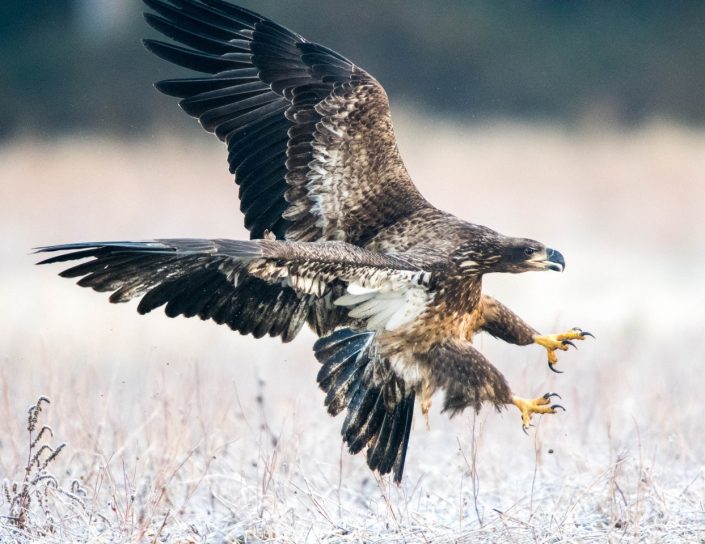
Bald eagle in flight. photo by Northside Jim
This breeding season, the Mercer County Park Commission is pleased to announce that two pairs of bald eagles have chosen County Parks for nest sites, continuing their expansion in New Jersey and the greater mid-Atlantic region. To celebrate the resident eagles, the Park Commission, Conserve Wildlife Foundation of New Jersey (CWF), PSE&G and the Wildlife Center Friends have launched a partnership to provide bald eagle-themed programs.
The first free public event will be at Mercer County Park at the West Picnic Area on Friday, Feb. 8 from 1 to 3 p.m. Participants will meet with naturalist staff and walk to the viewing site, where interpretation on eagle nesting will be offered. Attendees will also have the opportunity to view eagle activity through a spotting scope and binoculars.
On Sunday January 13th, 2019 photographer, Bob Cook was taking photos of the ~20 eagles at a lake in a Mercer County park. He noticed that one of the eagles had a green tag on it’s right leg. After reviewing the photos it was established that the band was D/99.
D/99;1/13/19@ Bob Cook
D/99 is from the Duke Farms nest located in Somerset County. He and his two siblings grew up as a celebrities their every move being watched by viewers of the Duke Farms eagle camera. The three chicks were banded on May 12th, 2014. Measurements showed that there there were two males and one female, D/99 was the youngest male. All three fledged from the nest in June 2014.
chicks at Duke Farms nest 5/12/14. D/99 is in the middle.
Unfortunately, in August of 2014 we received a report that D/98, the oldest male, was found dead up in Maine. He most likely died of injuries that occurred during a fight with another eagle. This most recent sighting of D/99 is the first report of either of the two remaining chicks. D/99 will be five years old in April and reaching the age where he will be looking for a mate and establishing his own territory. It is always nice to know that a chick has survived to adulthood and most likely has come back to NJ to nest.
The Conserve Wildlife Foundation of NJ in partnership with the NJ Division of Fish and Wildlife, Endangered and Nongame Species Program, has released the 2018 NJ Bald Eagle Project Report.
“Two hundred-four nest sites were monitored during the nesting season, of which 185 were documented to be active (with eggs) and 19 were territorial or housekeeping pairs. Thirty new eagle pairs were found this season, 20 in the south, nine in central and one in the north. One hundred-twenty-one nests (66%) of the 182 known-outcome nests produced 172 young, for a productivity rate of 0.94 young per active/known-outcome nest. The failure rate was well above average with 61 nests (33%) failing to produce. The Delaware Bay region remained the state’s eagle stronghold, with roughly half of nests located in Cumberland and Salem counties and the bayside of Cape May County.”
The number of active nests has increased while the number of young eagles fledged has decreased since a high of 216 young fledged in 2016. During the 2018 eagle nesting season there was an abundance of cold, wet, windy and snowy weather which was the cause for a portion of the nest failures. As the eagle population increases, there are more eagles competing for territories. This can also be a contributing factor in nest failures. NJ is still in the range of 0.9 to 1.1 young per nest which is needed for population maintenance with a productivity rate of 0.94 young per known-outcome/active nest in 2018. The 2018 NJ Eagle Project Report has all the details on the project including telemetry, re-sightings and recoveries.
The success of the eagle project is due to the tremendous dedication of the NJ Eagle Project Volunteers. They monitor the nests in all types of conditions and education people about the eagles with enthusiasm.