Keep Your Distance

Respect Signage to Protect Bald Eagle Nests

by Margaret O’Gorman, Executive Director

The recovery of New Jersey’s bald eagle population is a great success story for the state and for the many biologists, conservationists and volunteers involved in the effort.  This recovery has been over 20 years in the making with over 100 pairs now breeding in New Jersey, a huge increase from the late eighties when one pair remained in our state.

Bald Eagle pair © George Cevera

While we celebrate the success of our eagle population, we must now begin to deal with the fact that eagle nests are increasingly located in places where more people can view them and get close to these magnificent birds and who wouldn’t want to observe these iconic species?

But close observation can be dangerous to these birds and damaging to the continued recovery of the population.  Bald eagles do not react well when people or pets get too close to their nests.  They can be easily disturbed by humans in close proximity and this disturbance can cause them to expend valuable energy when flushed or, at the extreme, to abandon their nests leaving eggs to fail or newly hatched chicks to die. Continue reading “Keep Your Distance”

Surveying for Eagles in New Jersey

Results of the Midwinter Bald Eagle Count

by Larissa Smith, Biologist/Volunteer manager

Bald Eagle pair © George Cevera

In January 43 states participated in the Midwinter Bald Eagle Count including New Jersey which has participated since 1979. This year in NJ ~70 volunteers surveyed for eagles the weekend of January 14th & 15th.   The purpose of the survey is to monitor bald eagle populations. Since the survey takes place at the start of the NJ eagle nesting season possible new pairs and nests are often found.  New Jersey volunteers also map eagle activity and these data are used to delineate critical eagle wintering habitat.

PRELIMINARY RESULTS
  • 273 eagles in Southern NJ
  •   44 eagles in Northern NJ
  • 317 eagles total

This is a great time of year to get out and see some eagles.  Not only are the resident nesting eagle pairs around but also wintering eagles.

For more details on the National Midwinter Bald Eagle count go to: http://ocid.nacse.org/nbii/eagles/history.php

Thank you to all the volunteers who surveyed!


Nesting Bald Eagles

PLEASE DO not DISTURB
Photo taken with a high powered camera lens from a safe distance © Jeffrey White

by Larissa Smith; biologist/volunteer manager

Bald eagles are beautiful birds so it only makes sense that people want to get a closer look at them.  But often people don’t realize that by innocently stopping to look at an eagle nest they are putting the eggs or young in jeopardy.  As the New Jersey eagle population increases eagles are starting to nest in closer proximity to humans and human activity.  Any activity that causes the eagles to change their normal behavior is “disturbance.”  People walking too close to the nest to get a closer look or take photos will cause the birds to get off the eggs or leave the young unattended.  This leaves the eggs or young exposed to the elements and predators.  The safe distance for viewing is at least 1,000’ from the nest site.  If the birds are looking at you then you are too close.

The best way to see what goes on at an eagle’s nest without the chance of disturbing the birds is to watch them online.  The Duke Farms eagle nest site has had a camera streaming the picture since 2008.  This provides an up close and personal view that you cannot see from the ground.  The Duke Farms eagle cam should be streaming live in the next few weeks.  To view the eagle cam go to www.conservewildlifenj.org

If you have any questions about eagles or their nests or would like to report a nesting pair, please contact Larissa Smith.


Tracking two New Jersey eagles

WHERE DO THE CHICKS GO WHEN THEY LEAVE THE NEST?

by Larissa Smith, Biologist/Volunteer Manager

“Where do the chicks go when they leave the nest?” is a question that I get asked pretty often.  The Conserve Wildlife Foundation of NJ , Merrill Creek Reservoir, and the Endangered and Nongame Species Program collaborated on a new project that will help to answer this question. On June 13, 2011, biologists visited the Merrill Creek Reservoir eagle nest located in Warren County. The chicks, one male and one female, were each fitted with a transmitter attached by a harness made of Teflon ribbon. The solar-powered transmitters, monitored via satellites, allow the birds to be tracked for up to three years as they move away from the nest, migrate south, and move around the region before they begin to establish their own territories.  Following the birds movements will  help us to identify what type of habitat they are using during their first years.

Merrill Creek Reservoir chick with satellite transmitter
Merrill Creek Reservoir chick with satellite transmitter. © ENSP/Mick Valent

The eaglets fledged around July 11th and both stayed in the area of the reservoir into mid- September.  On September 14th the female eagle headed East to Long Island, NY.  She spent time on the eastern most tip of the Island and started heading back to Merrill Creek Reservoir on September 28th.  On October 17,  the female was found on the ground at the reservoir in a lethargic condition. She was taken to the Raptor Trust in Morris county, but she died the following day.  She tested positive for West Nile Virus.

The male eagle headed the opposite direction into PA and on September 19th was just west of the Susquehanna River near Harrisburg, PA.  He headed back east and spent time in Bucks county PA before heading back to NJ.  As of November 15th the male was in Warren County near the Musconetcong River.  To see the maps of both of the eagles movements go to: http://www.merrillcreek.com/eagletracking.html


NJ Bald Eagle numbers soar in 2011

thanks to the dedicated NJ Bald Eagle Project Volunteers

by Larissa Smith, Biologist/Volunteer Manager

Adult Bald Eagle at East Lake © John fox

2011 was a great year for bald eagles in NJ.  This season a record high of 118 chicks fledged from nests throughout New Jersey.  A total of 111 eagle pairs were monitored of these 95 were active which means that they laid eggs.  Seventy-one of these were successful in producing the 118 fledges.  This is especially good news after 2010’s less than stellar nesting season where only 69 young chicks fledged.

The success of the NJ Bald Eagle Project is directly due to the dedicated volunteers.  Every eagle nest that can be viewed is monitored by a volunteer/s.  Volunteers report on important dates such as incubation, hatching and fledging.  They also help to protect the nest by reporting disturbance and educating the public about eagles.  We can’t thank our eagle project volunteers enough for all the time and energy which they put into this project.

More details on the the 2011 nesting season will be  available later this year in the 2011 NJ Bald Eagle Project report.

One Lucky Eaglet!

Eagle banding team rebuilds eagle nest

by Larissa Smith, Biologist & Volunteer Manager

Bald eagle chick in the nest that was repaired.

On Friday May 13th the eagle banding team met to visit two eagle nests in Cumberland County. The first nest visit went smoothly, two healthy chicks were banded, blood samples and measurements were taken.  The second nest was located on an island out in the salt marsh. As we approached the island we could see that the nest looked somewhat small and it looked like some nesting material had fallen out of the tree.  As we got closer to the nest tree both of the adult eagles appeared and were making their alarm calls (which is normal) when we go out to band an active nest. As Mick Valent, Principal Zoologist with the Endangered and Nongame Species Program, prepared to climb the tree we started to look for prey items which we collect at each nest. One of the eagle project volunteers made a sad discovery, the remains of a 4-5 week old eagle chick. We then knew that something had happened to the nest.  As Mick got closer to the nest he told us that there wasn’t a nest and it must have fallen.  But the adults behavior indicated that there was still a live chick. We thought perhaps that the second chick was still alive on the ground, so we started to search.  Mick made his way up to the nest remains and we heard him yell, “there is a chick”.  It was decided that the chick would be brought to the ground  banded and examined. The nest would then be rebuild so that the chick could be put back up into the nest.

Erica Miller a veterinarian from Tri-State Bird Rescue and Research examined the bird. It had a full crop which means that it was being fed.  The only indication of its trial was a sore on the bottom of its foot pad from holding on tight to the remaining nest.

Meanwhile Mick began constructing a new nest base with large branches that were sent up using rope.  Jeremy Webber with the NJ Forest Service is training to climb nest trees and was able to assist in the nest building. Once a base platform was constructed the remaining nesting material was put up on the platform and then tied down so that it wouldn’t slide off the platform. Softer material was sent up in a bag for the final touches.  The chick was then sent back up and placed in his new home.

We estimate that the nest had fallen in the past two weeks.  The chick wouldn’t have been able to hang on much longer especially with any high winds or rain storms.   The nest volunteers went out the next day and reported that the chick was fine and the adults were at the nest.  It may have been Friday the 13th but it was this chicks lucky day!

Two Eaglets Have Hatched!

A close up view of the Duke Farms Eagle Nest.

by Larissa Smith, Biologist/Volunteer Manager

If you haven’t yet seen the Duke Farms Eagle Cam please check it out.  It’s a great opportunity to

Adults feed their young at the Duke Farms eagle nest on 4/12/11 @ 7am.

see what goes on at an eagles nest and it can be addicting!  The Duke Farms eagle pair has been nesting on Duke Farms property since 2005 and have raised and fledged eleven chicks. Both the adults in the pair are NJ banded birds which we know by their green leg bands.

This season there are  two chicks.  The first chick hatched on April 7th and the second hatched on April 9th.  The adults will brood the chicks to keep them warm so right now a great time to see the chicks is during feeding sessions.  Both chicks are getting plenty of food!

It’s hard to believe that these tiny chicks will be full grown and flying in about twelve weeks!  To  read  updates on the chicks and their development go to:


All About Eagles…

Bald Eagle Project meeting and Cumberland County Eagle Festival

by Larissa Smith, Biologist & Volunteer Manager

CWF volunteer Kevin Buynie with a birdhouse he made © L. Smith
Volunteer Maureen Barrett shows off the new eagle project t-shirt © L. Smith

On Saturday February 5th thirty eagle project volunteers met to discuss the 2011 eagle season.  The meeting took place during the Cumberland County Eagle Festival which is held the first Saturday in February.  It was a rainy day but that didn’t keep the volunteers away.

During the festival there were talks, walks, vendors and educational displays.  Eagle Project volunteer Kevin Buynie made and donated two eagle shaped bird houses to CWF.  We raffled one off at the festival and it was a big hit!

People stopped by the CWF table and reported eagle sightings and a few possible new eagle nests. It is always nice to see how interested people are in eagles, raptors and wildlife in general.

Thank you to everyone who came out to visit us and support our work to monitor and conserve eagles in New Jersey!

Volunteers Survey NJ’s Eagle Population

Midwinter Eagle Survey

by Larissa Smith, Biologist and Volunteer Manager

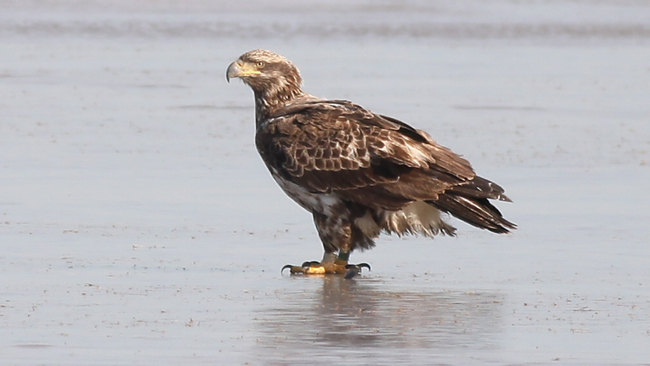
An immature eagle at Forsythe NWR in Oceanville. © Eric C. Reuter

The New Jersey midwinter eagle survey takes place each January and is part of the National midwinter eagle survey to monitor population levels.  Another benefit of the midwinter eagle survey is that new eagle nests and nesting pairs are often located.  The target dates for the 2011  survey was January 8th and 9th.  Approximately 75 volunteers participated throughout the state. This year the snowy winter weather on Saturday did  effect  the count due to the heavy snow fall at times and low visibility.  Sunday was clear and sunny which allowed volunteers to get out and survey.

Preliminary results:
  • 194 eagles – southern NJ
  • 24 eagles – northern NJ reservoirs
  • 17 eagles – Delaware Water Gap
  • A total of 235 eagles were observed this year.

This total is lower than 2010s count of 333 eagles which is in large part due to the weather. Full results will be released soon.

Thank you to all the volunteers who braved the snow, cold and windy weather!

New Jersey’s Rare Wildlife

A year in review: Weather and Disease Impact Populations
It was generally a good season for peregrine falcons, except for no successful nesting at the cliff habitats. © Kathy Clark

Biologists with the Conserve Wildlife Foundation of New Jersey help monitor and manage many endangered and threatened species in New Jersey. We work very closely with the Endangered and Nongame Species Program in the NJ Division of Fish and Wildlife. Each year we summarize the results of many surveys and monitoring programs to show the most current information about the status of New Jersey’s wildlife. Whether good or bad news, we like to share this information with the public to make them aware of the conservation needs and successes.

Weather had a huge impact on wildlife this past year. The cold winter lead to a higher than normal loss of young bald eagles while the hot dry summer was favorable to those species impacted by coastal floods, the piping plover, least tern and black skimmer. The hot dry climate also helped ospreys produce a record high number of young. However, disease still impacts our state’s bats and disturbance by people or predators plays a role in fledging success. Check out the full report for detailed information for over 15 species listed as endangered or threatened in New Jersey.