Native grass and wildflower seeds are loaded into a no-till planter. Photo: M. Hall
By MacKenzie Hall, Private Lands Biologist
New Jersey isn’t a corn belt state and probably isn’t what you picture when you think “prairie.” Fair enough. But New Jersey is an incredible medley of ecosystems, and for the past five years we’ve been working to make sure that native grasslands remain in the mix.
Switchgrass, big bluestem, and other native warm-season grasses provide excellent habitat for ground-nesting birds like the threatened bobolink and grasshopper sparrow (which is why we like them). But they have many other uses, too, such as livestock forage, mulch, and even bio-energy (which is why farmers like them).
Pat Hilton plants a prairie mix for wildlife and agriculture. Photo: M. Hall
More and more NJ farms are incorporating warm-season grasses and bird-friendly practices. Pat Hilton just converted eighteen acres of her Readington Township farm to native grasses and is delaying the hay harvest on another thirty acres. This will allow ground-nesting birds to fledge their young before the grass is cut.
Pat’s rolling farm – call it “midwest-reminiscent” – is highly suitable for grassland wildlife and has already attracted eastern meadowlarks, kestrels, grasshopper sparrows, and northern harriers.
After another busy restoration season, we’re delighted to watch as the summer sun brings these grassland ecosystems to life.
Are you a farmer or farm owner? Check out the NJ Landowner Incentive Program for a grassland grant. Applications are due July 15, 2010!
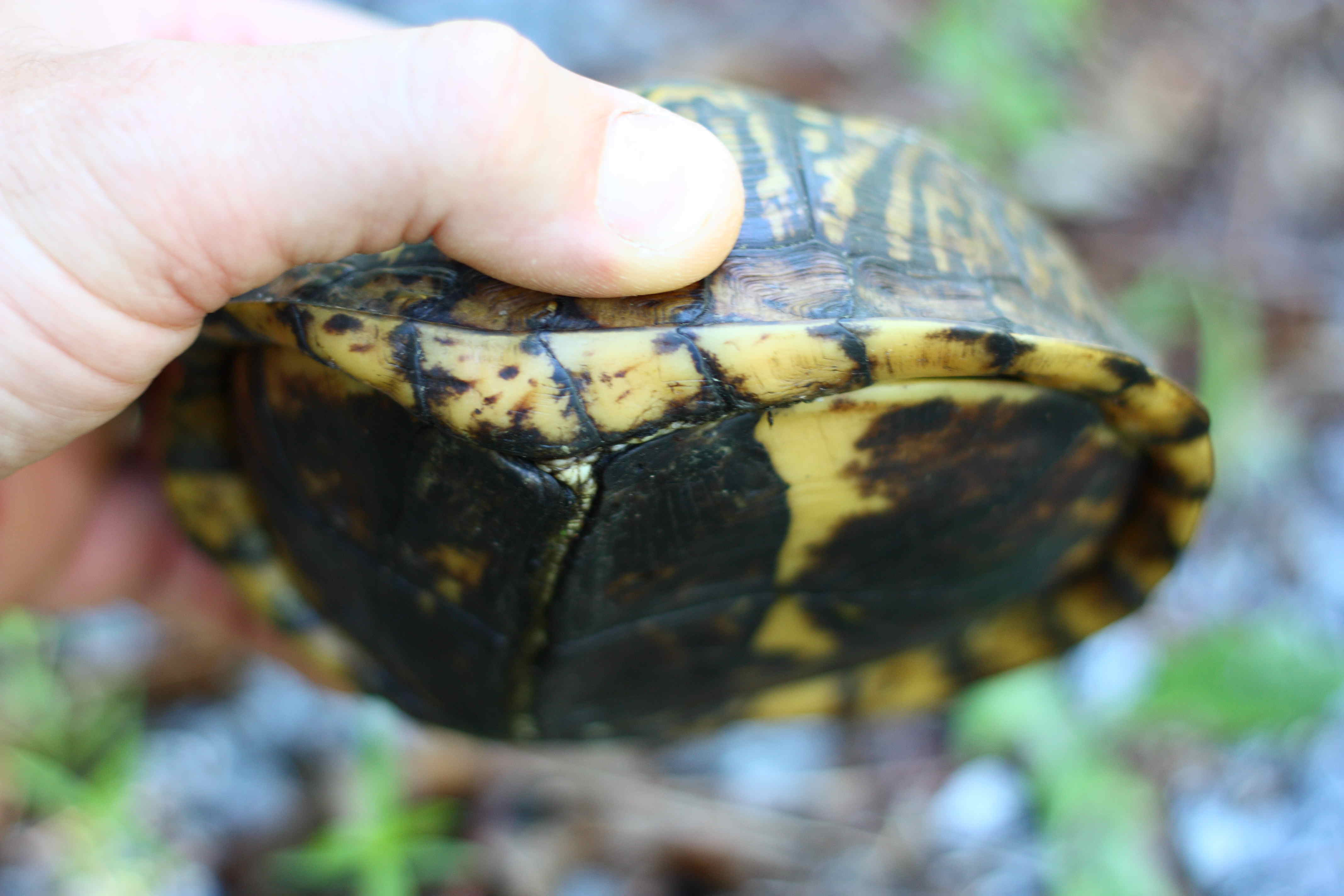
Highly domed carapace (upper shell) and a hinged plastron (lower shell). Most terrestrial turtle found in New Jersey.
Identification
Box turtles range in length from only 4″ up to 8.5″. The shell of the box turtle is unique. It’s carapace is high and shaped like a dome. It’s keel, or the ridge along the backbone is weak or very flat. The plastron is hinged and can close very tightly, in front and in rear. This is meant to protect the turtle from predators, especially the neighborhood dog.
Sexes are slightly similar in appearance. Both have yellow, orange, olive, or tan on their carapace and plastron that is contrasted by a light or dark black background. Individuals can appear very different in coloration. The male (pictured above) is very vibrantly colored. Younger turtles are more vibrantly colored than older ones. Males have a longer and wider tail than females. Their carapace is often more flattened than females. Males have a more vibrantly colored (orange or red) eyes. The plastron of males is slightly concave. Females have lighter colored (light brown to light orange) eyes and their plastron is flat. Their carapace is often more domed in shape.
Distribution and habitat
The Eastern or Common box turtle occurs in the eastern United States from central Maine south to southern Georgia and Alabama, west to central Michigan and southern Wisconsin and then south into parts of Illinois, all of Kentucky, Tennessee, and then parts of Mississippi. It can be found in all of the 21 counties in New Jersey.
Range of the Eastern box turtle. Image courtesy Davidson College Herpetology Lab.
Box turtles inhabit open woodlands and meadows. They are often seen in neighborhood backyards in rural and suburban areas. They are usually not far from streams or ponds, however, during rainy weather they may roam farther from water. They are the most terrestrial turtle found in New Jersey. They like water, but are not adapted for swimming in water.
Studies have shown that box turtles have very small home ranges. Researchers found that their territories are around 250 square yards or less. If box turtles are removed from their territories and placed in an unfamiliar area, then they may die while trying to find their way back home. It is very important to not take a box turtle from its habitat and relocate it. If you find an injured one and do transport it to a state certified rehabilitator; record the animals location and make sure to inform the rehabilitator so it can be re-released where it was found.
Diet
Box turtles are omnivores. Changes in food preference occur during different seasons and life stages. Young turtles eat more insects, while adults eat more plant matter. Young turtles eat earthworms, snails, insect larvae, and some vegetative matter. Adults eat large quantities of fungi and particularly like berries and fruits from trees and shrubs.
Life Cycle
Box turtles, like other reptiles are cold-blooded and in the northern parts of their range hibernate from late October or November until April. During hibernation they burrow into loose soil, vegetative debris, and/or loose sand, and sometimes in the mud of stream bottoms. They dig burrows with their front legs, instead of their back legs (which are used to dig holes for laying eggs). Some hibernate at depths up to two feet deep. They can arise during warm spells.
Individuals become reproductive at 4 to 5 years in age. They can live to be older than 20 years in age. Mating begins shortly after individuals emerge from hibernation. During courtship, males chase or follow females to mate. Males often bite the edges of the females carapace, head, and neck. The male mounts the female (males have the concave plastron that helps during copulation) and hooks his back legs under the back edge of the females shell. During copulation the males body becomes upright and reproduction occurs. There has been evidence that females can remain fertile for two or three years after mating.
Eggs are laid in June and July. Nesting usually occurs in the late afternoon. Females deposit eggs in a hole that she digs in loose or sandy soil and sometimes in lawns. The cavity is around 3 inches deep, or about as long as the back legs of the adult female turtle. They lay between 2 to 7 eggs. Most hatching occurs in September or average incubation is around 87 to 89 days. Young either remain in the nest after hatching, emerge and go directly into hibernation, or emerge and explore for a few days to weeks, then hibernate. They do not require food during their first summer or fall before going into hibernation.
Current Status, Threats, and Conservation
Box turtles are fairly common throughout their range; however, they’re population is declining in New Jersey. Habitat destruction and fragmentation isolate individuals from finding mates and food. This causes local populations to decline in numbers or become extirpated from an area. Their slow reproductive rate does not allow for a fast recovery if a local population losses several individuals in a given amount of time.
Be aware for box turtles while driving!
Another threat to box turtles is the illegal collection for use as pets. They are highly sought for their use in the illegal pet trade (one of the world’s most profitable markets). Many people collect box turtles to breed in captivity for use as pets. Another conservation concern is the impact of high mortality rates from impacts with motor vehicles. Many roads transect suitable habitat for box turtles and many turtles that enter roadways die each year.
These threats have exacerbated their decline and the fact that the NJ Division of Fish and Wildlife, Endangered and Nongame Species Program have listed them as a Species of Special Concern. This listing will mostly importantly help garner protection through enhanced habitat protection of suitable or critical habitat for box turtles.
How to help
The Endangered and Nongame Species Program would like for individuals to report their sightings of box turtles. Record the date, time, location, and condition of the animal and submit the information by submitting a Sighting Report Form. The information will be entered into the state’s natural heritage program, commonly referred to as Biotics. Biologists map the sighting and the resulting maps “allow state, county, municipal, and private agencies to identify important wildlife habitats and protect them in a variety of ways. This information is used to regulate land-use within the state and assists in preserving endangered and threatened species habitat remaining in New Jersey.”
Schwartz, Vicki and Dave Golden. 2002. Field Guide to Reptiles and Amphibians of New Jersey. NJ Division of Fish and Wildlife. Available in our online store!
Back on May 20th, we had our first Piping Plover nest hatch at Stone Harbor Point. Three out of the four eggs hatched, and since hatching only one chick was lost. On June 12th, I was delighted to witness the two chicks flying! When a chick survives to the point where it can fly, we call it a fledge or fledgling; usually about 25 days after hatching for piping plovers. I observed the pair of chicks flying even before their estimated fledge date; they grew up fast!
Watching the chicks over the last month has been fascinating. Within a day of hatching they are out of the nest feeding, not straying far from their parents. They grew quickly in the last month, now they’re just a bit smaller than the parents. The most discernable difference between the parent and the chicks now is the color of the beak; the chick’s beak is black while the parent’s is still yellow.
It is great news when a chick fledges; it has a much better chance of survival. As of right now there are three more chicks from another pair at Stone Harbor Point. Hopefully these chicks are just as successful. Sure makes all the hard work that goes into protecting them seem more worthwhile!
Visitors to Reeds Beach discuss the shorebird season with Shorebird Steward Jim May.
One part of my job that is quite enjoyable is getting to spend time on the Delaware Bay beaches in the spring and working with the Shorebird Stewards. As the CWF volunteer manager I organize the Shorebird Steward program which is part of the International Shorebird Project. During the two week period that stewards are on the beaches I try to get out and check on the beaches and meet with the stewards as much as possible. This season there were 26 stewards and 23 of those had worked as stewards during a previous season.
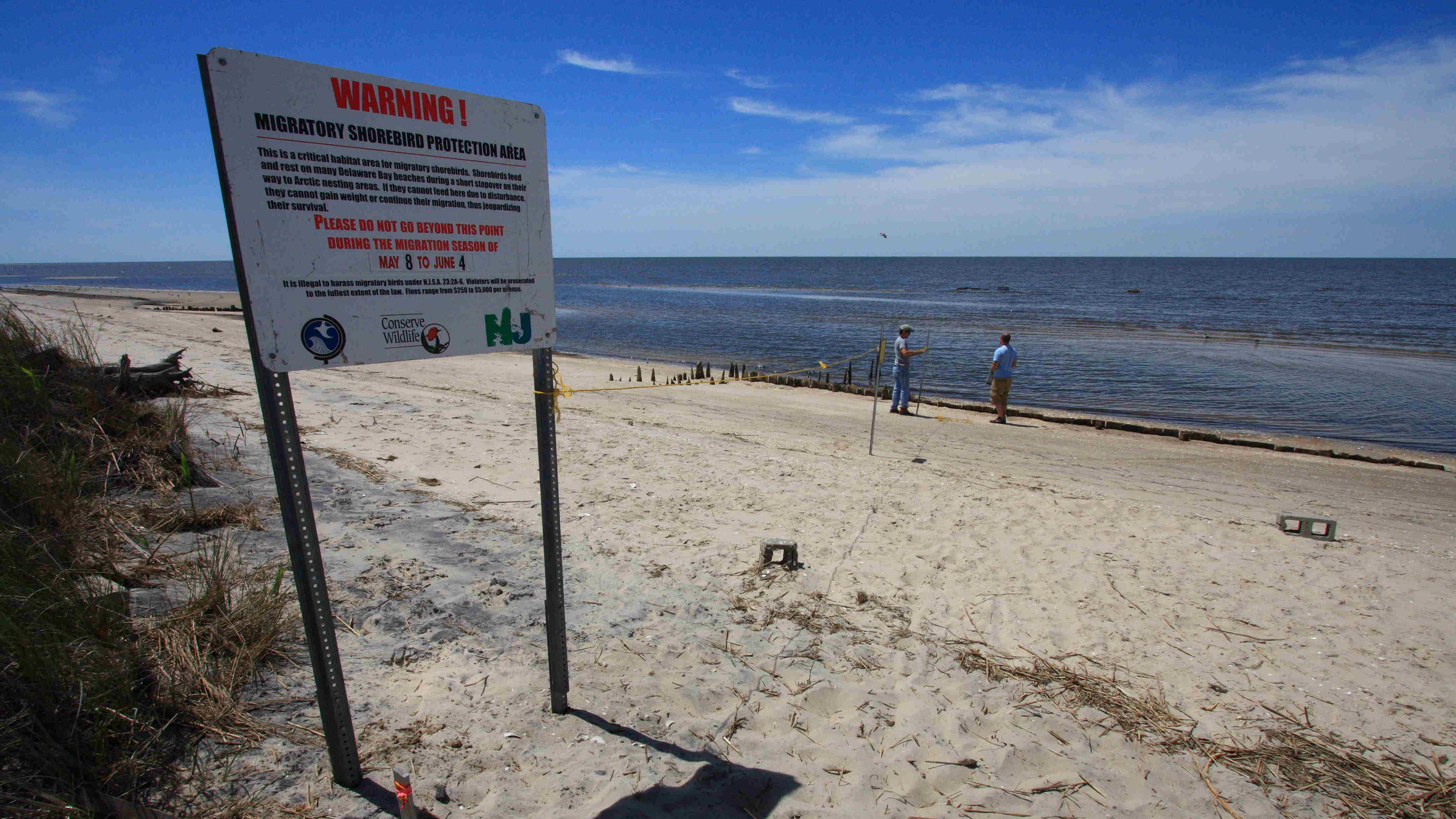
The main part of the steward’s job is to educate people about the shorebirds and horseshoe crabs, but they do a lot more than that in a day. Stewards also keep people from going into the closed areas of the beaches so that the shorebirds can feed undisturbed. They give directions and send people to the beaches where the most birds have been sighted that day.
Shorebird Steward Rochelle Gimmillaro points out shorebirds to visitors to Cook’s beach.
If they have time they also count the number of shorebirds on the beaches and if possible record any banded birds that they see. Stewards deal with all types of people and situations. Some beaches are much busier than others, such as Reed’s beach where there is a viewing platform. On many days there is a constant stream of people coming to the view the shorebirds and horseshoe crabs.
This season there were very few problems on the beaches and it is directly due to the shorebird stewards hard work and dedication to the project.
I look forward to getting back on the beaches next shorebird season and working with such a great group of volunteers.
The subject of peregrine falcons have hijacked this blog! On Friday, I visited a nest at Forsythe NWR to medicate the young for prevention of trichomonas, an avian disease carried by pigeons and doves. Adult peregrines can transfer it to their young and if not treated can kill them. Kim Steininger, a renowned and award-winning bird photographer joined me and got some amazing photos! While I was up on the nesting tower, Kim was stationed behind her camera, which was wielding a powerful lens to capture these amazing photos of the adult peregrines in flight while I checked on the nestlings.
This was my third visit to this particular nest. I can attest to the strong parental bond of this female to her young. During my first visit (5/21) she hit me while I was attempting to look for a parasitic fly that has caused hatchlings to die in previous years. The young were about 2-3 days old and were very vulnerable, so the aggressive nature is understood.
Peregrines and other birds of prey, like eagles, owls, ospreys, and hawks see humans as predators. This is because they don’t have any other predators in the wild. This is also why disturbance is a major issue during the nesting season. When an adult leaves the nest; its young are unprotected. They are susceptible to predators like gulls and crows. Never approach a nest and only view from established viewing locations!
On the second visit (5/24) the female landed on the nesting tower, not more than 5 feet away from me! In the nest 2 weeks the young will be banded with federal USGS bird bands and state bi-color bands for future identification.
In early June, I assisted Kathy Clark, a zoologist with the Endangered and Nongame Species Program to help collect and transfer peregrine falcon nestlings. The nestlings are being collected to help the recovery of peregrines in New River Gorge National River, West Virginia. The goal of the project is to help promote the recovery of peregrine falcons throughout the Appalachian Mountain range.
The project began in 2006. One fledgling that was found on the ground near the Walt Whitman Bridge New Jersey was contributed to the project. Since then, New Jersey has sent over 30 peregrine nestlings to the recovery project. The falcons are raised at a mountain hack site near Beckley, West Virginia inside New River Gorge.
Peregrine falcons are listed as endangered in New Jersey. However, over the past few years the population has done very well. Around 20 pairs occur in the state. In West Virginia, they are very rare. Only one nesting pair was found in 2009.
On Wednesday, nine peregrine nestlings were collected at different locations throughout New Jersey. Coordination of these collections can be dangerous. It also requires a lot a planning and preparation. We have to climb on bridges, ledges, and tall towers and carefully collect the young. ENSP and CWF biologists collected falcons from the Walt Whitman & Burlington-Bristol Bridge, The Hilton in AC, and several old hacking/nesting towers along the Atlantic coast.
Juvenile peregrines in a hacking tower box. Photo courtesy NPS.
The young were transported to Tri-State Bird Rescue in Delaware. From there they were driven by volunteers to West Virginia where they will be placed in the hacking tower.
“Hacking is the process of placing young falcons in a structure and caring for the birds in a manner that minimizes human exposure until they are mature enough to fly,” explained Matt Varner, NPS wildlife biologist. “The artificial aerie or hack box simulates nesting and feeding conditions on steep rock cliffs – prey is dropped into the box through a tube so the birds don’t see or associate people with the food. This cage-like structure protects the birds from predators during the pre-flight period while allowing them to acclimate to and imprint on the Gorge. When they are ready to ‘fledge’ (fly), they are released from the box, but will return for occasional feedings until their hunting skills allow them to survive on their own.” (http://www.nps.gov/neri/naturescience/peregrine.htm)
Ever since I was young I knew I wanted to work with nature and wildlife. As I grew up I learned many species were in trouble and needed our help. Imagine my excitement when I got a job working for the Conserve Wildlife Foundation of New Jersey. I was hired to monitor Hereford Inlet, between Stone Harbor and North Wildwood in Cape May County, for the migratory and breeding bird season.
My first day on the job was the day after my last college final (I just graduated from the Richard Stockton College of New Jersey). After I met the people I would be working with for the next few months we were off to set up a predator exclosure, which is a special wire cage that protects piping plover nests from its many predators. This is when I first got to observe a piping plover up close. To put up a predator exclosure, we needed to temporarily cover the nest while we set up the cage. The piping plover spent this time trying to draw us away from its nest; their defensive behavior is fascinating. The first thing you notice is the ‘peep’, their call to distract you from the nest. When you get closer to the nest, the piping p[lover starts exhibiting a behavior called ‘broken wing’. The goal is to look injured to further distract a predator from their nest. Ironically, looking for this behavior is one of the ways we use to find the nests. After working this job for a few weeks, I have had the exciting experience of finding quite a few nests (including finding American oystercatcher nests).
Before the end of my first day I also got to see Stone Harbor Point, the location that I would be focusing on this summer. This area is different every year, and this year it is quite large. After enough exploring and assembling an accurate map I eventually learned the area well. One area of concern I have for the future of the beach nesting birds at the “Point” is its history of flooding. Hopefully the weather and tides will cooperate this summer. This job has been an amazing experience so far; and when the eggs start hatching, I can only imagine things getting more exciting.
POSTSCRIPT: Just after I submitted this blog, the first piping plover nest hatched at the Point. Now I have the challenge of keeping tracking of three highly mobile chicks. On the downside, quite a few nests were lost to flood tides already. Looks like my job as a “beachnester” will have its share of ups and downs.
The Delaware Bay beaches are a busy place right now and not with sunbathers and beach goers, but with horseshoe crabs and birds! The horseshoe crabs are coming up onto the beaches to spawn and the shorebirds are arriving to feed on their eggs. It’s a great time to take a trip to the beaches to watch all the activity. The Delaware Bay is the Western Hemisphere’s second-largest spring concentration of shorebirds. The shorebirds arriving on the beaches include red knots, sanderlings, ruddy trunstones and semipalmated sandpipers. People come from all over the world to view this natural phenomenon taking place right here in NJ.
Beach access is restricted on critical beaches from May 8th through June 4th to allow the shorebirds to feed undisturbed. But there are still plenty of viewing areas. In Cape May County Reed’s Beach has a viewing platform that has a great view down the entire beach. Cook’s, Kimbells, Norburys and the Villas beaches all provide areas for viewing the shorebirds. In Cumberland County, Fortescue is another wonderful viewing spot. Please use the designated viewing areas and bring binoculars or a telescope so you can get a good look at the birds.
While you are out visiting the beaches you might run into one of CWF’s shorebird stewards. These dedicated volunteers are located at the closed beaches educating the public about the shorebirds. CWF had a new brochure printed this year, Spotting Shorebirds, Along the Delaware Bay, be sure to ask the steward for a copy of this so you can practice your shorebird ID. The stewards can also let you know on which beaches shorebirds have recently been spotted.
It really is worth the trip to see this spring migration, you won’t be disappointed. To find out the best beaches to view migratory shorebirds, check out our exclusive Wildlife Viewing Map.
Last week Senators Kerry and Lieberman released a draft of their new Senate energy bill called “The American Power Act.” At the heart of this bill is an effort to develop new American energy, create American jobs and protect American communities. These are all laudable goals made even more laudable when placed against the job loss and community damage occurring in the Gulf right as a result of our continued reliance on old energy.
“The American Power Act” is a serious effort to address global climate change and thanks to the hard work of a national coalition called “Teaming with Wildlife,” of which Conserve Wildlife Foundation is a member, it contains language that not only promotes better energy policies but also the need to help our natural resources during these times of changing climate.
The bill, like its predecessor passed by the House of Representatives, seeks to set aside funding to protect and restore species, habitats and ecosystems threatened by the impact of climate change. It also proposes programs focused on water systems, floods, wildland fires and coasts.
“Climate change is impacting our wildlife populations now and will impact our populations in greater ways as the changes in climate become more pronounced.”
These inclusions are very important because they recognize the impact of a changing climate on our natural resources – the lands, plants and animals that add value to our lives, both economic and intrinsic.
The inclusion of this language happened because of the strong coalition of groups and individuals dedicated to wildlife and natural resource protection in this country but the timing of the funding leaves a lot to be desired. In the Kerry Lieberman bill, allocations (funding) for Safeguarding Natural Resources/Community Protection, doesn’t start until 2019. Allocations start at 0.75% in 2019, increasing to 3% by 2030. It is unclear how this translates in to actual dollars, but most importantly there is no funding for nearly a decade. This is unacceptable.
The other worrying part of this draft bill is whether the funding to establish programs to address impacts to natural resources is dedicated or not. This is unclear in the bill’s current wording and is also unacceptable.
Climate change is impacting our wildlife populations now and, under the most conservative scenarios, will impact our populations in greater ways as the changes in climate become more pronounced. New Jersey species at risk include the shorebirds that are already teetering on the edge of extinction due to the decimation of their stopover food source; beach nesting birds like the piping plover that is already fighting for beach space as sea-level rise continues to threaten its habitat. Other species like the bog turtle and eastern salamander are threatened by loss of habitat from changing seasonal patterns and endangered raptors face losses every breeding season from storm events that used to happen every 100 years and are now much more frequent.
Senators Kerry and Lieberman should be thanked for introducing this important bill but they, and all other Senators, should be encouraged to remove the ten-year delay for wildlife and natural resources and insist that such funding should be dedicated to help our natural systems adapt to a world where a changing climate could spell extinction if steps are not taken to mitigate where possible and allow adaptations where necessary.
If you’ve a minute today, contact your New Jersey Senator and tell him we can’t put off for ten years what needs to be done today.
Credit: The National Wildlife Federation’s analysis of the bill informed this article.
Osprey pairs are very busy this month. Females are hunkered down in nests while incubating their eggs. They must keep their eggs at a temperature of around 99 degrees Fahrenheit. They must maintain this temperature for over 32 days and up to 43 days! Warm air temperature and normal precipitation are crucial during incubation. If there are periods of extended rain and cool temperatures, then the success rate at raising young decreases.
Eggs are incubated immediately after they are laid. This is referred to as asynchrony. This ensures that during times of low prey availability at least one nestling will survive to fledge or leave the nest. Disturbance is critical to incubating females now. If they must leave the nest, then the eggs are very vulnerable to the suns radiation, cool air temperatures, and predators. Females do 70% of the incubation duties.
While females are sitting there, incubating those eggs, males are mostly on the wing or perched near the nest. They provide almost all of the food to the female. They can fly a few miles from the nest, or only a few hundred feet to find prey (live fish). This is why ospreys nest near water, their source of food. The males ability to provide food to the female is also crucial to the success of the pair at raising young.
The young hatch (in the order that they were laid) and are born semi-altricial, or blind, feathered, and completely helpless. They are totally dependent on their parents to keep them warm and to provide them with food. They need very close parental care during the first week of life. After the first week the nestlings begin to more around more and begin exploring the surroundings in their nest. At three weeks of age (pictured at right) the nestlings can easily walk around the nest and often raise their heads to look around. Their contour (body) feathers and flight feathers begin to emerge from their protective sheaths during this time. The coloration of their feathers (dark brown with a buff feather tip) give them remarkable camouflage in the nest. Their coloration is very close to the nesting material ospreys use which consists of sticks, seaweed, marsh grasses, and human garbage like plastic bags, fishing line, and other trash.
I find a lot of ribbon from Mylar balloons every year. Some nestlings become entangled in the ribbon. If I do not get to the nest in time and remove the ribbon, then some may lose a limb or even die. It is not clear why adult ospreys choose to use fishing line and ribbon as nesting material. It may be because it is fairly common (unfortunately) in marine and estuarine ecosystems.
Keep an eye for hatching to begin two weeks from now. Females will not be sitting as much and they will be more aware of those eggs that are hatching beneath them. In late June and early July, volunteers throughout coastal areas will perform surveys by boat to determine the health of the population. I’ll post more updates soon on this in the coming weeks.
In the meantime, if you’d like to help, participate in coastal clean-ups or if you’re out for a walk or hike, bring a small trash bag and pick up some trash!