Atlantic Coast Leopard Frog. Photo by Brian R. Curry.
Amphibians are among the most vulnerable and rapidly declining wildlife groups in the world. Do you want to get out in the field and help frogs here in New Jersey?
Join CWF biologist Allegra Mitchell and be a part of the Kauffeld’s Calling Frogs Citizen Science Monitoring Project.
by Marissa Murdock, 2019 NJ Osprey Project Intern; Rider University ’21
Marissa holds osprey 83/K who was banded after pre-maturely fledging and landing on the ground.
This past summer I was lucky enough to work with Conserve Wildlife Foundation as a volunteer student intern. I worked alongside Ben Wurst, CWF’s Habitat Program Manager, helping with the New Jersey Osprey Project. My internship consisted of assisting with osprey surveys, banding young, and recording data so that we can estimate the health of the population in New Jersey.
January 13, 2019, Mercer County Park. NJ D/99banded at Duke Farms in 2014 @Bob Cook
Conserve Wildlife Foundation of NJ in partnership with the
NJ Division of Fish and Wildlife’s Endangered & Nongame Species Program, is
releasing results of the 2019 NJ Bald Eagle nesting season.
2019 was a record year for NJ eagles with the highest number
of active nests and young fledged in the history of the project. This year, 238 eagle nests were monitored, of
which 189 were active (laid eggs) and 248 young fledged. This is the highest number of fledges ever,
surpassing the previous high of 216 in 2016.
Bald eagle nesting population and young produced in New Jersey, 1982-2019.
We owe the incredible amount of information about NJ eagle success
to the NJ Eagle Project nest watchers. An
extremely dedicated group of approximately 85 volunteers monitor nests during
the season, recording the important dates and watching for possible issues at
nest sites.
This season two eagle cams were available to watch on the CWF website: one at Duke Farms and another at Mercer County Parks. The Duke Farms nest produced two chicks, and one was outfitted with a satellite transmitter; the movements of this eagle are on CWF’s Eagletrax website .
More details on the 2019 nesting season will be available in
the annual eagle report to be posted by December. The report will include individual nest data, state
totals, and eagle recoveries and resightings.
CWF partners with PSEG, the Mercer County Park Commission, Mercer County Wildlife Center, and Wildlife Center Friends and Duke Farms to protect bald eagles in New Jersey. Thank you to the Wakefern Food Corp./ShopRite Markets, Wells Fargo, Chemours and the American Eagle Foundation for additional eagle program funding.
There is a hole in my heart this week after hearing about the passing of my friend Pete Bacinski. I met Pete many years ago when he used to lead NJ Audubon Sussex County weekends jointly with the Weis Ecology Center.
The Conserve Wildlife Foundation of NJ in partnership with the NJ Division of Fish and Wildlife, Endangered and Nongame Species Program, has released the 2018 NJ Bald Eagle Project Report.
“Two hundred-four nest sites were monitored during the nesting season, of which 185 were documented to be active (with eggs) and 19 were territorial or housekeeping pairs. Thirty new eagle pairs were found this season, 20 in the south, nine in central and one in the north. One hundred-twenty-one nests (66%) of the 182 known-outcome nests produced 172 young, for a productivity rate of 0.94 young per active/known-outcome nest. The failure rate was well above average with 61 nests (33%) failing to produce. The Delaware Bay region remained the state’s eagle stronghold, with roughly half of nests located in Cumberland and Salem counties and the bayside of Cape May County.”
The number of active nests has increased while the number of young eagles fledged has decreased since a high of 216 young fledged in 2016. During the 2018 eagle nesting season there was an abundance of cold, wet, windy and snowy weather which was the cause for a portion of the nest failures. As the eagle population increases, there are more eagles competing for territories. This can also be a contributing factor in nest failures. NJ is still in the range of 0.9 to 1.1 young per nest which is needed for population maintenance with a productivity rate of 0.94 young per known-outcome/active nest in 2018. The 2018 NJ Eagle Project Report has all the details on the project including telemetry, re-sightings and recoveries.
The success of the eagle project is due to the tremendous dedication of the NJ Eagle Project Volunteers. They monitor the nests in all types of conditions and education people about the eagles with enthusiasm.
On a brisk November morning, a couple dedicated NJ Osprey Project volunteers joined myself and CWF Biologist Larissa Smith to install an osprey platform on the coastal saltmarsh of New Jersey. The new platform was installed to replace a very old and unstable platform that fell this summer. The new structure is more than twice the size of the old one and will give the nesting pair, who return in the spring, a much more resilient nest site. As you can see from the video above, it takes a bit of strength to raise up a 16′ tall wood nest platform. We decided to slow it down when WCC Volunteer, Wayne R. gives it a final push. Continue reading “Video from the Field: Osprey Platform Install”
On August 20th, 2018 a resident of Monmouth Beach reported a young eagle that had been perching in the neighborhood and was possibly injured. NJ Eagle Project Volunteer Randy Lubischer, was able to respond and check out the situation. The bird was a hatch year eagle, which means it fledged during this nesting season. The eagle was feeding on a swan carcass and though Randy could get fairly close, the bird was able to fly a short distance and appeared to have an injury to its left leg. The eagle had been seen feeding on the swan carcass for the past few days, so it was assumed that its injury was keeping it from hunting and the bird would only get weaker over time.
Volunteer Nicole Dion ready to conduct mobile acoustic survey
Across the country bat populations continue to decline due to the threat of White Nose Syndrome. Last year, to collect important population data to monitor population trends of New Jersey’s bat species, Conserve Wildlife Foundation of New Jersey (CWF), in partnership with Endangered and Nongame Species Program (ENSP), re-launched their Statewide Mobile Acoustic Surveys with new equipment and protocol. With all the kinks of a revamped project worked out, CWF entered their second year of this project. Continue reading “Acoustic Monitoring Drives Efforts to Save Bats”
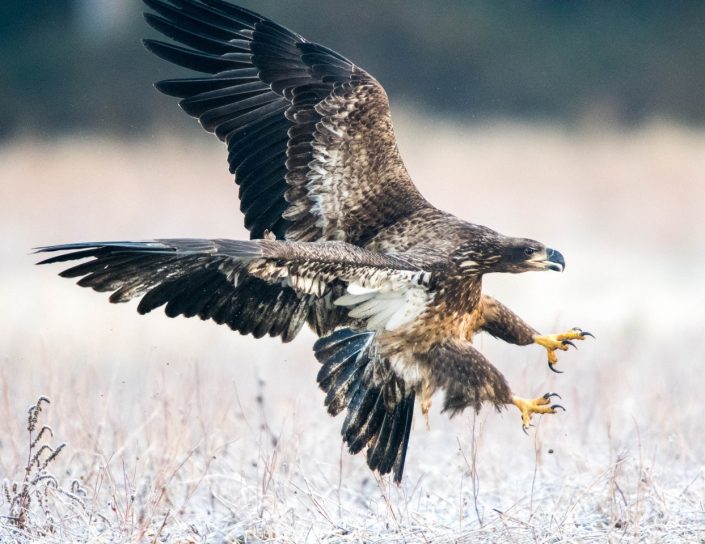
So far this season 123 eagle chicks have fledged (taken their first flight). Even after fledging the chicks will stay around the nest area for the next few weeks learning to hunt, fly and survive on their own.
Below are some photos of recent fledges taken by NJ Eagle Project Volunteers