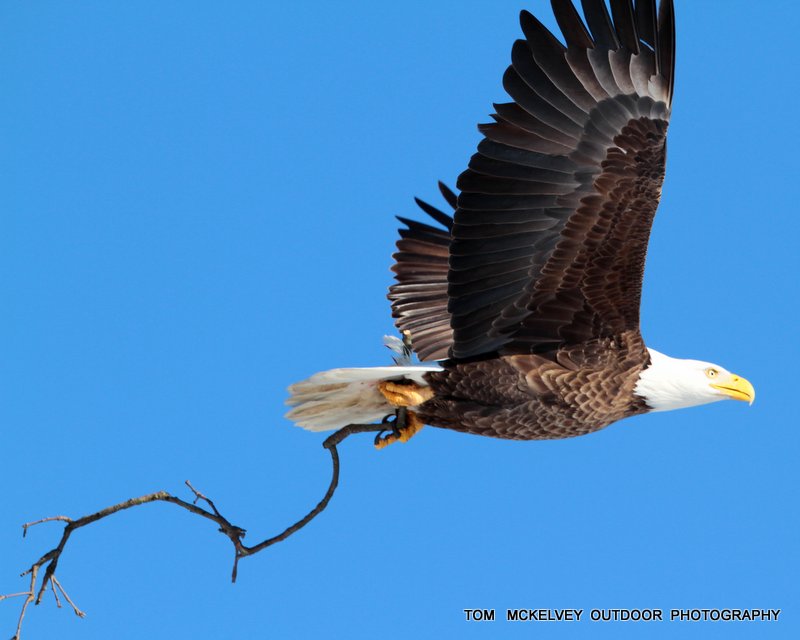
Yesterday, Conserve Wildlife Foundation of NJ and NJ Endangered & Nongame Species Program staff released a rehabilitated bald eagle back into the wilds of NJ. Eagles, as well as other raptors, have made a huge comeback in NJ, down to just a few birds in the 1980’s. Today, CWF, with the help of volunteers, monitors approx. 150 nests.
We took advantage of the break in cold/wet weather along the southeast coast of New Jersey and installed a new nesting platform for ospreys this week. The new platform was installed for a pair that previously nested on sensitive equipment used by the Rutgers University Marine Field Station on Great Bay Blvd. in Little Egg Harbor. The equipment was located on a short cluster of pilings near the boardwalk to the Station. It failed to produce young in 2013. More than likely it was predated by raccoon, the main ground predator of osprey young.
A large number of volunteers showed up to help out. The actual install was quite easy considering it could be accessed by the land via Great Bay Blvd. The platform was placed along a tidal creek so that biologists can easily access the nest for future surveys. Rutgers staff will install deterrents on the old nest so birds can’t nest there when they return in late March. You can see the location of the nest on Osprey Watch or drive out on GBB to see it in person.
Thank you to all the volunteers who came out to help!
Today nine volunteers assisted with the installation of this nesting platform inside Great Bay Blvd. Wildlife Management Area. The platform was built during last year’s Sandy relief effort and was several “extra” platforms that were built using donated materials. It’s being used to replace an existing nest that is too close to disturbance and prone to predation. The new platform is far from disturbance, gives them protection from predators, but is close enough to the road for wildlife photographers and birders to observe them at a safe distance. You can report nesting activity for this new nest platform on Osprey Watch.
by Larissa Smith: Wildlife Biologist/Volunteer Coordinator
Bald Eagle Project Brochures.
The New Jersey Bald Eagle nesting population is on the rise with 148 nesting pairs monitored in 2013 and 177 young fledged.As the eagle nesting population increases so do the incidences of eagles nesting in close proximity to humans and human activity. It’s exciting to have a pair of bald eagles nesting and people often want to get a closer look but this can cause disturbance to the nesting eagles and have detrimental impacts. Over half of NJ’s eagle nests are located on private property which makes it important to advise and educate land owners, land managers about living with eagles.
To address this issue CWF received a grant to produce two informational brochures about co-existing with bald eagles in NJ. One is a general brochure for anyone interested in eagles in NJ and the other is specifically for landowners/land managers with eagle nests located on their property.The brochures contain information on eagle history, living with eagles as you neighbors, how to be a good eagle watcher or steward, as well as phone numbers for information and law enforcement. As the eagle project volunteers monitor their nests they will have these brochures available to educate interested people.
Eight pairs of NJ eagles are currently incubating (sitting on eggs). The earliest pair to start incubating was confirmed on January 12th, so the birds been keeping the eggs warm throughout the snow and cold weather. Eagle Project volunteers report that pairs all over the state are busy working on their nests in preparation for egg laying.
by Larissa Smith, Wildlife biologist/Volunteer Manager
2013 was a good year for the New Jersey bald eagle population. A total of 148 nests were checked during the season and 119 were found to be active (with eggs). A record high of 177 young were produced. Eagle nests can now be found in all but two of New Jersey’s 21 counties.
As we wrap up the 2013 season eagle pair’s are already reported to be working on nests for the 2014 nesting season. I would like to thank all of the dedicated eagle project volunteers as well as all others involved in the eagle project.
Volunteers help to “re-plant” leaning osprey platform
by Ben Wurst, Habitat Program Manager
This past week I was joined by a large group of volunteers to remove and re-plant a leaning osprey tower in Point Pleasant. It all began after Superstorm Sandy barreled through the area a little over a year ago…
This nest, along with many others, were uprooted from where they were originally installed. Many homes in the area were flooded by the storm surge associated with the storm (and many were still rebuilding when we were there). Any and all debris that was created ended up being pushed to the high areas of the marsh and in turn, people’s yards. This platform ended up in a homeowners backyard. Fortunately the platform was not lost and was thankfully re-installed by a bulkheading company who was working on the homeowners house. This was great news for the ospreys! Their nest had been returned to the saltmarsh and was, in turn, used again by them this past summer. They raised one nestling on the platform.
Things a-drift…a strong Nor’easter ended up pushing over the platform, which caused it to lean…significantly. However, the ospreys adapted and added nesting material to make sure their only nestling would not fall out. At the same time we made plans to re-plant the platform in a section of marsh with more soil, so the platform would have a firm foundation and support. A crew of strong and able volunteers met up with me to help fix the problem. They pulled out the platform and then we transported it to the new location. There we dug a new hole (around 2-3′ deep) and they easily dropped the short (around 12′ high) platform into the hole. These volunteers did a great job, and I was happy to see that many of them lived in the local area. It’s great to see locals getting involved in their local environment and I know that they’ll continue to watch over the nest if anything should happen to it in the future. I’m planning on working with the local community association (who owns the land) to install a couple more platforms for ospreys. There’s little suitable nesting habitat for ospreys up on N. Barnegat Bay and in the past we’ve had problems with birds nesting on houses, so this will only help reduce those occurrences.
Not exactly stable…Not much dry land either…Down she goes…All better!
Ashley Hecht, Great Bay Terrapin Project Intern helps band ospreys.
My name is Ashley Hecht and I’m going to be a senior this year at Delaware Valley College. My major is Biology with a concentration in Zoology.
This summer I had the opportunity to work with northern diamondback terrapins. Every year female terrapins come out of the bay to lay their eggs and end up crossing the roads, often getting hit by cars. My job was helping reduce the high mortality rates of terrapins from motor vehicles by safely crossing terrapins across the road. My days consisted of patrolling for terrapins along Great Bay Blvd, in Tuckerton, New Jersey. I came across anywhere from 20-60 terrapins a day. I recorded data on the age, length, width, height, and weight, along with if they were gravid (i.e – a female who is full of eggs) .
I didn’t just work with terrapins; I also had to work with the public, which I found many to be very supportive of the conservation effort. One day I was taking measurements on a female, and a car came up behind me. The next thing I know a whole family ran out grabbed another female walking by and moved her safely across the road. They continued to do it for 3 more hours. I’m pretty sure they crossed more terrapins than I did that day.
Many times I came across dead terrapins. Usually it was when the road had a lot of traffic and a ton of terrapins.That’s what you have to expect. I only came across one injured terrapin. After she got hit, she laid 9 eggs on the side of the road. With the help of a volunteer I was able to safely transport her eggs and put them in a nesting cavity over at the Tuckerton Seaport. It was in hopes that I could save the female, so I drove her down to the Wetlands Institute in a bucket strapped in the front passenger seat of my car. I have to say that was the most interesting 40 minute car ride I ever had. I’m sure I got many looks talking to a yellow bucket, while speeding down the parkway.
You never knew what you are going to see on the road, but what you hoped for was terrapins safely crossing the road. I saw many doing just that this summer and I am glad. I wasn’t very familiar with this species, but now I can tell you a whole lot. I enjoyed every moment of this internship, even the green heads.
I have loved New Jersey’s wildlife my entire life. This is probably because I grew up spending my summers at the Delaware Bay. As a child, I never guessed that helping terrapins across the road, flipping over every horseshoe crab, and watching the many species of birds land on the beach, would lead me to want a career in Wildlife Biology. This was the opportunity I was looking for to help me get experience for my future career goal. Next year I hope to be furthering my education or being in the field.
by Larissa Smith, Wildlife Biologist/Volunteer Coordinator
Shorebird Steward Liz Hermoso shows beach visitors a clump of horseshoe crab eggs on Cook’s beach.
Once again migratory shorebirds, including the NJ endangered red knot, have returned to the Delaware Bay to feed on horseshoe crab eggs. This annual phenomenon brings people from around the world to the Delaware Bay beaches.
Beaches are closed during the migration from May 7th through June 7th to protect the shorebirds from disturbance when feeding. Just as the birds return each year so do volunteer Shorebird Stewards who educate the public about the beach closures , shorebirds and horseshoe crabs on nine beaches in Cape May and Cumberland County. Now is a great to come out to the beaches to view shorebirds and crabs and say “hi” to the stewards.
This year the hot spots for shorebirds in Cape May County are Reed’s , Cook’s and Kimble’s Beaches and Fortescue in Cumberland County.
by MacKenzie Hall, Amphibian Crossing Project Coordinator
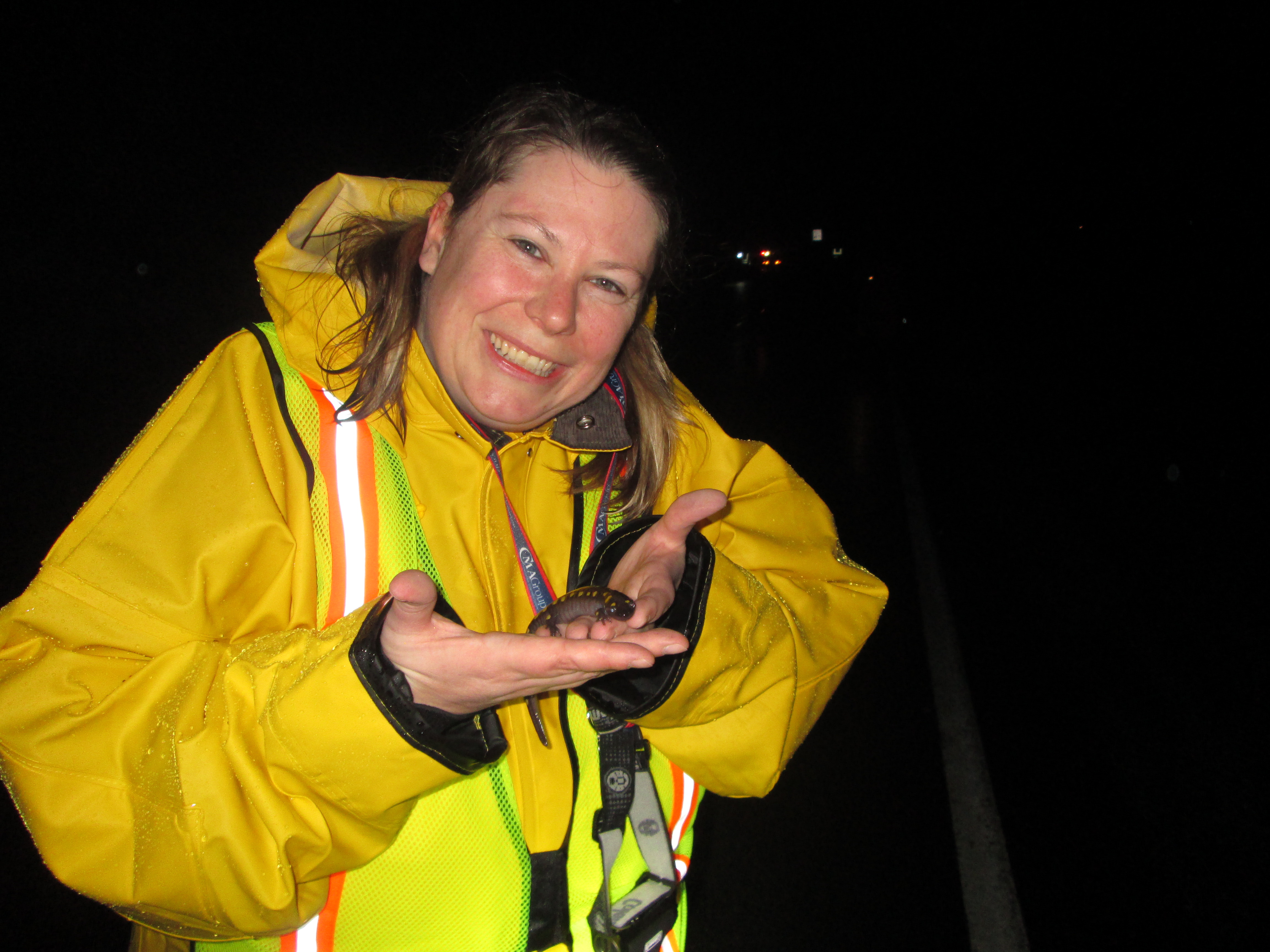
Karen Ruzycki gives a salamander a lift. Photo: M. Hall
Easter Sunday is a celebration of rebirth, resurrection, springtime, life. And this Easter Sunday – right on cue – a warm day turned into a mild night, the mild night met with rain, and together they gave rise to lots and lots of life. The amphibian migration was underway…in a big way!
Our teams were ready. Despite heavy bellies and a long day with family, at least 50 trained volunteers came out to “guard” the animals at road-crossing hot spots. From nightfall to around 11:00 pm we escorted, ferried, and tallied more than 3,000 salamanders and frogs across! (Numbers are still coming in from other teams.)
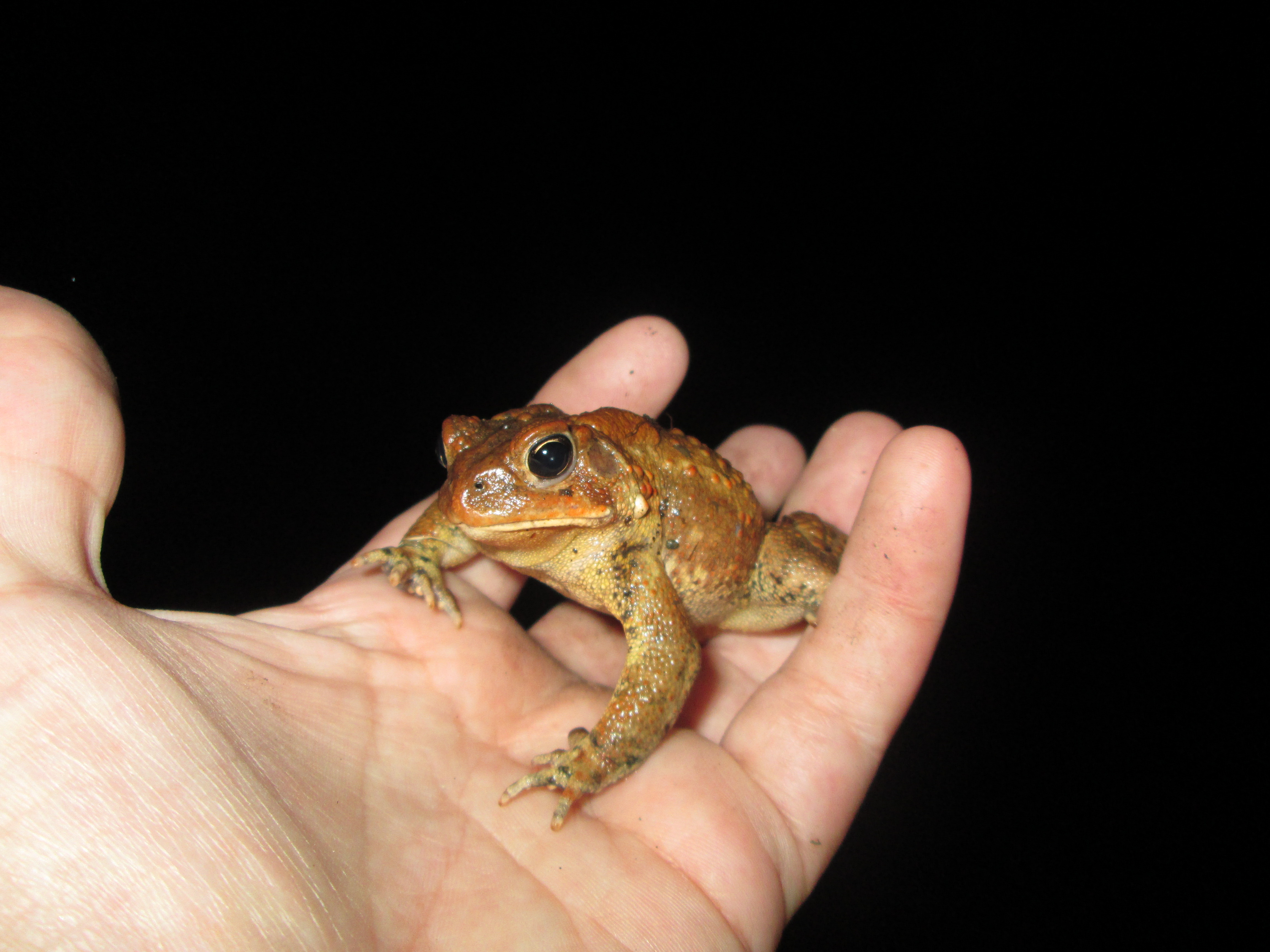
American toad in transit. Photo: Karen Ruzycki
It was a heart-pounding pace, often with multiple animals entering the roadway at once. They didn’t seem to understand the danger, but we humans were darting in and out, racing against car tires and grabbing up slippery critters as fast as slippery critters can be grabbed…while still being safe, orderly, and polite to passing motorists. A lot of drivers stopped to see what all the speed-walking was about. One woman said “God bless!” when I showed her a fat female spotted salamander and told her about the migration. Another guy must have been a local because he just asked “how many tonight?”
Everyone had an exhilarating night – the kind of migration night we plan for but don’t often get. It was a lot of fun and we saved a lot of lives. From the vehicle count, most of those little animals wouldn’t have stood a chance. A few still didn’t.
Before heading home from the site where I was working, I took a midnight stroll down to the vernal pool. It’s so neat to watch salamanders swimming around. Especially the big spotted salamanders. They spend almost their entire year underground in the woods, yet they are graceful and natural in the water. They even look excited to be there, swirling around each other in contest and attraction. I felt lucky to know about this wonderful thing. It felt great to have made some of it possible. Look at those gorgeous animals! And their impossibly bright yellow spots! They are colors lost in the night, but not by our watchful lights.
They made it! Spotted salamanders in the pool. Photo: M. Hall