CWF Releases its First Annual Report Ever Using a Story Map Format: “2014 Annual Report“
By David Wheeler, Executive Director
Technology has proven to be vital to Conserve Wildlife Foundation’s work protecting rare wildlife species over the years. Our biologists depend greatly on modern technologies to band, track, and share online the journeys of wildlife. Our webcams broadcast the most intimate behaviors of nesting birds and bats across the web. And we seek out ever-evolving communications technologies to spread the word about the inspiring stories of wildlife, from social media and infographs to e-books and Story Maps. These technologies offer newfound abilities to share complex data on multiple levels, while still incorporating the awe-inspiring photography and videos that bring wildlife’s stories to life.
Conserve Wildlife Foundation of New Jersey is excited to offer our 2014 Annual Report in a unique format that utilizes one of those technologies – Story Maps. In the past year, we have explored the wonders of American oystercatchers with our first Story Map – and now the annual report allows all of our projects to be highlighted in this interactive format.
A screen capture of one of the pages of the CWF 2014 Annual Report Story Map.
Visit the multiple pages within this Story Map to learn about Conserve Wildlife Foundation’s many projects and partnerships in 2014, and the imperiled wildlife species in need of our help. Find examples of the innovative and dedicated leadership of our biologists and volunteers. And take an online journey across the state to learn how our projects made a difference in all corners of New Jersey in 2014 – a great year for wildlife in the Garden State!
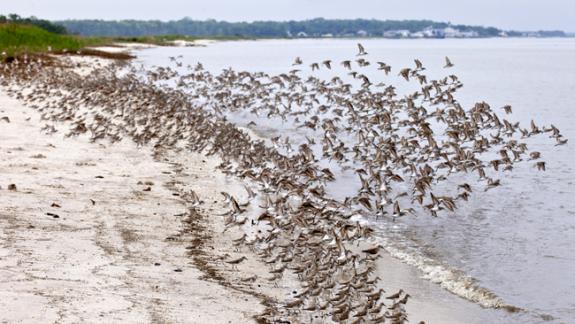
Each spring New Jersey hosts the largest concentration of shorebirds in North America! From about the first week in May to the second week in June, the biggest gathering of horseshoe crabs in the world comes to Delaware Bay to spawn.
At the same time, hundreds of thousands of shorebirds arrive on the Bayshore to refuel on horseshoe crab eggs at a critical stopover during their migration. Delaware Bay is an extremely important area for a number of at-risk wildlife, including Red Knots and Horseshoe Crabs.
CWFNJ AND MONMOUTH UNIVERSITY PARTNER IN THE BAHAMAS
By Todd Pover, Beach Nesting Bird Project Manager and Stephanie Egger, Wildlife Biologist
Monmouth University student using a pvc push core to collect sediments on a tidal flat in The Bahamas.
We totally shifted gears for the second half of our week here on Eleuthera, The Bahamas. Piping Plover surveys took a back seat as we focused on working with 20 students from Monmouth University (MU), who were taking part of in a two-week Tropical Island Ecology course during their winter break.
We settled into the Cape Eleuthera Institute, who hosted the students at their world class facilities for an intense (but fun) regimen of hands-on science research, typically marine based, but a Piping Plover unit was added for the MU students. It was particularly exciting to work with the MU students here in the Bahamas because back in New Jersey we have partnered with MU for over ten years on a beach nesting bird internship program during the summer months.
First up was an evening primer for the students on Piping Plovers, including a brief summary of our efforts in NJ on the breeding grounds and recent work by CWFNJ and others on the wintering grounds in the Bahamas. The next morning we were up early to kick off our trial research project; benthic macro-invertebrate sampling at Piping Plover wintering sites in the Bahamas to try to develop an inventory of their potential prey items, and eventually determine what constitutes a highly suitable foraging site. This was spurred, in part, by field observations of tidal flats that appear to be highly suitable, but have no piping plovers present, whereas similar adjacent flats are covered with shorebirds. Perhaps not all flats are created equal and prey availability is the key.
Students collecting and processing the sediment samples as part of the research to assess foraging quality.
For our field work with the students we chose two sites in Eleuthera where Piping Plovers have been observed; Savannah Sound, a classic low-tide flat in a sheltered area, and Winding Bay, an oceanfront, high-energy beach. The students extracted core sediment samples (20 cm deep) at each site along prescribed transects (10 samples per transect) for two consecutive days. Then it was back to the lab to sift the sand, sort the samples, and identify any invertebrates found. As part of the analysis, the students compared the species abundance and diversity between the two different sites, as well as between different transects within a site.
The results are yet to come and this was just a preliminary test of the methods and logistics involved. We were learning along with the students and while we were happy with the overall outcome, many questions were raised that will have to be addressed if we decide to develop a larger more robust study moving forward. In the meantime, the students got to learn a bit about Piping Plovers in the context of a research project, and inaugurate what we hope is another long-term partnership in the Bahamas.
Back in the lab to identify benthic macro-invertebrates from a Piping Plover foraging site in The Bahamas.
A special thanks to the staff at Cape Eleuthera Institute for their hospitality and for letting us be part of their innovative learning experience. Thanks to John Tiedemann and Pedram Daneshgar at Monmouth University for setting the wheels in motion and now helping us implement this partnership. And finally, “shout-out” to Taylor Rodenberg for stepping up to assist us with the field work – Taylor was one of our MU interns in New Jersey last summer and happened to be one of the students visiting the Bahamas this winter, so she is part of a small group of lucky people to see (and work with) Piping Plovers on both their breeding and wintering grounds!
CWF RESEARCHERS EXPAND SURVEYS TO ANOTHER ISLAND IN THE BAHAMAS
By Todd Pover, Beach Nesting Bird Project Manager and Stephanie Egger, Wildlife Biologist
Todd Pover, CWF Biologist, surveying for Piping Plovers using the final minutes of daylight.
Our experience so far this week in Eleuthera is a reminder why we do so much pre-trip “recon” for our Bahamas Piping Plover Project. Prior to the trip, we poured over Google Earth maps to try to identify the most suitable habitat for plovers. We read (and reread) the report from the 2011 International Piping Plover Census, the last time any significant surveys were conducted here. Finally, we “huddled” with our partners from Monmouth University so they could help us with logistics, as they have a history of marine-based research here.
Without this preparation we would have been ill prepared, of course, but we still faced many challenges right out of the gate. First and foremost, Eleuthera is more than 100 miles long, with two coasts, so covering even a small portion of the island is difficult in a short period of time. Once we decided which sites were the top priority, we quickly found out that reaching those locations is difficult. There are few official signs to the shoreline on the Atlantic side along the one main “highway”, and many of the “roads” are difficult to traverse, even with a 4WD. A number of turnoffs ended as dead ends or too overgrown to continue.
Piping Plover “Gry E4” was banded as a chick at White Point Beach, southern Nova Scotia in June 2014. Resighted on Spanish Wells and the first time reported after the breeding season.
It also quickly became apparent that Eleuthera’s rocky coast, especially along the western side is not nearly as suitable for piping plovers as we had experienced on earlier trips to Abaco and Grand Bahama. And some of the beaches on the Atlantic side were too narrow to likely support piping plovers. Not surprisingly, the initial day of surveys ended with a lot of lessons learned, but NO piping plovers.
Day Two we took an entirely different tack. We left our vehicle on the mainland and headed out on small ferries to two islands off the northern coast of Eleuthera; Spanish Wells, a residential community with a commercial lobster port and Harbor Island, a resort town known for its famous Pink Sands Beach. Our luck turned around, as we observed 20 piping plovers (with relative ease) including four that were marked with engraved flags that denoted they were Canadian breeders. This was one of the highlights of all our Bahamas trips to date.
We were also able to track the movement of 18 plovers from a high tide roost on the ocean side beach to a low tide flat on the other side of the island as the sun set. From what we learned on Abaco on previous trips to the Bahamas, this type of information is some of the most critical we can collect to help inform future surveys. We definitely earned our celebratory Kaliks that evening!
On the road to nowhere – locating piping plover sites on Eleuthera was a logistic challenge at times.
Our goals for the surveys this week are modest. We are trying to confirm some of the site information our colleagues Pat and Doris Leary gathered during the 2011 International Census, as well as add some additional sites to the survey inventory. We also are trying to visit high value sites, such as Savannah Sound, to determine which tide or portion of the tide is most productive for the surveys. With this information in hand, we hope to do our small part to help make the 2016 International Census next winter the most productive and accurate to date.
The Rufa red knot (a shorebird) named “Moonbird,” or “B95,” photographed in a crowd of birds at Fortescue, NJ. Credit: Christophe Buidin.
“Moonbird is the most famous, charismatic member of a group of mid-sized shorebirds called Rufa red knots, whose numbers have plummeted so dramatically in the past several decades that they just became the first bird ever listed under the Endangered Species Act with climate change cited as a “primary threat.”
Rufa red knots are among the avian world’s most extreme long range flyers (especially in light of their relatively small size). They travel vast distances — some flying over 18,000 miles — in the course of an annual migration that begins in Tierra del Fuego, Argentina, and extends all the way up to the Canadian Arctic (and back again).
Which brings us to Moonbird’s distinction: Because he is so old — he is at least 21 — he is believed to have flown as many as 400,000 miles in his lifetime. The distance to the moon varies, depending on where it is in its orbit, but the average distance is about 237,000 miles. Thus, Moonbird has not only flown the distance it takes to reach the moon — he has also covered the bulk of the return voyage.
Assuming that Moonbird is still living — the last sighting was in May — there are reasons to wonder whether there will ever be another bird that is his equal. Why? Simply put, his subspecies has been devastated, and climate change will only make matters worse — making extreme survival of the sort that Moonbird has achieved that much more difficult.”
Washington Post Science and Environment Reporter Chris Mooney explores Moonbird’s journey, threats to the species, and the recent Endangered Species Act listing of the Rufa Red Knot:
Wildlife conservation organizations leading the efforts to restore New Jersey’s Delaware Bay beaches for at-risk shorebirds today applauded the U.S. Fish and Wildlife Service decision to designate the Red Knot, a migratory shorebird, as “threatened” under the Endangered Species Act. A “threatened” designation means a species is at risk of becoming endangered throughout all or a significant portion of its range.
“This federal designation will make a big difference in strengthening the protections of this incredible shorebird,” said David Wheeler, Executive Director for Conserve Wildlife Foundation of New Jersey.
“Here in New Jersey, we are restoring the vital beach habitat that had been decimated by Hurricane Sandy, and this designation ensures the safeguards we are providing can be complemented along the East Coast,” Wheeler added.
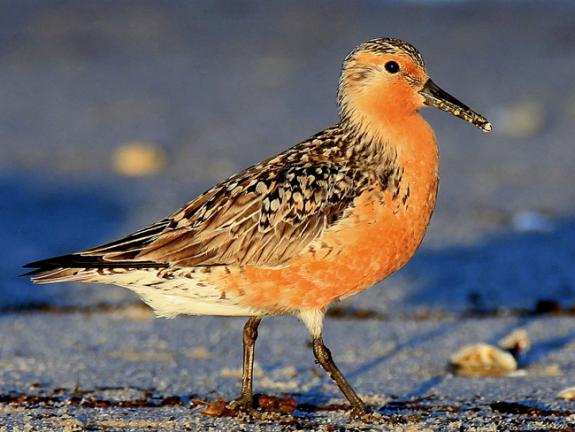
Since the 1980’s, the Knot’s population has fallen by about 75 percent in some key areas. Wildlife biologists believe the major threat to the Red Knot is the dramatic decline of horseshoe crab eggs, an essential food source at the most critical stop over during their 8,000 mile trip from southern wintering grounds to Arctic breeding territory. High-energy horseshoe crab eggs provide nourishment for Red Knots to refuel and continue their journey.
“This is an important and needed step in the conservation and recovery of the Red Knot. It is an essential step in preventing the extinction of this amazing long distance traveler,” stated Tim Dillingham, Executive Director forAmerican Littoral Society.
The largest concentration of Red Knots is found in May in the Delaware Bayshore of New Jersey and Delaware, where the shorebirds stop to gorge themselves on the eggs of spawning horseshoe crabs. In just a few days, the birds nearly double their weight to prepare for the final leg of their long journey.
“The major decline of horseshoe crabs in Delaware Bay is one of the largest threats to the survival of the shorebird,” explained Dr. Larry Niles, a biologist who leads the beach restoration efforts for Conserve Wildlife Foundation of New Jersey and American Littoral Society, and has studied Red Knots for three decades. “Agency groups have been working hard for the last two years, and will continue for the next two years going forward to rebuild the habitat damaged by Hurricane Sandy that the horseshoe crabs rely on. This work is integral to the recovery of the Red Knot and the shorebird’s best hope for survival.”
In the wake of Hurricane Sandy, American Littoral Society and Conserve Wildlife Foundation of New Jersey worked with the U.S. Fish and Wildlife Service, the New Jersey Division of Fish and Wildlife and the New Jersey Recovery Fund to remove 8,000 tons of debris and added 45,000 tons of sand to the beaches just before the annual spring arrival of the Red Knot in 2013.
Data nerds rejoice! Today, Wednesday, November 19 is GIS Day. Geographic information systems (GIS) technology helps our wildlife biologists protect rare species throughout New Jersey. GIS technology is used to create our species range maps and other important tools that show where wildlife occur and what habitat they need to exist.
Conserve Wildlife Foundation is a key player in updating the NJ Endangered and Nongame Species Program’s (ENSP) database of rare wildlife species. The database called “Biotics” is a GIS and Oracle-based system developed by NatureServe, the leading source of information on the precise locations and conditions of rare and threatened species and ecological communities in the Western Hemisphere.
Although CWF and ENSP biologists submit a majority of the data on Biotics, we rely on the help of citizen scientists to fully understand the wildlife picture in New Jersey. Do you want to help biologists monitor certain areas of the state and locate the presence of species of concern? Visit our website to learn how you can get involved.
In addition to the Biotics database, GIS was used to create range maps for all 190 species featured on our online field guide! Check it out.
Have you seen our American Oystercatcher Story Map? GIS was used to create that tool as well! A Story Map is a web-based interactive GIS map embedded with all kinds of content, like text, photographs, and video.
On behalf of our friends – the piping plovers, red knots, American oystercatchers, least terns, ruddy turnstones, black skimmers, and many others – Conserve Wildlife Foundation wishes you a happy World Shorebirds Day.
To learn more about our beach nesting birds work, click here.
You can click here to learn about our migrating shorebirds work.
And if you haven’t seen the Delaware Bay beach restoration video yet, enjoy it here!
Finally, you can help support our shorebirds work with a donation, or through volunteering on one of our shorebird projects.
Click here to make a donation to our shorebird work here!
One other fun way to cozy up to a bird this fall is to visit Unreal Birds, and consider making a purchase of those adorable birds. A portion of every purchase benefits CWF!
This marks the second story in Shorebird Week! Our first blog post, on Tuesday, introduced the film “A Race Against Time” and directed you to a free viewing of the film on our website. Today’s blog post, will highlight an incredible news story about a resighting of the iconic Red knot B95 on the Delaware Bay! And tomorrow’s blog post, will highlight volunteer’s incredible efforts to save stranded horseshoe crabs!
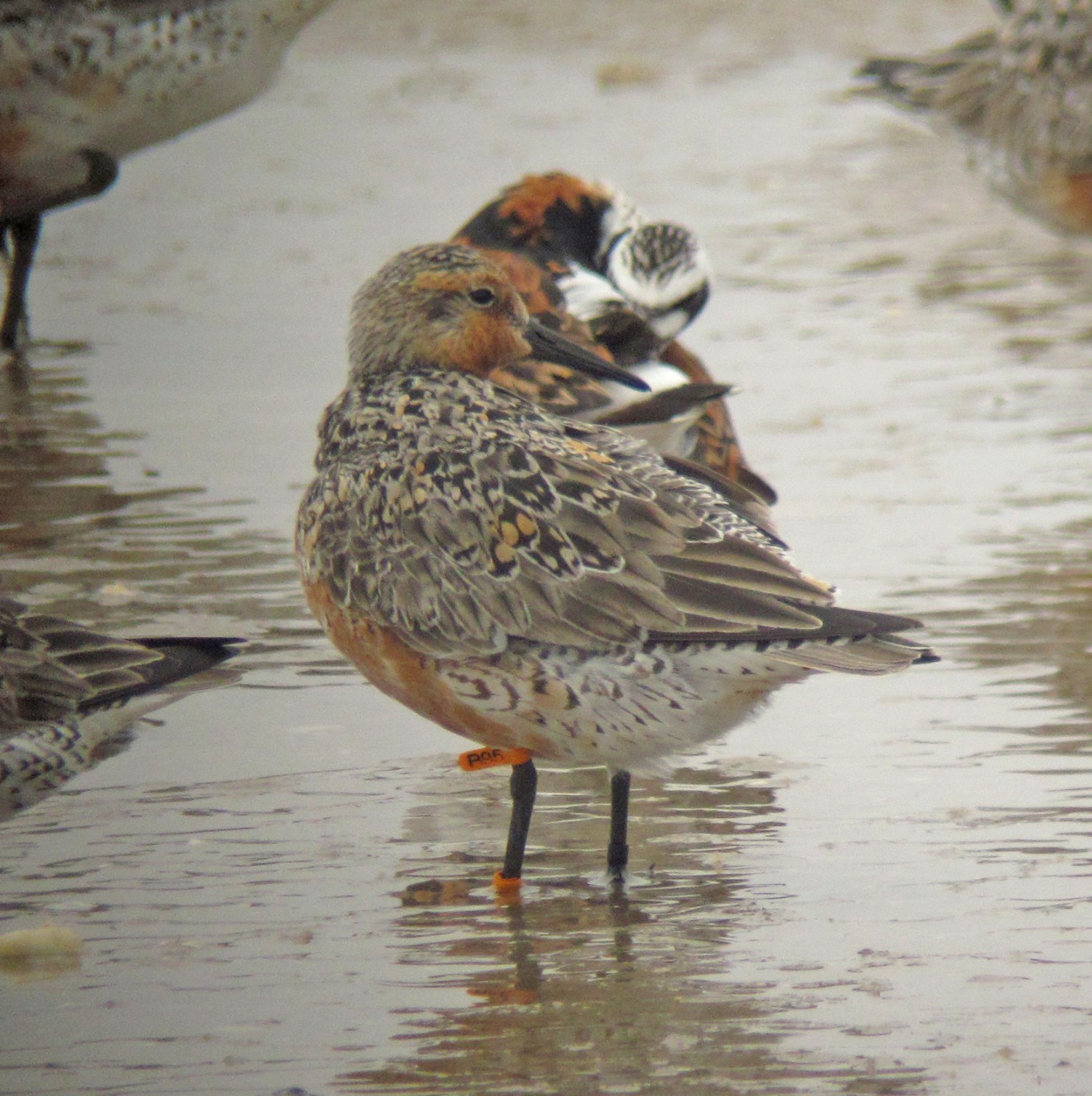
This story highlights the iconic Red knot, B95, being resighted on the Delaware Bay. B95, nicknamed Moonbird, is at least 20 years old, which makes him the oldest Red knot on record. He received his nickname because he has flown the equivalent of the distance between the earth and the moon and at least halfway back in his lifetime.
Iconic Red knot shorebird B95
One of Conserve Wildlife Foundation’s partners, Manomet Center for Conservation Science, highlights this bird in an fascinating news story about his resighting and the research efforts being done by the CWF biologist Dr. Larry Niles and Amanda Dey, senior biologist with the Endangered and Non-game Species Division of N.J. Fish and Wildlife and their team to restore the Delaware Bay.
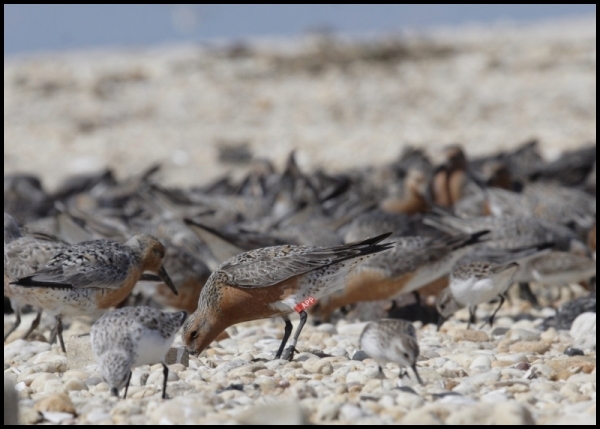
A banded red knot searches for food on a Delaware Bay beach.
This week for Animal Week, we will be spotlighting Shorebirds in the Media! Endangered red knots, ruddy turnstones, and other magnificent birds travel from South America to the Canadian Arctic during their migration, and make an important stopover along the Delaware Bay Shore from May to June.
The 2014 Shorebird film, “A Race Against Time” celebrates the Delaware Bay Beach Restoration
The film can now be enjoyed for free on our website:
Greener New Jersey Productions this spring produced a 30-minute film documenting the ambitious campaign by Conserve Wildlife Foundation, American Littoral Society and other partners to restore Delaware Bayshore beaches decimated by Hurricane Sandy. This project ensures that the at-risk horseshoe crabs and globally migrating shorebirds relying on this habitat can survive.
Conserve Wildlife Foundation of New Jersey and the Endangered and Nongame Species Program (ENSP) of the New Jersey Department of Environmental Protection’s Division of Fish & Wildlife, and New Jersey Audubon have partnered for many years to conduct research on Delaware Bay shorebirds in order to prevent their decline.