Be Terrapin Aware!

Public urged to use caution while driving in shore areas this summer

By: Ben Wurst, Habitat Program Manager and Stephanie Egger, Wildlife Biologist

A adult female northern diamondback terrapin searches for a suitable nest site along Great Bay Blvd. Photo by Ben Wurst
An adult female northern diamondback terrapin searches for a suitable nest site along Great Bay Blvd. Photo by Ben Wurst

Each year in late May and early June the annual nesting season for northern diamondback terrapins begins. This unique species of turtle is the only one to inhabit our coastal estuaries year round. They live exclusively in brackish water.

During this time of year, adult females emerge from the protection of their aquatic habitat to find suitable areas to lay eggs. They seek nesting areas with a sandy gravel type substrate that’s above the high tide line.

Throughout their range along the coast, terrapins face a variety of threats to their survival. Terrapin nesting habitat has been lost due to commercial and residential development, shoreline hardening and flooding which poses a greater threat to these limited nesting areas. Loss of terrapin nesting habitat along marsh systems put terrapins at greater risk of mortality as a result of increased time searching for adequate nesting areas (Winters 2013). Terrapins will utilize roadsides for nesting which increases the threat of being hit by motor vehicles. Roads are essential to our daily life but they often are barriers to wildlife, especially small critters like terrapins. Studies have shown that adult females have become less abundant and smaller from road mortality. (Avissar, 2006).

You can help terrapins several ways during the nesting season. Driving more cautiously from now until mid-July is a simple way to be more aware of terrapins crossing the roads. Nesting peaks during the full and new moon cycles and they’re more active during the high tide (less distance to travel on land to nest sites). We ask drivers in coastal areas to “Be Terrapin Aware” while driving in these areas. If you find a terrapin crossing the road use these steps to help it cross safely:

  • Stay safe. Never put yourself at risk! Make sure that you do not endanger yourself, or others, by walking into traffic.
  • When safe to do so, pull your car over and onto the shoulder, if possible. Turn on your hazard signals.
  • When safe to enter the roadway, approach the turtle and pick it up by grabbing its shell with both hands between its front and hind legs. HOLD ON – Terrapins have strong legs!
  • It is important that you move the turtle in the direction that it is heading. They are not always headed directly towards water. They will turn around if you put them in the wrong direction, so work with their instincts.
  • Place the terrapin off the road onto the soft shoulder (dirt or grass).
  • If you have a GPS or a smartphone then record your location and submit your sighting on our website.
  • Please do not move a terrapin long distances to “somewhere safe!” They have very small home ranges and moving them will only hurt them.

Rescuing a live terrapin (or any other turtle) from the road is a rewarding experience. It’s a great way to engage future generations in caring for our terrapins.

You can also help terrapins during the nesting season by supporting our new “Turtle Gardens” project. CWF, in partnership with the Marine Academy of Technology of Environmental Sciencewill develop and implement an educational initiative to promote terrapin nesting habitat enhancement. These “Turtle Gardens” will raise awareness of the benefit of living shorelines to terrapins and other coastal wildlife, as it relates to sea level rise and coastal flooding within the Barnegat Bay Watershed. Turtle Gardens for terrapins are patches of sandy nesting habitat above the high water line that are less susceptible to flooding. They also reduce the risk of road mortality. We will be having informational training sessions for those that would like to volunteer for monitoring Turtle Gardens or have property that would support a Turtle Garden. Information on these sessions will be announced in mid-June.

In addition, we will also be looking for terrapin sighting information with Project Terrapin in Berkeley and Lacey Townships in Ocean County as part of an initiative to fill in data gaps for this species on the mainland. If you see terrapins in these locations please report your sightings online.

Learn more:


Ben Wurst is the Habitat Program Manager for Conserve Wildlife Foundation of New Jersey and Stephanie Egger is a Wildlife Biologist with Conserve Wildlife Foundation of New Jersey.

Photo from the Field: Timber Rattlesnake Emergence

Warming weather brings out one of New Jersey’s most misunderstood species

By: Michael Davenport, GIS Program Manager

I recently had the opportunity to accompany Kris Schantz, a biologist with the NJ Endangered and Nongame Species Program, to search for timber rattlesnakes (and northern copperheads) emerging from their dens in northern New Jersey.

Many New Jersey residents are surprised to learn that we have venomous snakes within our state, the most densely populated state in the U.S. We have two venomous species, in fact.

A timber rattlesnake resting outside its den. © Mike Davenport

The timber rattlesnake is an Endangered species in New Jersey, while the northern copperhead has a status of Special Concern. To learn more about venomous snakes in New Jersey, please read my blog entry from May 13, 2011 and visit our online field guide:


Conserve Wildlife Foundation of New Jersey “2014 Annual Report” Released

CWF Releases its First Annual Report Ever Using a Story Map Format: “2014 Annual Report

By David Wheeler, Executive Director

Technology has proven to be vital to Conserve Wildlife Foundation’s work protecting rare wildlife species over the years. Our biologists depend greatly on modern technologies to band, track, and share online the journeys of wildlife. Our webcams broadcast the most intimate behaviors of nesting birds and bats across the web. And we seek out ever-evolving communications technologies to spread the word about the inspiring stories of wildlife, from social media and infographs to e-books and Story Maps. These technologies offer newfound abilities to share complex data on multiple levels, while still incorporating the awe-inspiring photography and videos that bring wildlife’s stories to life.

Conserve Wildlife Foundation of New Jersey is excited to offer our 2014 Annual Report in a unique format that utilizes one of those technologies – Story Maps. In the past year, we have explored the wonders of American oystercatchers with our first Story Map – and now the annual report allows all of our projects to be highlighted in this interactive format.

A screen capture of one of the pages of the CWF 2014 Annual Report Story Map.

Visit the multiple pages within this Story Map to learn about Conserve Wildlife Foundation’s many projects and partnerships in 2014, and the imperiled wildlife species in need of our help. Find examples of the innovative and dedicated leadership of our biologists and volunteers. And take an online journey across the state to learn how our projects made a difference in all corners of New Jersey in 2014 – a great year for wildlife in the Garden State!


Explore New Jersey’s Wetlands!

By: Kelly Triece, Wildlife Biologist

Photo Credit: Brian Zarate, NJ Division of Fish and Wildlife

Wetlands are important because they are part of New Jersey’s water resources and are vital to the health of our waterways. Although historically underappreciated, wetlands provide many environmental benefits such as filtering pollutants, storing floodwaters and serving as carbon sinks. New Jersey is comprised of a multitude of wetland types, including freshwater swamps, bogs, fens as well as estuarine and tidal marshes.

 
Many threatened and endangered species in New Jersey depend directly on wetlands, including the small and elusive bog turtle (Glyptemys muhlenbergii)! Bog turtles spend their entire lives in mossy bogs, wet meadows or stream fed seeps. They fed mostly on invertebrates, seeds, berries and carrion. Bog turtles are important members of their ecosystem because they help recycle nutrients, keep insect populations in check, and serve as indicators of wetland function and water quality. This tiny turtle and other wetland species are often victims of habitat loss and fragmentation, so protection of our precious wetlands is important to the long term vitality of many wildlife populations!

 
Millions of citizens enjoy their local wetlands every year through recreational uses provided by photography, hiking, fishing, canoeing and more! Did you know New Jersey is home to over 900,000 acres of wetlands? Get out and explore today!


Learn more:


Kelly Triece is a Wildlife Biologist for Conserve Wildlife Foundation of New Jersey.


The End of Another Terrapin Season

An Intern’s Perspective

By Derek Noah, CWF Intern, Summer 2014

Derek Noah, CWF Intern, collecting patron surveys at Stone Harbor, New Jersey.
Derek Noah, CWF Intern Summer 2014, collecting patron surveys at Stone Harbor, New Jersey.

My name is Derek Noah, I was an intern this summer for Conserve Wildlife Foundation of New Jersey (CWF). I am a wildlife and nature enthusiast who likes to kayak, bike, and hike . I live in Monmouth County and I go to the beach during any extra time I have.

The Northern diamondback terrapin is a small to medium-sized species of turtle that lives in coastal salt marshes, including the marsh near the Stone Harbor Boulevard Causeway. Adult terrapins are commonly struck by vehicles while attempting to cross causeways, and terrapin eggs are eaten by raccoon and other mammalian predators. Currently, CWF’s Wildlife Biologist, Stephanie Egger, is working with other researchers and organizations on the best way to protect wildlife and satisfy people’s needs that visit, live, or work in coastal communities in New Jersey. I collected information from visitors, residents, and employees of Stone Harbor about their understanding and perception of terrapins and management of terrapins along roadways through a patron survey. I worked on this project in July and August and surveyed nearly 500 patrons! I conducted the surveys on the beach as well as local stores and shops. The survey introduced general questions of terrapins and ideas on how to limit terrapin road death through different road management practices.  The patron survey can be viewed here.

As a thank you for their participation each person surveyed received our newest “Be Terrapin Aware” decal and our “Be Terrapin Aware” Brochure. Continue reading “The End of Another Terrapin Season”

CWF’s Ben Wurst to speak on Diamondback Terrapins tonight at Bass River

A nesting terrapin.
A nesting terrapin by Ben Wurst

Today at 8 pm, CWF’s habitat program manager Ben Wurst will speak on Northern Diamondback Terrapins during the Bass River State Forest’s “2014 Lectures at the Lake.” Wurst’s “Terrapins and Tires” program will discuss the history of terrapins and CWF’s efforts to protect them. For more information or to read the full article, click here.

  • To learn more about CWF’s efforts to protect Diamondback Terrapins along the New Jersey coast, click here.
  • To read our five part Terrapin Week blog series, here!

Terrapin Week: Spotlighting our Partners!

This story marks the last of our five blog stories spotlighting New Jersey’s Diamondback Terrapin – and educating people on the research and efforts being done to protect these fascinating reptiles!

Part 1, Monday, was an introduction into the world of the Diamondback Terrapin. Part 2, Tuesday, featured CWF’s research efforts to protect the terrapins. Part 3, Wednesday, looked at great places to view these beautiful turtles . Part 4, Thursday, highlighted some important ways you can help protect the Diamondback Terrapins. Part 5, today’s post, will showcase some other important regional research being done by our partners.

Beyond New Jersey: Diamondback Terrapins across the Northeast

By Stephanie Egger, CWF Wildlife Biologist

Contributions by Don Lewis (Cape Cod Consultants), Russ Burke (Jamaica Bay Terrapin Research and Conservation), and John Wnek (Project Terrapin)

Conserving the Northern diamondback terrapin in New Jersey is vitally important to CWF and our partners. As a result, it is crucial that we work cooperatively with our partners in the Northeast for the long-term protection and sustainability of terrapins from a regional perspective.

The terrapin has been identified as a Species of Greatest Conservation Need in the Northeast States Wildlife Action Plans (WAP).  The terrapin is found in eight states of the Northeast /mid-Atlantic regions and are considered Threatened in Massachusetts and Endangered in Rhode Island under State laws. In New Jersey, while the terrapin receives some protection under commercial and recreational fishing regulations, it is also considered a game species. The species has been also identified by the Northeast Partners in Amphibian and Reptile Conservation (NEPARC) as a species of regional conservation concern in the Northeast Amphibian and Reptile Species of Regional Responsibility and Conservation Concern Report as it found in ≥ 75 % of states listed in their WAPs and > 50% of northern diamondback terrapin distribution is within the Northeast Region of North America (NEPARC 2010).

Our regional partners have invested many years into the survival of this species through their conservation and research efforts below and as partners in the development of the Northeast Regional Conservation Strategy for Terrapins headed by CWF.

Cape Cod, Massachusetts – our northernmost terrapins

Don Lewis & Sue Wieber Nourse, Turtle Journal
Don Lewis and Sue Wieber Nourse, Cape Cod Consultants for terrapins

In Wellfleet Bay on Outer Cape Cod resides the northernmost population of diamondback terrapins.  Research on these elusive critters began in June 1980, and this longitudinal study has continued uninterrupted through this, its 35th season.  Terrapin research and conservation in Massachusetts encompasses more than 250 miles of coastline, dozens of estuaries and hundreds of sites from the fist of Cape Cod through Buzzards Bay on the South Coast to Mount Hope Bay on the Rhode Island border.  Within this expanse, there are many vestigial groups on the cusp of extirpation and a few stable populations.  Intense conservation measures over the last decade and a half have reversed statewide population declines, and numbers have begun slowly, yet steadily to increase throughout the range.  These measures focus on dramatically increasing the number of hatchlings entering the system through protecting nests and shepherding hatchlings from wild nests through a gauntlet of predators to the safety of their nursery salt marsh.  We also strive to expand nesting habitat through uplands preservation and coastal turtle gardens.  The result has been a significant, measurable increase in juvenile recruits entering these populations.

Covering this broad expanse of estuaries and beaches entails a large volunteer effort of citizen scientists augmented by hundreds of homeowners within coastal communities throughout Massachusetts.  Outreach forms the cornerstone of terrapin conservation.  Whether formal in classrooms or informal on beaches and in backyards, hands-on educational experiences transform bystanders into supporters.  The goal of each encounter is simply to change personal pronouns from “your turtles” to “our turtles.”

When terrapin activity ends in October, staff and volunteers change into winter garb and return to now frigid Cape Cod beaches to save stranded, cold-stunned sea turtles.  Each fall hundreds of sea turtles get trapped in the enormous “seine net” of Cape Cod sticking forty miles into the Atlantic Ocean, and they become too cold to survive without human intervention.  Thousands of the most endangered sea turtles in the world have been recovered from Cape beaches, rehabilitated and returned back to the ocean.

Jamaica Bay, New York

Russ Burke, Jamaica Bay Terrapin Partner
Russ Burke, Hofstra University and Jamaica Bay terrapin partner

Alex Kanonik (Queen’s College) and Russell Burke (Hofstra University) run a citizen-science project focusing on the ecology of the diamondback terrapin population in Jamaica Bay, New York.  Our work is built around a mark-recapture project started in 1998, and has been the basis for nine M.S. theses and numerous publications co-authored by high school students, undergraduates, and graduate students.  Our early focus was on nesting ecology and nest predation, then hatchling behavior, and field tests of temperature sex determination.  Currently we are investigating terrapin diets, movements and distribution in Jamaica Bay and elsewhere in New York.  We also work closely with biologists at JFK airport to address their issues with terrapins on the runways.

Barnegat Bay, New Jersey

John Wnek, Project Terrapin, partner
John Wnek, Marine Academy of Technology and Environmental Science and Project Terrapin

Project Terrapin, through the Marine Academy of Technology and Environmental Science, New Jersey, is conducting its 13th year of diamondback terrapin nesting research at Barnegat Bay, New Jersey.  We are studying the reproductive output of terrapins throughout Barnegat Bay with an emphasis on populations at Island Beach State Park and Long Beach Island, New Jersey.

We are also studying populations by identifying critical habitat throughout the Barnegat Bay Estuary.  We conduct a mark and recapture study throughout the northern Barnegat Bay region.  The past two years, we have been focusing on possible impacts on nesting ecology as a result of “shifting” nesting habitats from the storm surge from post-tropical cyclone Sandy.  We are also mapping nesting areas throughout the system.

Our team has a few different conservation projects, including the establishment of nesting habitats in areas where there are a high density of nesting terrapins in developed coastal communities.  We also sponsor a bycatch reduction device (BRD) distribution program working with local crab pot retailers and manufacturers.  To date, we’ve distributed over 20,000 BRDs throughout Ocean County, New Jersey.

We are also working with local environmental education centers and schools to promote diamondback terrapin education, with an emphasis on habitat and the importance of protecting our barrier islands.  Project Terrapin has developed an education module called the Terrapin Education KIT used by informal and formal educators.  Finally, we also sponsor a hatchling head start program for schools throughout the state and eastern Pennsylvania.

Our latest initiative is to assist with the protection of our barrier islands by promoting and funding coastal vegetation plantings so that the dunes and coastal habitats are better stabilized.  This past year, we have reached over 6,000 people, including school students, with volunteers providing over 1100 hours. Project Terrapin works with several colleges and universities supporting both graduate and undergraduate research studies.

Contact information for our partners:

Cape Cod (MA)

Don Lewis & Sue Wieber Nourse, Turtle Journal and Facebook, (508) 274-5108

Bob Prescott, Director, Mass Audubon Wellfleet Bay Wildlife Sanctuary, (508) 349-2615

Jamaica Bay (NY)

Russ Burke, Hofstra University and Facebook 

Barnegat Bay (NJ)

John Wnek, Marine Academy of Science and Technology, Project Terrapin, and Facebook

References

NEPARC.  2010.  Northeast Amphibian and Reptile Species of Regional Responsibility and Conservation Concern. Northeast Partners in Amphibian and Reptile Conservation (NEPARC). Publication 2010-1.


Stephanie Egger is a Wildlife Biologist for Conserve Wildlife Foundation of NJ and Co-Chair of the Mid-Atlantic region of the Diamondback Terrapin Working Group

Terrapin Week: Making a Difference

This story marks the fourth of five blog stories spotlighting New Jersey’s Diamondback Terrapin – and educating people on the research and efforts being done to protect these fascinating reptiles!

Part 1, Monday, was an introduction into the world of the Diamondback Terrapin. Part 2, Tuesday, featured CWF’s research efforts to protect the terrapins. Part 3, Wednesday, looked at great places to view these beautiful turtles . Part 4, today’s blog post, will highlight some important ways you can help protect the Diamondback Terrapins. Part 5, Friday, will showcase some other important regional research being done by our partners.

Steps You Can Take to Protect the Diamondback Terrapins!

by Ben Wurst, CWF Habitat Program Manager

A female terrapin pauses while crossing Great Bay Blvd in Little Egg Harbor, NJ.

We all can make a difference to help conserve northern diamondback terrapins. This beautiful species is a symbol of our coast – and now more than ever, we need to be sensitive to our incredible coastal estuary ecosystems!

Here are some ways that you can help make a difference to protect this amazing species:

  • Slow down, don’t tailgate, and be aware while driving in coastal areas from May through July.
  • If you see a terrapin on the road, pull over, put on your hazard lights and carefully help the turtle cross in the direction it is going. Please be careful and use your best judgement and do not get in front of a motor vehicle to stop them on area roads. Do not jeopardize your own safety for a turtle.
  • If you go crabbing and use commercial-Maryland style crab pots, use BRDs or “bycatch reduction devices” to prevent terrapins from getting trapped in them. Use line that sinks to prevent a crab pot from becoming lost. Abandoned crab pots can trap and kill a ton of marine life over time, including blue claw crabs, many species of fish, and terrapins.
  • Talk to others to educate them about terrapins and their role in the ecosystem. You can learn all about them in our Online Field Guide!
  • Volunteer with CWF to patrol roadways and take part in other volunteer actions in Southern Ocean County, Atlantic County, and Cape May County! We really need your help – so please contact us if you, your business, or your civic group is willing to help save the incredible diamondback terrapin!
  • Donate to CWF’s diamondback terrapin program. Any amount would help greatly! Click here and note Terrapin in the PayPal note, or you can mail a contribution to Conserve Wildlife Foundation, 501 East State Street, P.O. Box 420, Mailcode 501-03E, Trenton, NJ 08625-0420. Be sure to note Terrapin in the check’s subject line.

Email us at info@conservewildlifenj.org with Volunteer in the Subject line if you’re interested.

Terrapin Week: Viewing Terrapins!

How to See Terrapins in the Wild in New Jersey

This story marks the third of five blog stories spotlighting New Jersey’s Diamondback Terrapin – and educating people on the research and efforts being done to protect these fascinating reptiles!

Part 1, Monday, was an introduction into the world of the Diamondback Terrapin. Part 2, Tuesday, featured CWF’s research efforts to protect the terrapins. Part 3, today’s blog post, will look at great places to view these beautiful turtles. Part 4, Thursday, will highlight some important ways you can help protect the Diamondback Terrapins. Part 5, Friday, will showcase some other important regional research being done by our partners.


by Ben Wurst

During full and new moon cycles females terrapins are hard NOT to see on Great Bay Blvd. in Little Egg Harbor, NJ.

During their nesting season, Northern diamondback terrapins are usually pretty easy to spot along the coast of New Jersey, and throughout their range. They are beautiful turtles with very unique coloration.

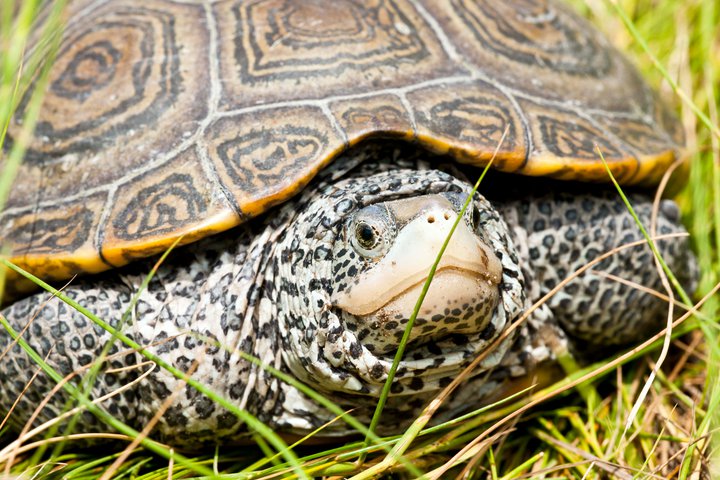
Individuals vary in coloration, but in general, their upper shell, or carapace, is dark with a diamond shaped pattern on it. Their lower shell, or plastron, is a light yellow/green color. Their skin is a grey color with black spots that vary highly between individuals. Almost all have a light upper mandible.

From May through July, spotting a terrapin is pretty easy!

Females leave the protection of the coastal waterways to find suitable nest sites to lay eggs. They seek areas with sandy soil, like dunes, parking lots and road shoulders. When our barrier islands were developed, roads were created to access those islands.

The creation of these roads also increased the amount of available nest sites for terrapins. But the development itself actually decreased the amount of suitable nesting habitat for them overall. Much of our coast is now bulkheaded.

Bulkheading restricts the natural movement of terrapins and limits their ability to find suitable nest sites. So, now they must take what they can get: roadsides. Nesting on the edges of roads is a perilous journey for terrapins. The vehicles that travel on those coastal roads may have careless drivers behind the wheel.

Terrapins may be found in many different places along the coast, especially roads that criss-cross saltmarsh. Use extreme caution in trying to spot terrapins on active roads used by vehicles – not only to avoid driving over terrapins, but for your own safety and that of other drivers or pedestrians.

Some widely used locations include Avalon Boulevard and other west-east highways connecting the mainland with barrier islands and peninsulas. Many coastal areas in Cape May also feature high numbers of terrapins, while Monmouth County, Ocean County, and Meadowlands coastal regions feature plenty of terrapins as well.

However, one of the best places to view terrapins during their nesting season is inside the 5,000+ acre Great Bay Blvd. Wildlife Management Area, Little Egg Harbor, NJ. The WMA is located along the coast and is accessible by motor vehicle from the 5 mile long road that ends at the Rutgers Marine Field Station. The road was originally planned to connect the mainland with Atlantic City in the early 1900s. Luckily that plan fell through and the last bridge was never built (road is also called 7 Bridges Road, after the 7th bridge that was never built). There is plenty to see and do out on GBB, at all times of the year. A wide variety of wildlife can be observed from the road, including ospreys, terns, oystercatchers, herons, egrets, and shorebirds. Lots of outdoor recreation opportunites await as well, including crabbing, fishing, and kayaking. There are boat ramps along the road, and all the owners of the local marinas are very nice, including Capt. Mike’s, Rand’s Boats, and Cape Horn Marina.

A nesting terrapin.
A nesting terrapin.
Viewing terrapins:

Terrapins can be timid if approached, especially when nesting. Please keep your distance when near a nesting female. You wouldn’t want to cause a female to abandon laying eggs in a nest cavity! If she is unable to cover up her eggs with soil then they might become an easy meal for a gull or crow… Watching them nest is fun to watch as they excavate down and lay 8-12 eggs.

If you see one on the road and there is no traffic, slow down or stop and let it cross. If there is traffic coming, stop your vehicle, put on your hazard lights and carefully get out and move the terrapin in the direction it is heading. Terrapins can bite, so be careful and pick it up from the side of it’s shell (called the bridge). Use 1-2 hands to ensure you have a good grip. Sometimes they use their legs to try and get you to let go! Put it on the soft shoulder to be out of harms way. If you have a GPS or a smartphone, record the location and submit us a sighting via our online terrapin sighting form. Data collected from the form will help guide future conservation efforts for them in NJ.

Other great viewing areas:
  • Gateway National Recreation Area – Sandy Hook Unit
  • Island Beach State Park
  • Edwin B. Forsythe NWR – Oceanville
  • Wetlands Institute – Stone Harbor
  • Reeds Beach
  • Fortescue Beach

Ben Wurst is a wildlife biologist for Conserve Wildlife Foundation of New Jersey.

Terrapin Week: Developing a Northeast Regional Conservation Strategy for Terrapins

This story marks the second of five blog stories spotlighting New Jersey’s Diamondback Terrapin – and educating people on the research and efforts being done to protect these fascinating reptiles!

Part 1, Monday, was an introduction into the world of the Diamondback Terrapin. Part 2, today’s blog post, will feature CWF’s research efforts to protect the terrapins. Part 3, on Wednesday, will look at great places to view these beautiful turtles . Part 4, Thursday, will highlight some important ways you can help protect the Diamondback Terrapins. Part 5, Friday, will showcase some other important regional research being done by our partners.

by Stephanie Egger, CWF Wildlife Biologist

I am pleased to announce CWF was awarded a grant from the Regional Conservation Needs Program* for the development of a conservation strategy (strategy) that focuses on the conservation, management, and protection of terrapins from Massachusetts to Virginia.

Stephanie Egger, CWF wildlife biologist

For the next two years, we will be working with over 30 partners, many of whom are part of the Mid-Atlantic and Northeast regions of the Diamondback Terrapin Working Group (DTWG), assembling data and developing a strategy with the help of their years of expertise working with terrapins.

The overarching goal of the strategy is to help achieve long-term sustainability of terrapins by identifying the species current and historical populations and its habitat (known and unknown occupancy); characterizing and ranking threats; prioritizing focal areas for regional and individual state management; identifying data gaps; and reviewing the regulatory status in each state. The strategy will describe a strategic initiative for implementation of conservation actions across eight states and identify focal areas for conservation. The results of the strategy could be used to solicit additional funding for implementation for more regionally significant areas for terrapins in the future.

(c) Eric Sambol
(c) Eric Sambol

We’ve hit the ground running for this project and will convene the partners in meetings later this year at the College of William & Mary in Virginia and Cape Cod, Massachusetts as well as visit states for more local terrapin meetings.

More information on this project can be found on the Northeast Regional Conservation Needs (RCN) Grant Program site.

*The Northern Diamondback Terrapin (Malaclemys terrapin terrapin) in the Northeastern United States:  A Regional Conservation Strategy” is supported by State Wildlife Grant funding awarded through the RCN Program.  The RCN Program joins thirteen northeast states, the District of Columbia, and the U.S. Fish and Wildlife Service in a partnership to address landscape-scale, regional wildlife conservation issues.  Progress on these regional issues is achieved through combining resources, leveraging funds, and prioritizing conservation actions identified in the State Wildlife Action Plans.  See RCNGrants.org for more information.


Stephanie Egger is a Wildlife Biologist for Conserve Wildlife Foundation of NJ and Co-Chair of the Mid-Atlantic region of the Diamondback Terrapin Working Group