Humans Help New Jersey Osprey Population Exceed 600 Nesting Pairs

2015 New Jersey Osprey Report documents close to 600 pairs up from low of 50 pairs

by Lindsay McNamara, Communications Manager

Bill Clarke, project supporter holds a young and feisty osprey that Ben Wurst prepares to band with a red auxiliary band on Barnegat Bay. July, 2015. Photo by Northside Jim.


Today, we released the 2015 New Jersey Osprey Report with our partner New Jersey Division of Fish and Wildlife’s Endangered and Nongame Species Program (ENSP). The report highlights the continued recovery of this threatened bird of prey.


“Ospreys are an important indicator of the health of our coastal ecosystems, so it is important to track the health of their population. Their continuing recovery is a very promising sign for our estuaries and the fish and other wildlife that depend on clean water to survive” stated Conserve Wildlife Foundation executive director David Wheeler. “Today, no visit to a coastal waterfront would be the same without the magnificent sighting of an osprey soaring above or crashing down to the water’s surface for a fish.”


Though only about 50 osprey pairs remained in New Jersey in the early 1970s, the report documents close to 600 pairs using a total of 534 active nests in 2015, more than any other year in the project’s history.


CWF and ENSP survey an estimated 80% of the population and create an accurate representation of overall health. Biologists have come to rely on the assistance of specially trained volunteers (osprey banders) and many “Osprey Watchers” who report nests on Osprey-Watch.org.


“The vital work of our volunteers helps us keep our finger on the pulse of the population,” said Kathy Clark, supervising biologist with the DEP’s Endangered and Nongame Species Program. “Having dedicated volunteers is a great long-term monitoring tool and really strengthens the team’s ability to cover the state osprey population effectively.”


“Over the past few years we’ve really seen a shift in how we can track the overall health of the osprey population. In previous years, the use of aerial helicopter surveys to document the size and health of the statewide population allowed biologists to reach large areas, but was also very expensive,” stated Conserve Wildlife Foundation habitat program manager Ben Wurst. “Today, we utilize volunteers to help collect much of this valuable data. These ‘Osprey Watchers’ can view all nests, report nest activity, and other data online that we can, in turn, use to track the statewide population. The use of Osprey-watch.org also helps to raise awareness and educate citizens about ospreys and current environmental issues that aquatic ecosystems face today, including global climate change, depletion of fish stocks, and environmental contaminants.”


As in previous years, biologists and dedicated volunteers conducted ground surveys in mid-summer. These surveys were conducted in the most densely populated colonies of nesting ospreys in New Jersey. From the Meadowlands, south to Cape May, and west along Delaware Bay, a sample of each major colony is checked and nest outcome data are used to determine how well our ospreys are faring. During these surveys, the health of nestlings is assessed and they are banded with USGS bird bands for future tracking. Since this is usually the only visit to nests each year, the condition of the nesting platform is also noted and repairs or replacement are scheduled for the non-breeding season.


In 2015, CWF continued to band young ospreys produced in Barnegat Bay with a red, alpha-numeric coded auxiliary band. Project RedBand is focused on ospreys that nest in the Barnegat Bay watershed from Point Pleasant to Little Egg Harbor. The main goal of the project is to engage the public in osprey management and conservation along the Jersey Shore. At the same time, while collecting data from re-sightings, biologists will learn about their dispersal, foraging habits, site fidelity, migration routes, and life span. This year 33 bands were deployed, putting the total in the field at 95. 2016 marks the first year that red banded ospreys (from 2014) will start to return here from their wintering grounds in South America.


2015 Report Highlights:

  • In 2015, 423 known-outcome nests fledged an average of 1.74 young per active nest. That rate has averaged 1.75 in recent years, remaining well above the minimum necessary for a stable population (1.0 young/active nest).
  • The 2015 productivity rate was near the long term average and suggests the population will continue to grow.
  • Thirty-one new nests were found this year, and we combined that number with last year’s census to estimate the overall population close to 600 pairs.
  • The next statewide census will occur in 2017.
  • Of the 423 known-outcome nests, 347 were found along the Atlantic Coast and 76 were found on Delaware Bay.
  • A total of 737 young were produced from these known-outcome nests.
  • A total of 432 young were banded by volunteers and biologists with USGS leg bands for future tracking.
  • Population growth remains around 10% since approximately 2009.


Learn More:


About ENSP’s New Jersey Endangered Wildlife Fund:

You can help protect New Jersey’s ospreys and all other rare wildlife by supporting ENSP’s New Jersey Endangered Wildlife Fund when you file your state income tax this year and every year. Simply look for Line 59 on your NJ 1040 income tax return, and check-off for wildlife. Every dollar you donate goes directly to ENSP, enabling biologists to continue their work to restore, conserve and enhance New Jersey’s populations of rare species. What’s more, your contribution is matched with an equal amount of federal funding, further strengthening efforts to protect hundreds of imperiled species.


Lindsay McNamara is the Communications Manager for Conserve Wildlife Foundation of New Jersey.

Track the Bald Eagle’s Triumphant Return to New Jersey

Updated Story Map Showcases Bald Eagle Nest Locations from 1985-2015

by Brian Henderson, GIS Specialist

Photo by Northside Jim

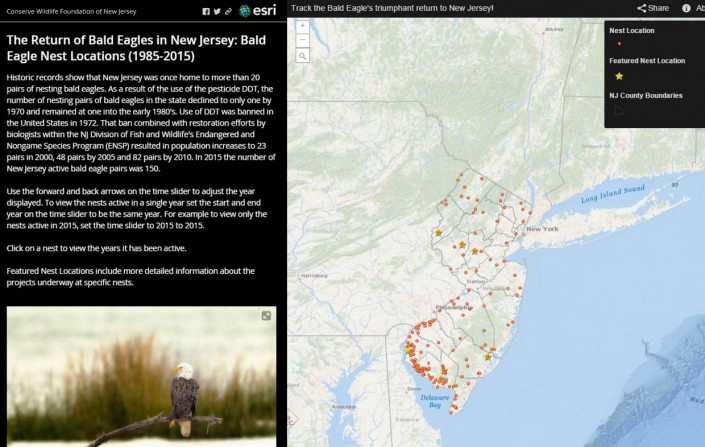
Our story map The Return of Bald Eagles in New Jersey has been updated based on the 2015 Bald Eagle Project Report. The story map shows the locations of every eagle nest known to be active (meaning they laid eggs) in New Jersey since 1985  — the year when there was only a single nest in the entire state. The map presents an animated depiction of where eagles have nested each year, so you can track the bald eagle’s triumphant return to the Garden State! Viewing the animation shows you how eagle nests spread from a single point in Cumberland County across all of New Jersey through the years.


The story map also highlights a number of Feature Nests which include more detailed information about the projects underway at specific nests, such as the Duke Farm nest which has been featured on our EagleCam since 2008.


The number of nesting pairs of bald eagles has steadily increased each year. This trend continued in 2015 with a record 150 active pairs, which was a slight increase over 146 such pairs recorded in 2014. In 2015, there were 122 nests that successfully  fledged at least one young compared to 115 successful nests in 2014 and the 199 total young fledged in 2015 was only slightly less than the record 201 young fledged in 2014.


Learn More:


Brian Henderson is the GIS Specialist for Conserve Wildlife Foundation of New Jersey.
Photos from the Field

Productive Trip to North Jersey Falcon nests

by Ben Wurst, Habitat Program Manager

Kathy Clark, ENSP Wildlife Biologist and myself made use of our trip to North Jersey on Tuesday. Both being based out of S. Jersey, we try to maximize our productivity and time spent up north. We visited a total of three peregrine falcon nest sites to conduct winter maintenance at them. Winter maint. is in preparation for the start of their nesting season, which usually begins in mid-late March. Eggs are usually laid in late March-early April. On the list for usual maint. (which we do at over 12 nest sites throughout NJ) is to refresh gravel, treat for parasites, and check condition of predator guards (for those sites on former hacking towers). At the sites we visited yesterday, we had some additional work.

Our first stop was at the Union County Courthouse in Elizabeth. While fixing up the nestbox on the roof, we also helped with the installation of a new pinhole camera that was installed on the inside wall. The camera, paid for and installed by Union County, will stream online soon. CWF will help to promote the camera and our own Peregrine Falcon Cam curriculum. The female that nests here was not seen as we would have known since she is overtly aggressive to anyone who climbs onto the roof there. It could be the same female but it was odd that she was not seen at all. In addition, Kathy photographed the male who is banded (likely in NY – you can tell by the silver band he wears – we use black in NJ). The previous male was not banded. So, there could be a whole new pair here. Only time will tell if this site will be active this year. Having the camera there will help biologists learn about the turnover and if eggs are in turn laid by the female.

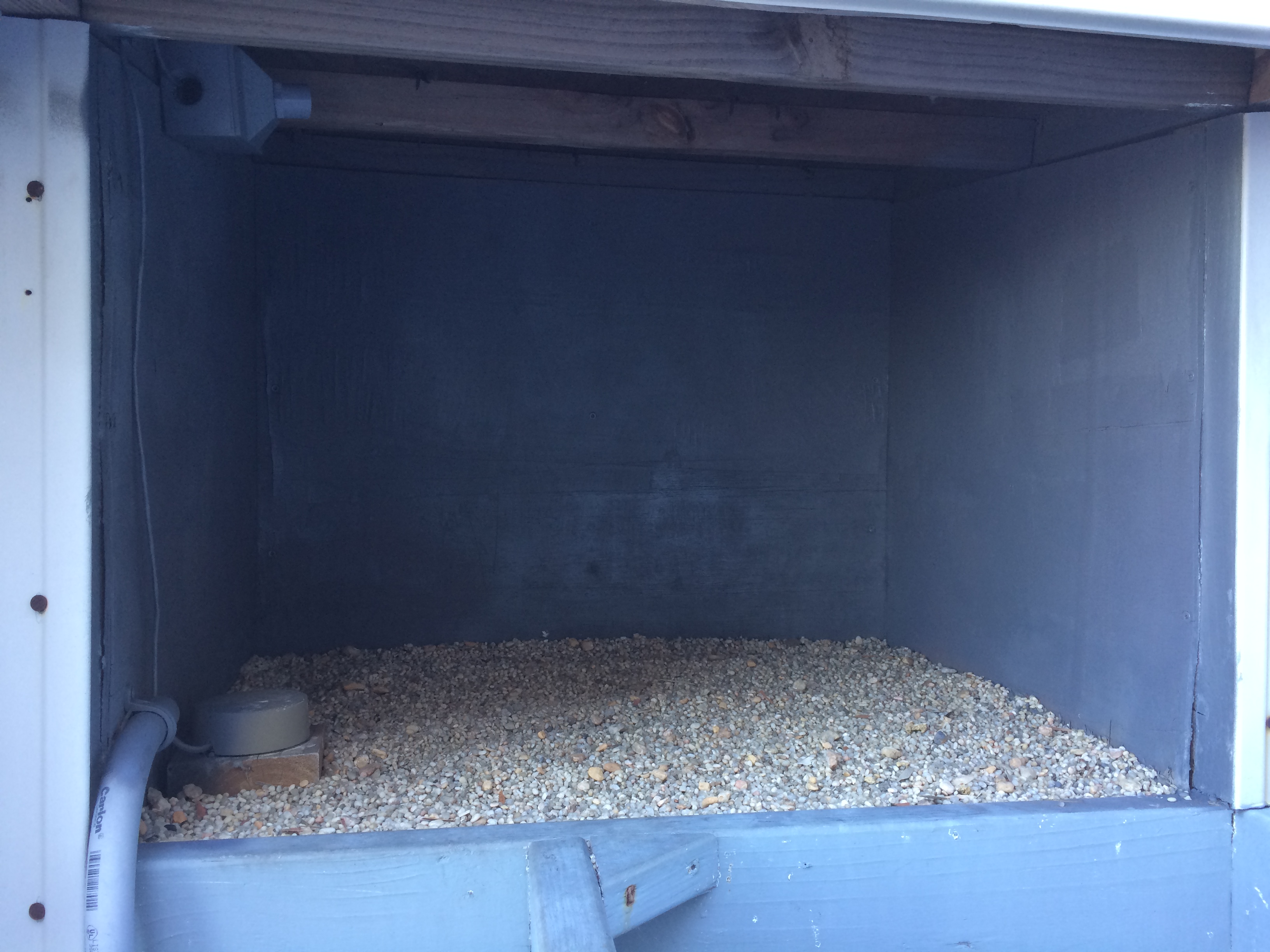
Second, we visited the Jersey City eyrie. There we removed the pinhole camera to get repaired/replaced. Then we painted the inside of the nestbox, which was showing its age and a good covering of guano. The female Juliette was there and not quite sure of our presence. Since she has not nested here yet, she does not attribute our presence with any kind of disturbance. This will change when she has young to protect.

Our last visit was to the PSE&G Sewaren Generating Station. Here we moved a new nestbox from one building to another. The story of this site is where young falcons were found on the ground after attempting to fledge a few years ago. Their nest site was found to be in an old and unused duct which was accessed by an open window on the north side of the building. Then last year the pair attempted to nest on a tiny ledge on the south side of the building, but the nest was flooded. Our site visit revealed that there was a suitable ledge above the tiny ledge and we moved the nestbox here. This will give them the best chance of successfully raising young. PSE&G staff were very willing to help and are proud that their generating is home to a pair of nesting falcons!

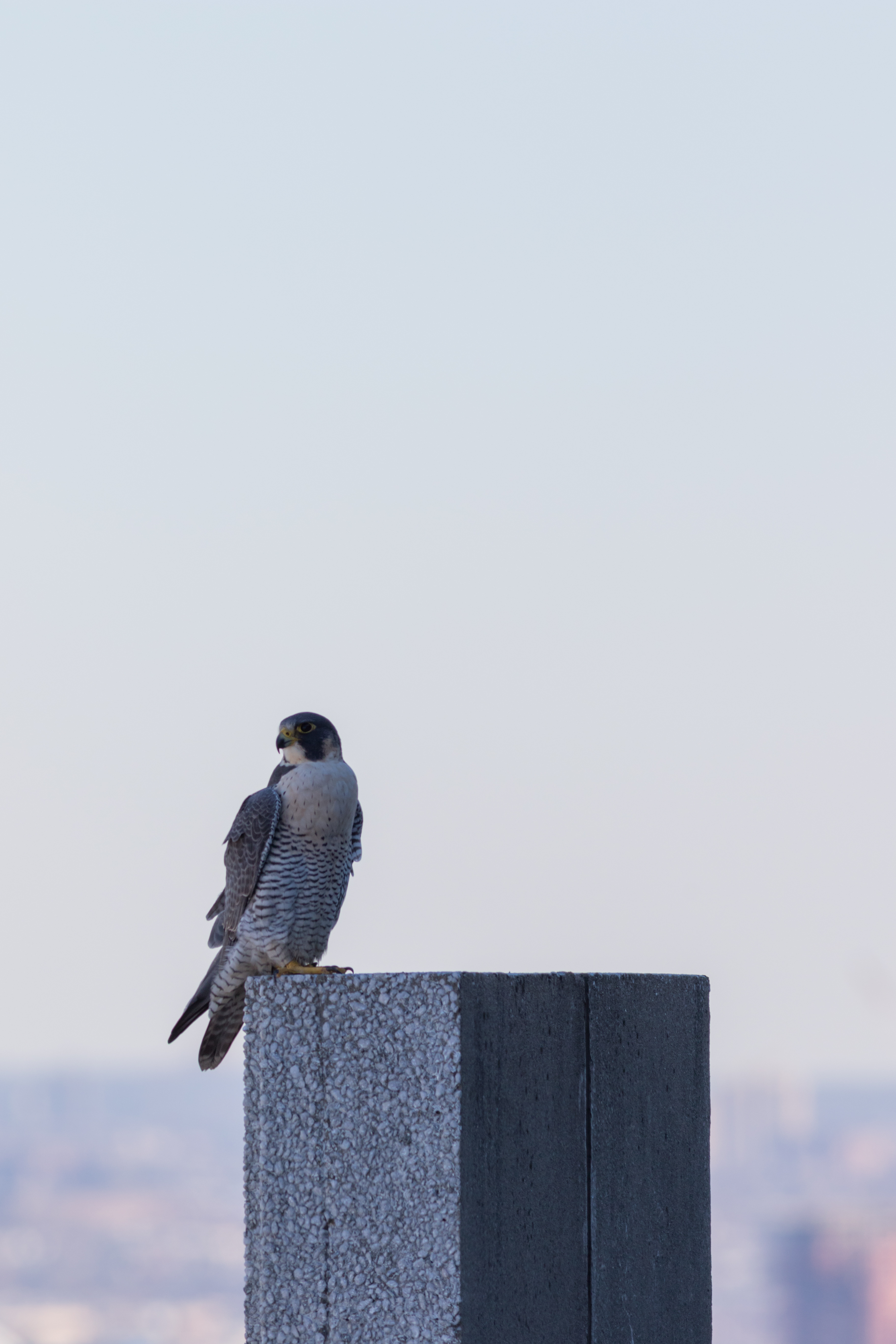
Cameras/photography can be used to document new birds at nest sites. This is a new male peregrine falcon (yet to be ID'd) at the Union County Courthouse. The previous male was not banded. Photo by Kathy Clark/ENSP
Cameras/photography can be used to document new birds at nest sites. This is a new male peregrine falcon (yet to be ID’d) at the Union County Courthouse. The previous male was not banded. Photo by Kathy Clark/ENSP
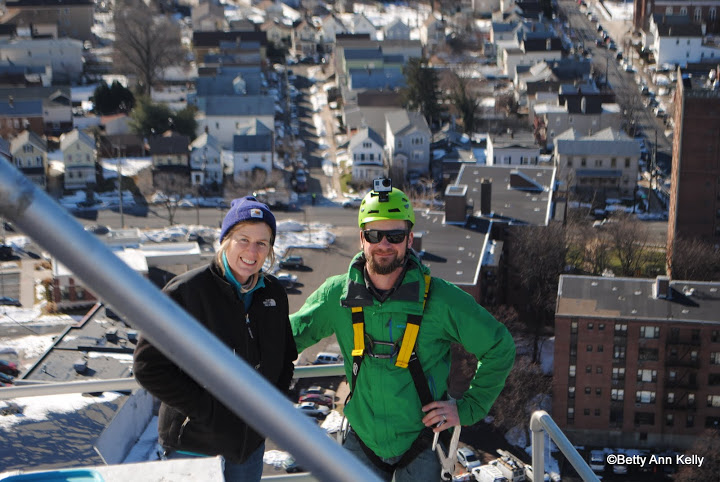
Kathy and I atop the Union County Courthouse. Photo by Betty Ann Kelly.
Prey remains atop the Union County Courthouse. Can you ID it? Photo by Ben Wurst
Juliette on a perch atop 101 Hudson St. Photo by Ben Wurst
The inside of the Jersey City nestbox got a new paint job.
Our last stop of the day was at the PSE&G Sewaren Generating Station where we moved a nestbox to a new location at the plant. It was placed directly above a narrow ledge that the birds nested on last year. Photo by Ben Wurst

Conserving Barn Owls in the Garden State

Insight into a Nocturnal and Enigmatic New Jersey Raptor

by Melanie Mason, Assistant Biologist

800px-Barn_Owl_-_Abingdon_2013_(8731175397)

Barn Owls (Tyto alba) are one of the most widespread avian species in the world. Despite this impressive distribution, their numbers have been decreasing in parts of their range, and New Jersey is no exception. The extent of their decline isn’t fully known since barn owls are nocturnal and enigmatic, so it’s difficult to estimate their numbers. Although barn owls can travel great distances to disperse after fledging and to find prey, they don’t truly migrate. Therefore, there isn’t a breadth of migration data to sift through in order to triage their downward trend either.


The first step in species conservation is to understand its biology. Because barn owls aren’t migratory, they don’t have the intense energy requirements needed to fuel long distance treks to warmer climates, but the trade-off is they are at the mercy of their local prey abundance and availability. If you look at a distribution map of North American barn owls, you’ll see that New Jersey is close to the northernmost extent of their range. In fact, the majority of their subspecies/races are found in lower latitudes. Unlike their tropical kin, however, northern owls have to frequently survive freezing conditions and in order to do so, need food and lots of it!


Catching enough prey through New Jersey winters can be a challenge in and of itself, but if owls lack sufficient fat stores because of an unfavorable prey year (think hurricanes, floods, droughts, etc), they can easily succumb to cold conditions and die from exposure. The reality is that many young owls do not survive their first winter — a very steep learning curve.


Their preferred prey is meadow vole which are close relatives of lemmings — made famous for their explosive populations during favorable years. In order to respond to sweeping changes in prey availability, the reproductive strategy of barn owls is atypical for most raptors. Where small clutches and high parental investment are the norm, instead, barn owls are capable of breeding year round in favorable conditions (generally fall/spring here in New Jersey) and can have large clutches in order to respond quickly to prey availability. Another uncommon and well-documented strategy is polygyny — where one male sires and provides for multiple nests.


These reproductive strategies are important since barn owls are not a long lived species and typically do not survive much longer than five years. Their saving grace is their ability to “bounce back” and quickly repopulate local areas. This is where we can help!


Barn owls get their name from their close association with humans. They hunt in marshes, fields and grasslands typically favored for agriculture. They frequently nest in structures like old barns, buildings and silos. Constructed structures such as barns and nest boxes are generally preferred over natural cavities (dead or hollow trees for example) because they are safer from predators, more protected from the elements and have a vast supply of mice and voles at their doorstep. As silos and old barns fall down or are torn down in favor of newer, longer lasting metal structures, these nest boxes are even more critical to provide nesting opportunities.


The goal of our barn owl project is to provide safe nesting structures for barn owls in suitable habitat throughout the state. We also hope to gain insight into owl occupancy and nesting success in previously un-monitored areas of New Jersey.


Four ways to help barn owls:

  • Report any sightings, any time of year. While we are most interested in bolstering the breeding population, identifying winter habitat is critical as well.
  • Barn owls are better for the environment than barn cats since they are native and don’t kill songbirds, so consider housing barn owl instead! They’ll alleviate your rodent problem without the cost of feeding and risk of unwanted litters.
  • Don’t use rodenticides! They can harm or kill barn owls (and many other species too), plus owls often do a better job than poisons and are safer for everyone.
  • Know a potential location or just want to learn more? Email me at melanie.mason@conservewildlifenj.org. I want to hear from you!


The generous support of Washington Crossing Audubon Society provided quite literally the nuts and bolts of the fledgling nest box project by facilitating purchase of supplies for nest box construction — a million times thank you!


Learn More:


Melanie Mason is the Assistant Biologist for Conserve Wildlife Foundation of New Jersey.
2016: Off to a good start

Jersey City Falcons vocalizing on building ledge

by Ben Wurst, Habitat Program Manager

We’re really excited for the beginning of the peregrine falcon nesting season this year, especially for the pair that calls Jersey City home! We got this great video from Falcon Cam viewer Eric Chandler which shows the pair vocalizing to each other. Peregrine falcons mate for life and this will be the pair’s second nesting season. The first was not productive since they had just paired up and were too busy courting each other to raise any young.

Soon, over the skies of downtown Jersey City, the male will perform bold aerobatic flights over his eyrie (nest site) include loops, tight turns, and swooping dives. He also will provide the female with gifts to show his commitment to her – in the form of food, not a diamond ring. To help strengthen their pair bond (relationship) the male and female perform what is referred to as a “bowing” when they vocalize with a “ee-chupping” call which is seen in this short video.

We are in the process of activating the camera. We will let you know when it begins streaming on our website.

Jersey City Falcon Cam Alumni Update: 79/AN “Ivy”

Jersey Girl settles in Toronto, Canada

by Ben Wurst, Habitat Program Manager

79/AN "Ivy" continues in Canada. Photo by Charmaine Anderson taken in Toronto, Ontario.
79/AN “Ivy” continues in Canada. Photo by Charmaine Anderson taken in Toronto, Ontario.

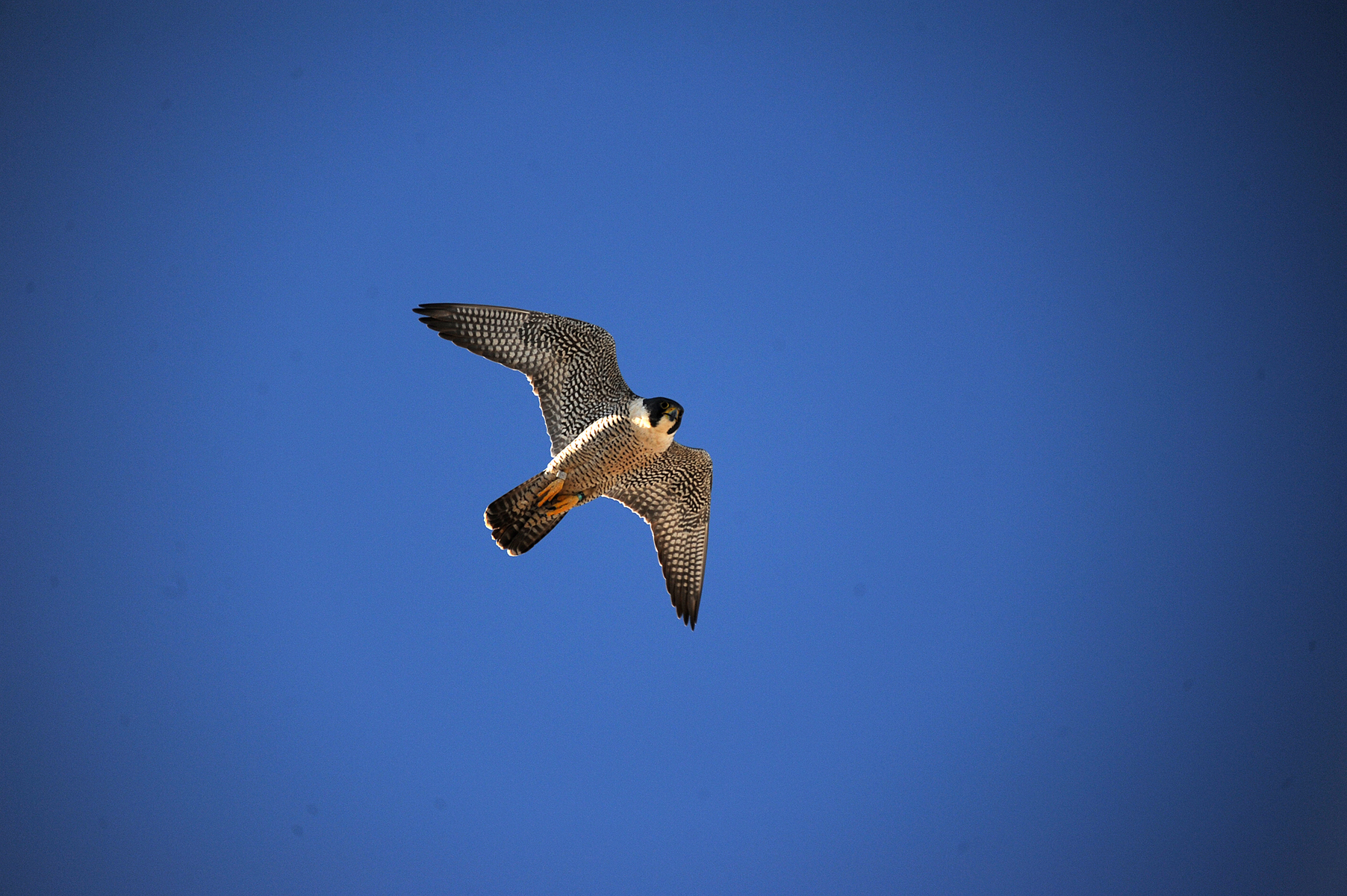
The above photo could be of any peregrine falcon from the continental United States. But, with the use of auxiliary “field readable” leg bands (NJ falcons where a black federal band on their right leg and a bi-color [green-black] band on their left leg) we know that this is 79/AN, a one year old falcon with roots in Jersey City, New Jersey. She originated at a nest atop 101 Hudson St., where an online camera has broadcast the live stream since the early 2000’s. If you watched her grow up then you know that she came from a special breed of falcons: absolute fearless and truly dedicated ones. I know I’ll never forget banding her…it was quite the memorable experience.

But she was the last of their kind. Ivy’s adopted parents at Jersey City were replaced with new adults in the winter of 2014-15 and their nest site was taken over by new adults. Today, the bands on her legs allow us and others the ability to properly identify her in the field. Without the bands that she wears, we would not know anything about the bird in this photo. Instead we know that 79/AN or “Ivy” as she’s been named has been hanging around several existing nest sites in Toronto. These nest sites are dominated by older (and now infertile) adult females. Could Ivy be setting the stage for a nest takeover of her own?

Only time will tell… She’s been seen there for several months now (after being re-captured in September), and it does seem like she has no reason to leave, with an aging population of breeding falcons, plentiful prey (like pigeons, doves and blackbirds), and plenty of rooftops, it sounds great for young falcons like 79/AN!

This also goes to show that banding young falcons in New Jersey is a critical tool for biologists to be able to learn a lot about them, including their age, mortality rate, breeding success, migration patterns, turnover rates, and more. We’re excited for future updates from the Canadian Peregrine Foundation, who monitor these majestic birds in Canada. The Jersey City Falcon Cam will be re-activated in mid-February.

Osprey Pair Get A New Home

Students install a new nesting platform for Avalon ospreys

by: Larissa Smith, Wildlife Biologist/Volunteer Manager

Volunteers and Students from Cape May County Technical School

One lucky pair of ospreys received a brand new nesting platform due to the effort of volunteers and students from the Cape May County Technical School! Dedicated osprey project volunteer Matt Tribulski reached out to CMC Tech Natural Science teacher Hanna Toft, regarding replacement of an aging platform in the Avalon back bay. Hanna is an osprey project volunteer and bander and incorporates the osprey project into her curriculum. The nest that was replaced was an old four poster that was unstable and not predator proof. The nest was located at the edge of the water causing the birds to get off the nest every time a boat or jet ski went by (which in the summer is quite frequently).


Hanna had a platform available that her students had built last year. We couldn’t have picked a better day for the install, the weather was gorgeous and warm for November. We met Hanna and eight of her students out on the water. The new platform was placed further back from the water and has a predator guard. The students removed the old platform, leaving some posts for the ospreys to perch.


We hope that the birds like their new home when they return in the spring.


Thank you to Matt, Hanna and her students for all of their help!

[slideshow]

Learn More:


Larissa Smith is the Volunteer Manager/Wildlife Biologist for Conserve Wildlife Foundation of New Jersey.


Jersey City Falcon ruffles some Canadian feathers!

79/AN or “Ivy” thriving in Toronto

by Ben Wurst, Habitat Program Manager


Look at that plumage! A beautiful two year old female peregrine falcon. Photo courtesy Tommy Thompson Park Bird Research Station.

I’ll never forget banding this particular eyas. Here’s a flashback entry of Nestbox News after the banding:


“The banding day when as smooth as it could. I found I would be all alone with banding there the evening before (Kathy was too engulfed in budgeting to join me). So, for the first time I would be banding at JC (Jersey City) all alone. I have banded young falcons before, so I wasn’t worried. If you know me, I like a good challenge! Six guests joined me to watch at 101 Hudson St. and our Executive Director, David Wheeler would be joining us to help. However, things changed rapidly.. Shortly after arriving I got a call from David that he had vehicles issues while only 1 mile away! He was stuck and could not abandon his car, which was a rental…bummer! I was all on my own now. For safety reasons, I was the only person allowed on the roof to grab the eyas. Easy, right? I thought so… I had all my gear: helmet, umbrella, gloves, box. Check. I headed out onto the roof to grab the eyas. As soon as I opened the door the adult female came diving down from the upper parapet to drive me off. We use an umbrella to ward her off. Since Kathy had the usual umbrella, I brought my wife’s. When I had to grab the eyas I needed two hands, so with no helper (to hold the umbrella) I sat it down on the edge of the nestbox and on my helmet. I quickly load the eyas in the box. I hear the female swoop down towards my head. The umbrella is gone! She took my wife’s umbrella and flew off with it! I bring the eyas inside, examined her (determined its a female) and band her legs for future tracking. All in all, everything went well considering the circumstances. I never found the umbrella…” —Fast forward to this past March… I got the umbrella back!! Building engineers at 101 Hudson St. found my wife’s umbrella on a ledge of the building.


Ivy to other sites
Map of nest sites and the banding station.

After an uneventful season for all of us Falcon Cam viewers this year we need some positive news… Well, last week 79/AN or “Ivy” was re-captured at a banding station outside of Toronto, Canada. She has also caused quite a news storm up there! After she was captured Tracy Simpson, Raptor Centre and Education Coordinator with the Canadian Peregrine Foundation started to piece together the puzzle…


“We were talking about her last night and thinking, “Oh yeah, remember that sub (adult) that showed up at that one nest a few times…  …and don’t forget that other incident downtown. Could that have been Ivy?”  So she is suspect number one in several incursion incidents around the southern province all along the lakeshore area.” said Tracy. Apparently Ivy is working her way into the local peregrine falcon scene, which looks to be pretty active up there.


Sporting her bands. Photo courtesy Tommy Thompson Park Bird Research Station.

Ivy was caught in a mist net at a hawk watch/banding station, called the Tommy Thompson Park Bird Research Station. She was described as a “cracking female Peregrine falcon” who was already banded. They assumed she was a Toronto hatched falcon but after being caught they reported the bands to USGS and found out that she’s a Jersey City girl! Here’s a link to their post on Facebook with more photos.


Tracy informed me that they have some volunteers who are watching her interaction with the local resident pairs. She also said that Ivy “stands a real chance at finding a home here in Toronto.” We’re happy to know that 79/AN is alive and well in Canada. Hopefully we’ll get some more news on her in the future, all because she was banded!


Learn more:


Ben Wurst is the Habitat Program Manager for Conserve Wildlife Foundation of New Jersey.


A Second Chance At Life

CWF Biologist and Volunteers Find Foster Home for Osprey Chick

by Meghan Kolk, Volunteer

On July 6, I had the opportunity to participate in an osprey banding project with Larissa Smith (Wildlife Biologist/Volunteer Manager) and her husband Matt, who have been banding ospreys for many years. I was thrilled that Larissa invited me to tag along because I knew that it would be an amazing experience, but I had no idea it would be a day that I would never forget. I was expecting to get some good pictures and maybe even get to hold an osprey, but we came upon a situation that would make the day so much more rewarding.

osprey chick found on ground July 6th, 2015, Avalon @ M. Kolk
Osprey chick found on ground July 6, 2015, Avalon Photo by M. Kolk

About half way through the day as Matt approached an osprey nest and got ready to climb up, he noticed a young osprey chick lying on the ground below the nest. It appeared weak and dehydrated, but uninjured. The nest above contained two older and larger chicks, and it became evident to us that the young runt was most likely pushed out of the nest by it’s competitive siblings. Our first thought was to put the chick back in the nest, however we knew that it would ultimately suffer the same fate, especially in it’s weakened condition. Our second thought was to take it to a rehabilitation facility, but since it did not appear to be injured we thought it would be best to keep it in the wild if possible. This brought us to our third option…find a foster home.


Meghan with chick@ L. Smith
Meghan with chick Photo by L. Smith

We offered the chick some much needed water and carried it back to the boat. I had the pleasure of holding and comforting our chick on the boat ride as we searched for the perfect nest. We came upon an empty nest holding three eggs which never hatched. The parents were lingering nearby and still seemed interested in parenting. We decided to give it a try. I was really enjoying my time with the chick and quickly grew attached, but I knew we had to get it into the care of some adults as soon as possible. Reluctantly, I climbed the ladder and placed the chick into it’s new home and said goodbye. We got back in the boat and watched from a distance to observe how the adults reacted.

Meghan placing chick into foster nest@ M. Tribulski
Meghan placing chick into foster nest Photo by M. Tribulski


One adult circled the nest many times observing from a distance. After several minutes it landed on the edge of the nest to get a closer look. I can just imagine the surprise and confusion it must have felt, but I was hoping that it was happy to see the little bundle of joy. After a few more minutes the partner joined in the nest, and we continued on with our banding to give them a little time to adjust.


Before finishing for the day, we went back to check on the nest. We were relieved to see both foster parents in the nest, and already protecting their adopted chick by swooping at us as we got close. It seemed as though they had already accepted the chick as their own.


Two days later Matt went back to the nest to check on the foster family. The chick looked stronger and had a full crop. This made it clear that the parents were feeding it since the crop was completely empty on the day we found it. About three weeks later, at the end of July, he checked on the nest once more and found our foster chick in good health and growing. I was so elated to hear the news and to know that our rescue mission was a success and this wonderful bird got a second chance at life.

Chick in foster nest July 29th, 2015 @ M. Tribulski
Chick in foster nest July 29, 2015 Photo by M. Tribulski

This experience was so rewarding for me because even though we had to intervene, we were able to let the natural instinct of the osprey take over to raise this abandoned chick in need. I now have an even greater respect for ospreys because they will care for young that are not their own. This is an important characteristic for a threatened species to have in order to keep the population growing.


This particular chick experienced both the competitive instincts of it’s siblings fighting for survival, and also the protective instincts of it’s foster parents who put all of their energy into raising it. I feel so thankful to have been a part of this success story, and it reinforces all the reasons that I will continue to be a volunteer. Being able to make a difference even to just one individual is all the reward I need.


Learn more:


Meghan Kolk is a Volunteer for the Conserve Wildlife Foundation of New Jersey.
Photography Show to Celebrate Long Beach Island’s Wildlife

Hiding in Plain Sight” to Take Place on Friday, August 14 at Ann Coen Gallery in Surf City

By: Lindsay McNamara, Communications Manager

Ann Coen Conserve Wildlife Postcard

On Friday, August 14 at 6 PM, the Ann Coen Gallery will host “’Hiding in Plain Sight:’ Celebrating LBI’s Wildlife,” a photography show featuring three talented local outdoor photographers.


This – free and open to the public – event will feature a clam bar, refreshments, acoustic music, and the work of three local photographers, Eric Hance, Northside Jim and Ben Wurst, including handmade frames.


Despite their different backgrounds, all three shutterbugs are known to brave the elements all four seasons to bring rarely seen perspectives of our coastal species.


Eric Hance is a professionally trained photographer with beautiful fine art wildlife photographs. Northside Jim is an enthusiast with some outrageous and whimsical pictures showing the lives of local wildlife that live on the Island. Ben Wurst is the osprey expert who takes care of LBI’s osprey and habitat and captures stunning images of both in their most intimate moments.


“Hiding in Plain Sight” is a free event, and proceeds from the sale of photographs will benefit the work of Conserve Wildlife Foundation, a private, statewide nonprofit dedicated to protecting New Jersey’s endangered and threatened species. Photos of Humpback Whales, Bald Eagles, Osprey, Piping Plover, Terrapin, Black Skimmers, and other amazing endangered species that can be found on the Island will be on display at the Ann Coen Gallery.


“I am really excited to host this show and these three photographers. The body of work between them should prove to be very eye-opening to locals and vacationers,” explained Gallery Owner Ann Coen. “I don’t think too many people realize the wildlife we have right in our own backyard. When I approached each photographer for the show, they were all in agreement right from the start that a portion of their sales would go right back to Conserve Wildlife Foundation, which really motivated me and showed the importance each photographer places on the conservation of our wildlife here in New Jersey.”


Eric Hance is a photographer for Ann Coen Photography. His goal is to captivate viewers in the simplest form; to capture a specific scene in the strongest way.


Northside Jim is a self-proclaimed “beach bum with a camera,” from North Beach. He uses a camera to experience, to learn about, and to share stories about LBI’s creatures on his popular blog, Readings From The Northside.


Ben Wurst, photographer and Habitat Program Manager for Conserve Wildlife Foundation, is responsible for managing and protecting ospreys as part of the New Jersey Osprey Project. In addition to photography, Wurst is known for his woodworking with reclaimed materials with his small business, reclaimed LLC.


“Being able to utilize my skills to help raise critical funding and awareness for rare wildlife is a dream come true for me,” exclaimed Conserve Wildlife Foundation’s Ben Wurst. “Working with these species in New Jersey is what spawned my interests in both hobbies. Now they have progressed into lifelong passions of mine. I consider myself lucky to be on the roster for this show!”


Doors open at the Ann Coen Gallery, 1418 Long Beach Blvd. in Surf City, New Jersey, at 6 PM on Friday, August 14 for Hiding in Plain Sight: Celebrating LBI’s Wildlife. The show will remain on display until Friday, August 21.


Learn more:


Lindsay McNamara is the Communications Manager for Conserve Wildlife Foundation of New Jersey.