Matt Tribulski places a young osprey back in its nest.
It’s osprey season. Osprey Survey Season, that is. However, we never like to start the season off with these types of emergency surveys, but with the increase of strong storms and extreme straight line wind events, they are becoming an annual event. Ospreys nest on platforms in open areas near water, so their young can easily become victims during these types of storms. After receiving a text message from my colleague Kathy Clark yesterday evening about the intensity of the storms, she said we should try to do a survey of the affected areas. I had other plans but I knew that those could wait. Continue reading “Emergency Osprey Nest Surveys in Cape May, Wildwood and Stone Harbor”
Boaters urged to not approach active osprey nest inside Barnegat Inlet
by Ben Wurst, Habitat Program Manager
Osprey Nest #3591
Yesterday, while working on Barnegat Bay, we visited this natural nest that is behind the dyke inside Barnegat Lighthouse State Park. This is the third time we’ve passed by to monitor their success. So far, so good and it looks like they now have young in the nest. As you can see the nest is built in a precarious location on a sandbar. When the sandbar is exposed people can walk right up to the nest. Last year the pair did not raise young but people did still walk up to the nest. With young, the adults will be more defensive of their nest to protect their young.
Technology has proven to be vital to Conserve Wildlife Foundation’s work protecting rare wildlife species over the years. Our biologists depend greatly on modern technologies to band, track, and share online the journeys of wildlife. Our webcams broadcast the most intimate behaviors of nesting birds and bats across the web. And we seek out ever-evolving communications technologies to spread the word about the inspiring stories of wildlife, from social media and infographs to e-books and Story Maps. These technologies offer newfound abilities to share complex data on multiple levels, while still incorporating the awe-inspiring photography and videos that bring wildlife’s stories to life.
Conserve Wildlife Foundation of New Jersey is excited to offer our 2015 Annual Report in a unique format that utilizes one of those technologies – Story Maps. In the past year, we have explored the lives of seals, eagles, and freshwater mussels with Story Maps – and the annual report allows all of our projects to be highlighted in this interactive format as well.
Visit the multiple pages within this Story Map to learn about Conserve Wildlife Foundation’s many projects and partnerships in 2015, and the imperiled wildlife species in need of our help. Find examples of the innovative and dedicated leadership of our biologists and volunteers. And take an online journey across the state to learn how our projects made a difference in all corners of New Jersey in 2015 – a great year for wildlife in the Garden State!
New document provides guidance to homeowners and landowners with osprey nest issues and focuses on the use of UAVs around active nests
by Ben Wurst, Habitat Program Manager
An osprey prepares to land on its nest on a chimney along the Jersey Shore. Work to identify, protect and remedy problem nests is crucial to their long term survival. Photo by Kevin Knutsen.
In New Jersey, we’ve seen the osprey population grow to an estimated 600 nesting pairs in 2015. As the population continues to grow, work to identify, protect, and remedy problem nests is crucial for their long term survival. Each year many new young adults return to their natal areas to find suitable areas to construct nests. Ospreys have a high level of site fidelity and usually return to the same areas where they originated (females do tend to wander more). A suitable nest site for an osprey is a high structure near water, usually away from human disturbance. However, ospreys can become more tolerant of disturbance if it can be expected and is not too close to their nest, especially for those birds that nest on tall structures.
Ospreys build large nests which can weight up to 200 lbs. They use sticks, grass, muck, seaweed, eelgrass, reeds, and often trash to build up their nests.
Around 75% of the state population nests on man-made platforms that are designed specifically for them. The other 25% is a mixture of nests built on other man-made structures and a few natural nests. Yes, ospreys do still nest in trees! But, trees that are suitable for them are few and far between. A suitable tree for an osprey is a standing dead tree (snag) or a tree with a top that has broken off. As the population continues to grow and there are fewer nest sites available on platforms and few suitable trees, more nests are being built on man-made structures where problems can arise. Ospreys are being pushed to nest in areas that are not always ideal, like on utility poles, stadium lights, emergency sirens, communication towers, boat lifts, docks, and even houses. Nests on utility poles can cause power outages and sometimes the nest might catch on fire or an adult can be electrocuted. Nests on houses, docks and boat lifts often limit use of such structures unless dealt with properly, but active nests cannot be removed without consulting with experts.
Osprey builds nest on chimney. Photo by Kevin Knutsen.
Lastly, it also provides some clear guidance on the use of UAVs near active osprey nests. UAV pilots must follow all FAA guidelines and not fly within 1,000 feet of any active osprey nest. To an osprey, a UAV looks like a potential predator. Ospreys will defend their nests and attack any potential predator at nest sites. Simply flying near a nest can add stress to birds and cause adults to fly off nests where their young are vulnerable to predation. Any pilot who flies within this area and pursues or harms an osprey or its young is in direct violation of the Migratory Bird Treaty Act. We ask that all UAV pilots use caution to protect the safety of our ospreys and other birds.
Enhancing public access to Barnegat Bay and its inhabitants!
by Ben Wurst, Habitat Program Manager
Ben Wurst describes the Nature Trail from the rooftop deck of Science Building at LBIF. Photo by Kyle Gronostajski.
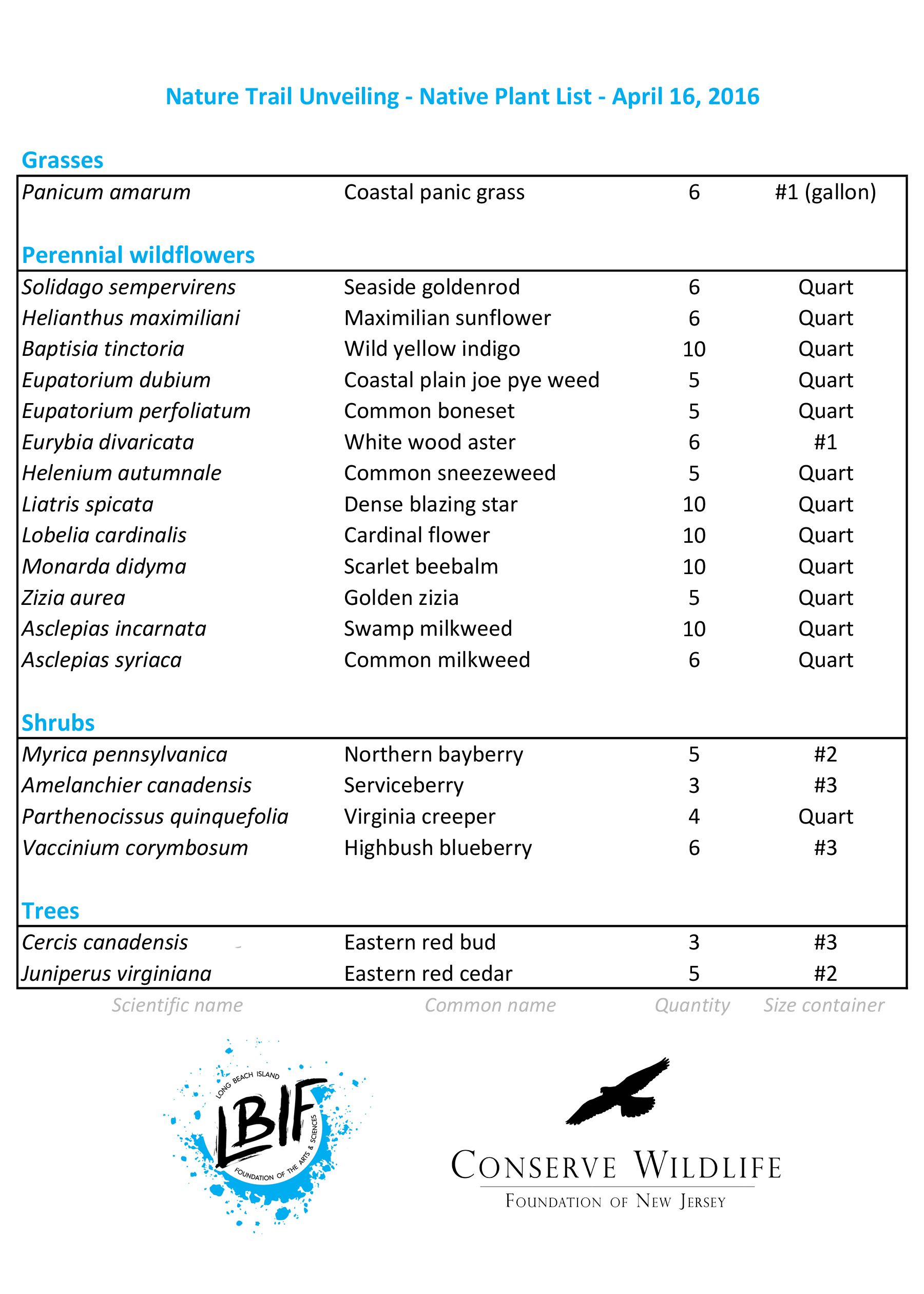
This past Saturday we “unveiled” the new Nature Trail at the Long Beach Island Foundation of the Arts & Sciences (LBIF). At the event we also conducted our first native plant sale, with lots of wildlife friendly plants, including milkweed, goldenrod, joe pye weed, bayberry, red cedar and many others. I lead guided tours along the trail to point out key features and work that we’ve done at LBIF. Our first stop was to the roof top of the Science Building, which is one of my favorite views. It provided visitors an opportunity to see what is the core foundation for our work, Barnegat Bay and some of the wildlife that we work tirelessly to protect and monitor: ospreys and northern diamondback terrapins, in particular.
2015 New Jersey Osprey Report documents close to 600 pairs up from low of 50 pairs
by Lindsay McNamara, Communications Manager
Bill Clarke, project supporter holds a young and feisty osprey that Ben Wurst prepares to band with a red auxiliary band on Barnegat Bay. July, 2015. Photo by Northside Jim.
Today, we released the 2015 New Jersey Osprey Report with our partner New Jersey Division of Fish and Wildlife’s Endangered and Nongame Species Program (ENSP). The report highlights the continued recovery of this threatened bird of prey.
“Ospreys are an important indicator of the health of our coastal ecosystems, so it is important to track the health of their population. Their continuing recovery is a very promising sign for our estuaries and the fish and other wildlife that depend on clean water to survive” stated Conserve Wildlife Foundation executive director David Wheeler. “Today, no visit to a coastal waterfront would be the same without the magnificent sighting of an osprey soaring above or crashing down to the water’s surface for a fish.”
Though only about 50 osprey pairs remained in New Jersey in the early 1970s, the report documents close to 600 pairs using a total of 534 active nests in 2015, more than any other year in the project’s history.
CWF and ENSP survey an estimated 80% of the population and create an accurate representation of overall health. Biologists have come to rely on the assistance of specially trained volunteers (osprey banders) and many “Osprey Watchers” who report nests on Osprey-Watch.org.
“The vital work of our volunteers helps us keep our finger on the pulse of the population,” said Kathy Clark, supervising biologist with the DEP’s Endangered and Nongame Species Program. “Having dedicated volunteers is a great long-term monitoring tool and really strengthens the team’s ability to cover the state osprey population effectively.”
“Over the past few years we’ve really seen a shift in how we can track the overall health of the osprey population. In previous years, the use of aerial helicopter surveys to document the size and health of the statewide population allowed biologists to reach large areas, but was also very expensive,” stated Conserve Wildlife Foundation habitat program manager Ben Wurst. “Today, we utilize volunteers to help collect much of this valuable data. These ‘Osprey Watchers’ can view all nests, report nest activity, and other data online that we can, in turn, use to track the statewide population. The use of Osprey-watch.org also helps to raise awareness and educate citizens about ospreys and current environmental issues that aquatic ecosystems face today, including global climate change, depletion of fish stocks, and environmental contaminants.”
As in previous years, biologists and dedicated volunteers conducted ground surveys in mid-summer. These surveys were conducted in the most densely populated colonies of nesting ospreys in New Jersey. From the Meadowlands, south to Cape May, and west along Delaware Bay, a sample of each major colony is checked and nest outcome data are used to determine how well our ospreys are faring. During these surveys, the health of nestlings is assessed and they are banded with USGS bird bands for future tracking. Since this is usually the only visit to nests each year, the condition of the nesting platform is also noted and repairs or replacement are scheduled for the non-breeding season.
In 2015, CWF continued to band young ospreys produced in Barnegat Bay with a red, alpha-numeric coded auxiliary band. Project RedBandis focused on ospreys that nest in the Barnegat Bay watershed from Point Pleasant to Little Egg Harbor. The main goal of the project is to engage the public in osprey management and conservation along the Jersey Shore. At the same time, while collecting data from re-sightings, biologists will learn about their dispersal, foraging habits, site fidelity, migration routes, and life span. This year 33 bands were deployed, putting the total in the field at 95. 2016 marks the first year that red banded ospreys (from 2014) will start to return here from their wintering grounds in South America.
2015 Report Highlights:
In 2015, 423 known-outcome nests fledged an average of 1.74 young per active nest. That rate has averaged 1.75 in recent years, remaining well above the minimum necessary for a stable population (1.0 young/active nest).
The 2015 productivity rate was near the long term average and suggests the population will continue to grow.
Thirty-one new nests were found this year, and we combined that number with last year’s census to estimate the overall population close to 600 pairs.
The next statewide census will occur in 2017.
Of the 423 known-outcome nests, 347 were found along the Atlantic Coast and 76 were found on Delaware Bay.
A total of 737 young were produced from these known-outcome nests.
A total of 432 young were banded by volunteers and biologists with USGS leg bands for future tracking.
Population growth remains around 10% since approximately 2009.
You can help protect New Jersey’s ospreys and all other rare wildlife by supporting ENSP’s New Jersey Endangered Wildlife Fund when you file your state income tax this year and every year. Simply look for Line 59 on your NJ 1040 income tax return, and check-off for wildlife. Every dollar you donate goes directly to ENSP, enabling biologists to continue their work to restore, conserve and enhance New Jersey’s populations of rare species. What’s more, your contribution is matched with an equal amount of federal funding, further strengthening efforts to protect hundreds of imperiled species.
Lindsay McNamara is the Communications Manager for Conserve Wildlife Foundation of New Jersey.
Volunteers and Students from Cape May County Technical School
One lucky pair of ospreys received a brand new nesting platform due to the effort of volunteers and students from the Cape May County Technical School! Dedicated osprey project volunteer Matt Tribulski reached out to CMC Tech Natural Science teacher Hanna Toft, regarding replacement of an aging platform in the Avalon back bay. Hanna is an osprey project volunteer and bander and incorporates the osprey project into her curriculum. The nest that was replaced was an old four poster that was unstable and not predator proof. The nest was located at the edge of the water causing the birds to get off the nest every time a boat or jet ski went by (which in the summer is quite frequently).
Hanna had a platform available that her students had built last year. We couldn’t have picked a better day for the install, the weather was gorgeous and warm for November. We met Hanna and eight of her students out on the water. The new platform was placed further back from the water and has a predator guard. The students removed the old platform, leaving some posts for the ospreys to perch.
We hope that the birds like their new home when they return in the spring.
Thank you to Matt, Hanna and her students for all of their help!
CWF Biologist and Volunteers Find Foster Home for Osprey Chick
by Meghan Kolk, Volunteer
On July 6, I had the opportunity to participate in an osprey banding project with Larissa Smith (Wildlife Biologist/Volunteer Manager) and her husband Matt, who have been banding ospreys for many years. I was thrilled that Larissa invited me to tag along because I knew that it would be an amazing experience, but I had no idea it would be a day that I would never forget. I was expecting to get some good pictures and maybe even get to hold an osprey, but we came upon a situation that would make the day so much more rewarding.
Osprey chick found on ground July 6, 2015, Avalon Photo by M. Kolk
About half way through the day as Matt approached an osprey nest and got ready to climb up, he noticed a young osprey chick lying on the ground below the nest. It appeared weak and dehydrated, but uninjured. The nest above contained two older and larger chicks, and it became evident to us that the young runt was most likely pushed out of the nest by it’s competitive siblings. Our first thought was to put the chick back in the nest, however we knew that it would ultimately suffer the same fate, especially in it’s weakened condition. Our second thought was to take it to a rehabilitation facility, but since it did not appear to be injured we thought it would be best to keep it in the wild if possible. This brought us to our third option…find a foster home.
Meghan with chick Photo by L. Smith
We offered the chick some much needed water and carried it back to the boat. I had the pleasure of holding and comforting our chick on the boat ride as we searched for the perfect nest. We came upon an empty nest holding three eggs which never hatched. The parents were lingering nearby and still seemed interested in parenting. We decided to give it a try. I was really enjoying my time with the chick and quickly grew attached, but I knew we had to get it into the care of some adults as soon as possible. Reluctantly, I climbed the ladder and placed the chick into it’s new home and said goodbye. We got back in the boat and watched from a distance to observe how the adults reacted.
Meghan placing chick into foster nest Photo by M. Tribulski
One adult circled the nest many times observing from a distance. After several minutes it landed on the edge of the nest to get a closer look. I can just imagine the surprise and confusion it must have felt, but I was hoping that it was happy to see the little bundle of joy. After a few more minutes the partner joined in the nest, and we continued on with our banding to give them a little time to adjust.
Before finishing for the day, we went back to check on the nest. We were relieved to see both foster parents in the nest, and already protecting their adopted chick by swooping at us as we got close. It seemed as though they had already accepted the chick as their own.
Two days later Matt went back to the nest to check on the foster family. The chick looked stronger and had a full crop. This made it clear that the parents were feeding it since the crop was completely empty on the day we found it. About three weeks later, at the end of July, he checked on the nest once more and found our foster chick in good health and growing. I was so elated to hear the news and to know that our rescue mission was a success and this wonderful bird got a second chance at life.
Chick in foster nest July 29, 2015 Photo by M. Tribulski
This experience was so rewarding for me because even though we had to intervene, we were able to let the natural instinct of the osprey take over to raise this abandoned chick in need. I now have an even greater respect for ospreys because they will care for young that are not their own. This is an important characteristic for a threatened species to have in order to keep the population growing.
This particular chick experienced both the competitive instincts of it’s siblings fighting for survival, and also the protective instincts of it’s foster parents who put all of their energy into raising it. I feel so thankful to have been a part of this success story, and it reinforces all the reasons that I will continue to be a volunteer. Being able to make a difference even to just one individual is all the reward I need.