Marine Mammal & Sea Turtle Week (Part 5 of a 5-part Series)

With Memorial Day Weekend upon us, summer is unofficially here for New Jerseyans. That means plenty of tourists enjoying shore, sand, surf, and sun – but it also means other types of annual summer visitors to our coast: bottlenose dolphins, sea turtles, and whales. However, what may be inspiring sightings from a healthy distance can become tragic encounters when marine animals become stranded or entangled in nets.

This story marks the fifth of five blog stories spotlighting New Jersey’s marine mammals and sea turtles – and educating people how to help animals in need, rather than make a bad situation worse.

Part 1, Monday, revealed the bottlenose dolphin die-off striking the Eastern Seaboard. Part 2, on Tuesday, featured a Question-and-Answer on the dolphin mortality event with NOAA’s Mendy Garron. Part 3, on Wednesday, looked at how people can safely help stranded wildlife. Part 4, yesterday, investigated the fascinating condition of cold-stunned sea turtles. Part 5, today’s blog entry, discusses the importance of reporting marine mammal and sea turtle sightings and how to do so.


MARINE MAMMAL & SEA TURTLE WEEK: Reporting Your Marine Mammal & Sea Turtle Sightings

By Michael J. Davenport, Marine Species & GIS Programs Manager

Conserve Wildlife Foundation (CWF) staff work with the New Jersey Endangered and Nongame Species Program (ENSP) to manage and populate the state’s official database of rare wildlife, known as Biotics. Currently, this database contains over 39,000 animal and plant records within New Jersey. ENSP and CWF currently collect and enter data for the state’s 182 endangered, threatened, and special concern species.whaleCWF_2014edit

Although much of the information within Biotics on imperiled species is received from CWF and ENSP biologists, a great deal of useful data is also submitted by the public since, although NJ is a relatively small state, the biologists are unable to survey all areas at all times. The biologists rely on these “citizen scientists” to help them monitor areas which they are unable to and/or locate the presence of species in areas in which they were previously unknown to occur. Wildlife watchers who observe rare wildlife may report such observations by submitting a Rare Wildlife Sighting Report Form which then gets processed and mapped by CWF staff.

Rare species data within the Biotics database plays a critical role in wildlife and habitat conservation within New Jersey. It is used for a number of scientific and conservation efforts such as the state’s Landscape Project and Critical Wildlife Habitat Mapping, environmental review, research (GIS modeling), status review (determining whether a non-listed species should become listed as endangered or threatened and vice versa), and it also assists biologists in targeting future survey efforts to new areas.

A Rare Wildlife Sighting Report Form is available on ENSP’s website for download as well as instructions for completing the form – there is also a Marine Wildlife Sighting Report Form, specifically for reporting sighting of marine mammals and sea turtles. A complete list of all of the species tracked by the state can be downloaded here.

Reporting your rare wildlife observation is easy. Simply complete the form, attach a map of where the animal was observed (a map is not necessary for marine sightings; geographic coordinates may be submitted instead), as well as any photographs taken, and then mail or e-mail the form and any additional documentation to ENSP at the address provided on the form. For more details about the state’s rare species mapping, please visit our webpage.

An injured seal ashore in Ocean Grove, NJ. © Michael J. Davenport

Observations of dead, dying, or stranded marine mammals or sea turtles should be reported to the Marine Mammal Stranding Center at 609-266-0538. Keep in mind, however, that a seal on the beach is not necessarily sick or injured. Resting on the beach is normal behavior for seals. They may haul-out onto beaches, jetties, or floating docks to rest or escape predators. So, a seal on land is not necessarily a seal in distress. Obvious indications of illness or injury are open wounds, entangled fishing line, or lack of responsiveness to their surroundings.
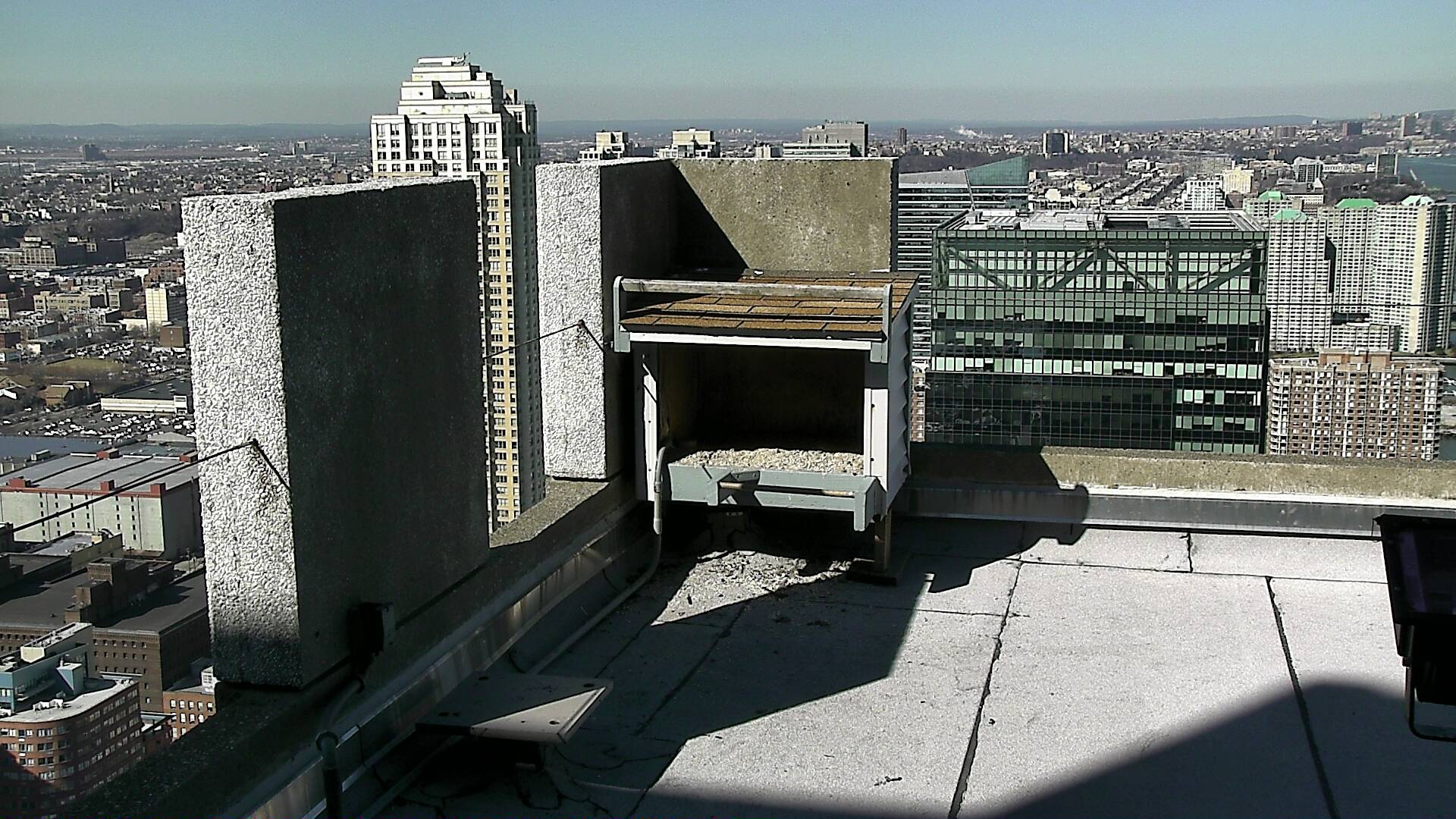
 

First look: Jersey City Falcon Cam

First glimpse from the new Falcon Cam at 101 Hudson St.

by Ben Wurst, Habitat Program Manager

First view from the new camera at the Jersey City peregrine falcon nest.

Yesterday we made the trip to 101 Hudson St. to install the new digital camera system at the Jersey City peregrine falcon nest.  I was joined by Kathy Clark, Supervisory Zoologist with ENSP, Charlene Smith, CWF and Paul Tarlowe, NJDFW, who all helped to remove the old system and to install the new one. Our main goal was to complete any work that took place outside, so if we needed to go back we would not disturb the nesting pair. Last year they laid their first egg on April 4th. After being there for over 5 hours we managed to get two new cameras installed. One camera (a pinhole) gives us an eye level perspective from inside the nestbox. The other (pictured above) will allow us to zoom and pan to see everything on the roof of the building, including the nestbox and the NYC skyline.

We were surprised that the nesting pair, who were present the whole time we were there, were quite passive. These birds, especially the female, are quite aggressive and are known to dive bomb and hit biologist on the head if you go near the nestbox! We were very careful as to not be causing any stress to the birds while there.

The camera is not online yet. We need to go back to the site next week to configure the network settings so that we can stream the camera feed(s).

Thank you to everyone who supported our Save the Jersey City Falcon Cam campaign. Although we have not yet reached our initial $10,000 goal, we believe that fans of the Falcon Cam will give once the camera goes live! So to be clear – contributions are still desperately needed. Please help support the Falcon Cam!

Bonus shots from Zoologist Kathy Clark with the Endangered and Nongame Species Program:

Adult male.
Adult male. Photo by Kathy Clark/ENSP.
Adult female.
Adult female. Photo by Kathy Clark/ENSP.

Basic Training Course for Wildlife Rehabilitation

ANNOUNCEMENT:

Basic Training Course for Wildlife Rehabilitation

Where:  Mercer County Community College

When:  Weekdays Nov 4 – Nov 8, 2013


A young Barn Owl, healed of a leg fracture and about to be returned to its nest.  Photo by MacKenzie Hall
A young Barn Owl, healed of a leg fracture and about to be returned to its nest. Photo by MacKenzie Hall

Wildlife rehabilitation is the process of  caring for injured, ill and orphaned native wild animals with the goal of releasing each back to their natural habitat.  This course is designed for individuals interested in becoming licensed wildlife rehabilitators, rehabilitators who wish to include additional species to their current permit and any person wishing to obtain knowledge about native New Jersey wildlife. Over the course of five (5) weekdays, students will have the opportunity to be taught by, interact with, and build relationships with some of the foremost experts in wildlife rehabilitation.


Course Description


The Basic Training Course for Wildlife Rehabilitation focuses on the skill sets necessary to become a successful wildlife rehabilitator. This course offers information and professional training provided by some of the most knowledgeable instructors in the field of wildlife rehabilitation. It includes history, licensing requirements and regulations, mammal, bird and reptile species identification and anatomy, proper handling, care and nutrition, medical procedures, and much more. Approved by the New Jersey Division of Fish & Wildlife (NJDEP), this course is part of an alternative route program to meet New Jersey State licensing requirements for wildlife rehabilitators. Successful completion of the course will count for 40 hours toward the 200 hour New Jersey apprenticeship licensing requirement. This course will also benefit anyone interested in the handling and care of native wildlife. 


Objectives


Upon successful completion of this course, participants will be able to:


  • better understand all aspects of wildlife rehabilitation
  • know how to provide safe handling and care of wildlife
  • have basic knowledge that encompasses mammal, avian and reptile species


The course will run five weekdays Nov 4 through Nov 8, 2013 from 9:00 am to 5:00 pm each day. Completion of the course requires attendance at all classes. The course schedule and instructor bios can be found on the CDI website at www.cditraining.org.

Tuition for this program is $499.00, which includes all materials. Registration will be through Mercer County Community College at 609-570-3311. There is no requirement for prior experience or training to attend this course. Please contact Career Development Institute (CDI) with any additional course content questions that you may have:  732-821-6997, www.cditraining.org.

PLOVERPALOOZA!

Piping plover chicks exercise their wings. © Bill Dalton

The entire staff at CWFNJ works tirelessly to protect our state’s at-risk wildlife, educate the public, and raise funds to continue our work.  It is especially gratifying when those efforts are recognized –  We are thankful to the blog,  Readings from the Northside, who recently wrote about CWF’s Todd Pover and his work to protect the piping plovers of Long Beach Island. 

Read the Blog Post here, and make a donation today to help continue our work to protect beach-nesters and all of NJ’s rare wildlife.

Attend the NJ Wildlife & Conservation Conference on April 26th

Public invited to hear expert panels on invasive species, wildlife disease, and other threats facing sportsmen and wildlife conservationists

NJWCC logoHunters and birdwatchers alike will come together for the first annual New Jersey Wildlife and Conservation Conference on April 26, 2013 in Eatontown, New Jersey. Conserve Wildlife Foundation of NJ (CWF) is partnering with the New Jersey State Federation of Sportsmen’s Clubs and the New Jersey Division of Fish & Wildlife to host these expert panels at the Sheraton Eatontown Hotel at 6 Industrial Way East in Eatontown, N.J.

“Working together for wildlife was the catalyst that blurred the lines between the Federation camouflage and Conserve Wildlife green, enabling us to partner together and tackle the complex fish and wildlife issues facing New Jersey today,” said Frank Virgilio, President of the New Jersey State Federation of Sportsmen’s Clubs.

The inaugural conference will feature panels of wildlife experts from New Jersey Audubon, the New Jersey Outdoor Alliance, and many other organizations, exploring timely and controversial issues ranging from invasive species and wildlife disease to our declining forest health and conservation advocacy.

“The many conservation enthusiasts in New Jersey owe a great deal to sportsmen, who practiced wildlife conservation long before it entered national consciousness,” said CWF Executive Director David Wheeler. “Today our shared interests have led to countless success stories, protecting New Jersey’s valuable habitat and wildlife species during a time when we face more challenges than ever. This conference will tackle those issues with the most timely and meaningful information available.”

Individuals or companies seeking to register should visit www.ConserveWildlifeNJ.org.  Discounted rates for attending are as low as $20 for the all-day panels.

Large turnout expected for osprey platform build day

Conserve Wildlife to repair or replace any platforms lost from Sandy

by Ben Wurst, Habitat Program Manager

Osprey pair in nest platform repaired by CWF staff in early 2012. © Brian Kushner

On Saturday, January 19, Conserve Wildlife Foundation of NJ (CWF) will host an osprey platform construction day from 10:00 am to 3:00 pm at Tuckahoe Wildlife Management Area in Woodbine, New Jersey. Volunteers who signed up in advance are helping to build up to 20 new platforms to replace those lost or damaged in Superstorm Sandy.

Constructing these platforms now will allow CWF time to install them before the start of the osprey nesting season in April. Ospreys mate for life and typically return to the same nest year after year.

Since Sandy slammed into the coast of New Jersey in late October, biologists with CWF have been actively surveying and assessing damage to habitat that wildlife needs to survive. Many osprey nesting platforms were right in the middle of the high winds and strong storm surge associated with Sandy. The majority of the platforms weathered the storm; others need repairs or must be replaced. We have already installed 5 new nesting platforms. Two platforms were installed on December 1st on Herring Island (N. Barnegat Bay) in an area of homes that sustained significant damage. The other three platforms were installed in the Wildwood area.

Volunteers!

HELP MAKE OUR WORLD GO ‘ROUND

by MacKenzie Hall, Biologist

Robert Hergenrother, in his natural habitat.

The Conserve Wildlife Foundation is a small staff with a lot going on.  If you glance through our conservation projects, you’ll see that volunteers have a role in almost everything we do.  This hardy fleet of dedicated helpers allows us to cover more ground, stretch our dollars, reach wider audiences, and continue our upward and outward evolution as a group.

We’ve featured a handful of people on our Volunteer Profiles page so far, with Robert Hergenrother being the most recent.  We enjoy learning more about their unique backgrounds and interests and hope you’ll check them out, too.  

Thank you to ALL of our wonderful volunteers!

CWF VOLUNTEERS GO “CAMP” ing

RESULTS FROM THE 2012 SURVEY SEASON.

Northern Gray Treefrog © Thomas Gorman

By: Larissa Smith: Wildlife Biologist/Volunteer Manager

When people first hear the word CAMP they might think of going out in the woods and setting up a tent, but CWF’s CAMP project is all about monitoring New Jersey’s amphibian population. CAMP stands for the Calling Amphibian Monitoring Project.

In 2012 33 volunteers participated and surveyed a total of 33 routes out of 63. Volunteers conduct roadside surveys (after dusk) for calling amphibians along designated routes throughout the state. Each 15-mile route is surveyed three times during the spring. Each route has 10 stops, where volunteers stop, listen and record all frog and toad calls for 5 minutes.

In 2012 15 out of the 16 New Jersey amphibian species were detected. The only species not detected was the Eastern Spadefoot.  Northern Spring Peepers were the most common species detected on 31 of the routes while Green Frogs were detected on 22 routes.  Both the American Bullfrog and Southern Leopard Frog were heard on 16 of the routes.

In NJ there are four frog and toad species of conservation concern; the Southern gray Treefrog  is a state endangered species, the Pine Barrens Treefrog  is a state threatened species, and the Carpenter Frog and Fowler’s Toad are both  special concern species. The Southern Gray Treefrog was detected on 2 of the CAMP route, the Pine Barren Treefrog on 3 of the routes, the Fowler’s Toad on 13 of the routes and the Carpenter Frog on 7 of the routes.

CAMP data is entered into the North American Amphibian Monitoring  Program (NAAMP)  database housed by the USGS Patuxent Wildlife Research Center. All of the occurrence data for these species is  extracted from the NAAMP database, quality checked for validity, and entered into the Biotics database by CWF & ENSP staff. These data will then be used in future versions of the Landscape Project maps.  These maps are used by planners in various state, county, municipal and private agencies to avoid conflict with critical wildlife habitat.

Thank you to all CAMP volunteers!

WOULD YOU LIKE TO HELP IN 2013?

  • Twenty-five routes are available for the 2013 season
  • For more information on volunteering e-mail:  Larissa.Smith@conservewildlifenj.org


Imagine A Halloween Without Bats

No chocolate, few tropical nuts and fruits, more insect pests…

Just the mere thought of no chocolate makes us frightened!

Big brown bats in an attic space. (c) Phil Wooldridge

Bats are one of the most beneficial animals to humans. They play key roles in the environment, eating bothersome insects, pollinating flowers, and dispersing seeds.  Unfortunately, across the world, and here in the Garden State, bats continue to face many threats including habitat loss and disease such as white-nose syndrome.  White-nose syndrome, alone, can kill 90-100% of bats in affected caves.

But you can help!  This year, why not trick or treat for bats? 

Collect your trick or treat money and make a donation to CWF!  Thank bats for all the wonderful benefits they provide to us.  Halloween wouldn’t be the same without bats and delicious m&m’s, snickers, and almond joys.

Make a donation to Conserve Wildlife Foundation of NJ and help us to protect NJ’s bat population.

Or consider adopting an Indiana bat, NJ’s federally endangered bat, to help protect its future here in NJ.

To learn more about how bats benefit humans, read on!

Bats are primary pollinators of many tropical fruits like bananas, mangoes, and dates, guavas, and figs.  The agave cactus relies on bats for pollination.  No agave = no tequila (scary!)

Bats also help in seed dispersal.  In fact, seeds dropped by bats can account for up to 95 percent of forest regrowth on cleared land.  Bats spread the seeds of almonds, cashews, and chocolate.  Did you read that?  CHOCOLATE!  Bats help us to have more cacao trees, which produces the yummy main ingredient of our favorite Halloween treats!

Closer to home in New Jersey, bats eat bugs, and a lot of them.  All nine species of bats found inNew Jersey eat insects, consuming one-third of their weight in bugs each night.  Bats play essential roles in keeping populations of night-flying insects in balance. Just one bat can catch hundreds of insects in an hour, and large colonies catch tons of insects nightly, including beetles and moths that cost American farmers and foresters billions of dollars annually, not to mention mosquitoes in our backyards.

Learn More

Have You Seen This Bird?

LOOKING FOR HELP FROM BIRDWATCHERS TO FILL-IN DATA GAPS

By Michael Davenport, Marine Species & GIS Programs Manager

Young barn owls. Photo by MacKenzie Hall.

Conserve Wildlife Foundation staff work with the New Jersey Endangered and Nongame Species Program (ENSP) to manage and populate the state’s official database of rare wildlife, known as Biotics.  Currently, this database contains over 35,000 animal and plant records within New Jersey.  ENSP and CWF currently collect and enter data for the state’s 173 endangered, threatened, and special concern species.

There are several species of birds for which more observation data would be useful; and it’s likely that birdwatchers or other nature watchers may have the data needed.  Most good birdwatchers keep logs of what they’ve observed, when, and where.  It would be helpful if anyone with detailed observation data for the species listed at the end of this blog could submit their data for potential inclusion in the Biotics database.

To submit your observation data, please complete a Rare Wildlife Sighting Report Form.  The form is available on ENSP’s website for download as well as instructions for completing the form (a map must be attached when submitted).  In addition to the species listed below, please feel free to submit one or more forms for any of the state’s endangered, threatened, or special concern species.  A complete list of all of the species tracked by the state can be downloaded here.

If you have a large amount of data to submit, please contact Mike Davenport of Conserve Wildlife Foundation at (609) 292-3795 – alternative data submission options may be available (such as submitting Excel spreadsheets or GIS files).

Barn Owl (Tyto alba)
Nashville Warbler (Oreothlypis ruficapilla)
Saltmarsh Sparrow (Ammodramus caudacutus)
Sharp-shinned Hawk (Accipiter striatus)
Spotted Sandpiper (Actitis macularius)
Whimbrel (Numenius phaeopus)
Winter Wren (Troglodytes hiemalis)