International Migratory Bird Day Series: Piping Plover

CWF is Celebrating International Migratory Bird Day all Week Long

by Lindsay McNamara, Communications Manager

CWF’s blog on the piping plover is the second in a series of five to be posted this week in celebration of International Migratory Bird Day (IMBD). IMBD 2016 is Saturday, May 14. This #birdyear, we are honoring 100 years of the Migratory Bird Treaty. This landmark treat has protected nearly all migratory bird species in the U.S. and Canada for the last century.

Piping plover. © Steve Byland
Piping plover photo by Steve Byland

The piping plover – a small sand-colored shorebird that nests in New Jersey as part of its Atlantic Coast range from North Carolina up to Eastern Canada –weighs only one to two ounces and is about six to six and a half inches long. These tiny shorebirds migrate all the way to their wintering grounds along the coast of eastern Mexico and on Caribbean islands from Barbados to Cuba and the Bahamas.


Migrants can be seen in New Jersey from early March to late April and again from mid-July to the end of October. Females are the first to leave the breeding grounds, followed by males, then juveniles. Breeding plover “hot spots” in each coastal county of New Jersey are Gateway National Recreation Area – Sandy Hook Unit, Barnegat Light, North Brigantine Natural Area and Stone Harbor Point.


We see a number of migratory piping plovers in New Jersey because the Garden State is roughly in the middle of their breeding range. Todd Pover, CWF’s beach nesting bird project manager, reasons that we have a high number of Eastern/Atlantic Coast Canadian breeders that stop in New Jersey — based on band resights — albeit usually for just a day on their way north to breeding grounds. Therefore, New Jersey may play an important role in the piping plover life cycle not just for breeding, but for migration as well, which emphasizes the importance of protecting shorebirds in all phase of their lives or “full life-cycle conservation”.


Piping plovers face a number of threats, including intensive human recreational activity on beaches where they nest, high density of predators, and a shortage of highly suitable habitat due to development of barrier islands and extreme habitat alteration.  Sea level rise and increased storm activity related to climate change will also likely lead to more flooding of nests.


Federally listed as a threatened species in 1986, piping plovers have since recovered in some areas of the breeding range. Yet piping plovers continue to struggle in New Jersey, where they are listed by the state as endangered. For more information about piping plover nesting results in New Jersey, please read Conserve Wildlife Foundation’s 2015 report.

Piping plover chick, photo credit: Asbury Park Press/Nancy A. Smith

CWF, in close coordination with NJDFW’s Endangered and Nongame Species Program, oversees piping plover conservation throughout New Jersey. Staff and volunteers help erect fence and signage to protect nesting sites, monitor breeding pairs frequently throughout the entire nesting season from March to August, and work with public and municipalities to educate them on ways to minimize impacts. Although conservation efforts on the breeding ground remain the primary focus, in recent years, CWF has also begun to work with partners all along the flyway, in particular on the winter grounds in the Bahamas, to better protect the at-risk species during its entire life-cycle.


We are working hard to link students across the piping plover’s flyway through our Shorebird Sister School Network, where we pair up schools in New Jersey and the Bahamas, one of the most important wintering areas for Atlantic Coast piping plovers. Now, we are hopefully recruiting some Canadian students as well.


Conserve Wildlife Foundation will continue to find innovative ways to save the small migratory shorebird. In 2015, 108 pairs of piping plovers nested in New Jersey, a 17% increase from 2014. What will 2016 bring? Follow us on social media to learn more about the tireless efforts of a team of passionate, dedicated biologists working to save the iconic coastal species.


Learn More:


Lindsay McNamara is the Communications Manager for Conserve Wildlife Foundation of New Jersey.

International Migratory Bird Day Series: Golden-Winged Warbler

CWF is celebrating International Migratory Bird Day all week long

by Kelly Triece, Private Lands Biologist

Kelly Triece’s blog on the Golden-winged Warbler is the first in a series of five to be posted this week in celebration of International Migratory Bird Day (IMBD). IMBD 2016 is Saturday, May 14. This #birdyear, we are honoring 100 years of the Migratory Bird Treaty. This landmark treat has protected nearly all migratory bird species in the U.S. and Canada for the last century. 


Ruth Bennett, studying GWWA in their wintering habitat, with a recently banded Golden-winged Warbler Photo by Mayron Mejia

The Golden-winged Warbler (GWWA), Vermivora chrysoptera, is a Nearctic-Neotropical Migrant songbird that spends half its life in Central or South America and the other half in North America. This small songbird is less than 5 inches long with a slim body and short tail. GWWA are most noted by their yellow-patched wings, yellow cap and black-and-white face.


Right now, GWWAs are migrating to their breeding habitat in North America. They return every spring to the Upper Mid-west and Appalachians, including New Jersey, where they find a mate, breed and rear their young. The breeding range of the Golden-winged Warbler extends along the Appalachians from the northern portion of Georgia in the south to Vermont in the north.


Our latest report from the online observation database, eBird, reported a Golden-winged Warbler sighting in Cameron County, Texas on May 3! They are currently migrating north, and do so mostly at night. GWWA migrate at night to avoid predation from day-time predators such as American crows or Blue jays. The skies are also friendlier at night with less turbulence, allowing the birds to stay the course more readily. In addition, migrating birds need to forage to maintain energy during the long migration and must do so during the day. So flying at night gives the bird’s ample time to chow down! Get ready New Jersey!

Golden-winged Warbler Photo by D. Kenny Golden

In September, after breeding season, Golden-winged Warblers migrate south, mainly through a corridor of states east of the Mississippi River and west of the Appalachians. The winter range for this species is southern Mexico and Central and South America, including Colombia and Venezuela. Migrants are seen most commonly in late April and May, and during September.


Recent studies have shown that Golden-winged Warblers can also migrate in response to storm events (Streby et al. 2015). While GWWAs migrate long distances twice a year to occupy their breeding and wintering habitat, they may also “mini-migrate” to avoid large storm systems. Last year, a study in Tennessee found that Golden-winged Warblers evacuated their breeding territories days before a large storm system. After the system they returned to their breeding grounds and continued to defend their territories and breed. This research is important as it may provide future insight into the energetic demands and fitness consequences of these “mini-migrations.” As climate change continues to increase the frequency and severity of large storms along the east coast the “mini-migrations” may impact the overall fitness of the species as the energetic demands of migrations are great (Streby et al. 2015).


Golden-winged warblers are threatened due to habitat loss in their breeding range and wintering range. Golden-winged warblers require early successional, young forest habitat to nest and raise their young. Young forest habitat, also known as scrub-shrub habitat, is new or regenerating forest that is less than 20 years old.  In its breeding range in North America, habitat loss has occurred as forests have matured. In the past 30 years, over 11,000 acres of upland shrub and emergent wetland habitat have been lost to succession in New Jersey. In a naturally occurring system, where fire, wind, flooding and other disturbances are not controlled by humans this age class would be more evenly distributed. In addition, loss of quality stopover and wintering habitat may also be contributing to declines. Golden-winged warblers are a federal species of concern and endangered in the state of New Jersey. Through management and proper forestry techniques, more diversity can be created to balance the age of the forest. This type of forestry management can help protect the Golden-winged warbler in its breeding range.


Learn More:


Kelly Triece is the Private Lands Biologist for Conserve Wildlife Foundation of New Jersey.


Reference: Streby, H. M., Kramer, G. R., Peterson, S. M., Lehman, J. A., Buehler, D. A., & Anderson, D. E. (2015). Tornadic Storm Avoidance Behavior in Breeding Songbirds. Current Biology, 25(1), 98-102. doi:doi:10.1016/j.cub.2014.10.079


395 Abandoned Crab Pots Removed from Barnegat Bay Estuary

CWF Spearheading Project to Recycle Dangerous Fishing Gear and Create Healthier Bay Ecosystem and Local Economy

by Lindsay McNamara, Communications Manager

A pile of abandoned crab pots before being processed at the WeCrab community day.

Through a series of public and private partnerships, and with the help of the local fishing community, CWF is leading a project to inventory and remove more than 1,000 abandoned crab pots in Barnegat Bay. These derelict pots, lost from storms or cut lines, can have devastating impacts on the bay ecosystem and local economy.


A phenomenon referred to as “ghost fishing,” these traps will often continue to catch and kill marine life when abandoned, like the Northern diamondback terrapin and otherwise harvestable crabs. These lost harvests translate to economic losses for fishermen and the local community. The pots also disrupt navigation and damage sensitive ecosystems.


In the first year of our two year project, our partners removed 395 of these abandoned crab pots from the Barnegat Bay watershed, championed by local fisherman RJ Cericola and his crew. Almost 260 other pots were assessed but not recovered.

  • RJ Cericola: 204 abandoned crab pots removed
  • MATES: 103 abandoned crab pots removed
  • Stockton University: 64 abandoned crab pots removed (40 near Waretown and 24 near Mud Cove, Little Egg Harbor Bay, reflected in the map below)
  • Monmouth University: 24 abandoned crab pots removed
Abandoned crab pots recovered by Stockton University.

Starting in December 2016, we look forward to working with RJ Cericola, our new partner Jeff Silady — ReClam the Bay boat captain and local fisherman — and bringing on a commercial fisherman to reach our goal of 1,000 abandoned crab pots recovered.


Some of the recovered pots were stored at Stockton University Marine Field Station in Port Republic and were inventoried for data; broken down and recycled by volunteers this past Earth Day.

MATES students collecting data at community data.
MATES students collecting data at community day.

Scientists, students, commercial crabbers and other volunteers gathered on April 23rd for the WeCrab Community Day to record data, clean and prep the recovered derelict crab pots for recycling. The WeCrab Marine Debris Project is a partnership between the Jacques Cousteau National Estuarine Research Reserve and Stockton University.

IMG_7465


Volunteers collected data on condition, cause of loss, weight, among other points. We are working to understand the impacts of abandoned pots and their distribution, gather information on the percentage of pots lost annually and also develop a long-term reporting system for lost pots and other fishing gear. Information collected from recovered pots help aid these efforts.


CWF’s abandoned crab pot removal project is funded by NOAA’s Community-based Marine Debris Removal Grant. We are proud to work with our partners at the Marine Academy of Technology and Environmental ScienceMonmouth UniversityStockton UniversityReClam the Bay, and volunteers. Conserve Wildlife Foundation is also working on an outreach campaign to raise awareness on the impacts of derelict crab pots and marine debris with additional funding from the New Jersey Corporate Wetlands Restoration Partnership.


Learn More:


Lindsay McNamara is the Communications Manager for Conserve Wildlife Foundation of New Jersey.


Living with ospreys in New Jersey

New document provides guidance to homeowners and landowners with osprey nest issues and focuses on the use of UAVs around active nests

by Ben Wurst, Habitat Program Manager

As the osprey population grows, work to identify, protect and remedy problem nests is crucial to their long term survival. Photo by Kevin Knutsen
An osprey prepares to land on its nest on a chimney along the Jersey Shore. Work to identify, protect and remedy problem nests is crucial to their long term survival. Photo by Kevin Knutsen.

In New Jersey, we’ve seen the osprey population grow to an estimated 600 nesting pairs in 2015. As the population continues to grow, work to identify, protect, and remedy problem nests is crucial for their long term survival. Each year many new young adults return to their natal areas to find suitable areas to construct nests. Ospreys have a high level of site fidelity and usually return to the same areas where they originated (females do tend to wander more). A suitable nest site for an osprey is a high structure near water, usually away from human disturbance. However, ospreys can become more tolerant of disturbance if it can be expected and is not too close to their nest, especially for those birds that nest on tall structures.

Ospreys build large nests which can weight up to 200 lbs. They use sticks, grass, muck, seaweed, eelgrass, reeds, and often trash to build up their nests.

Around 75% of the state population nests on man-made platforms that are designed specifically for them. The other 25% is a mixture of nests built on other man-made structures and a few natural nests. Yes, ospreys do still nest in trees! But, trees that are suitable for them are few and far between. A suitable tree for an osprey is a standing dead tree (snag) or a tree with a top that has broken off. As the population continues to grow and there are fewer nest sites available on platforms and few suitable trees, more nests are being built on man-made structures where problems can arise. Ospreys are being pushed to nest in areas that are not always ideal, like on utility poles, stadium lights, emergency sirens, communication towers, boat lifts, docks, and even houses. Nests on utility poles can cause power outages and sometimes the nest might catch on fire or an adult can be electrocuted. Nests on houses, docks and boat lifts often limit use of such structures unless dealt with properly, but active nests cannot be removed without consulting with experts. 

Osprey builds nest on chimney. Photo by Kevin Knutsen.

In partnership with NJ Division of Fish and Wildlife’s Endangered and Nongame Species Program, we developed a new guidance document to help address problem nests. “Living with Ospreys in New Jersey: A guide for the removal, relocation, and placement of osprey nests” addresses the laws protecting ospreys, who are protected both federally under the Migratory Bird Treaty Act of 1918 and statewide under the Endangered Species Conservation Act of 1973. Both of these laws protect the nest, adults and the contents of the nest, eggs and young. It also gives guidance on what actions can be taken to access, remove, or relocate an active or inactive osprey nest on any man-made structure, including communication towers. Also included are directions on how to build and install an osprey nesting platform.

Lastly, it also provides some clear guidance on the use of UAVs near active osprey nests. UAV pilots must follow all FAA guidelines and not fly within 1,000 feet of any active osprey nest. To an osprey, a UAV looks like a potential predator. Ospreys will defend their nests and attack any potential predator at nest sites. Simply flying near a nest can add stress to birds and cause adults to fly off nests where their young are vulnerable to predation. Any pilot who flies within this area and pursues or harms an osprey or its young is in direct violation of the Migratory Bird Treaty Act. We ask that all UAV pilots use caution to protect the safety of our ospreys and other birds.

Connecting the Life Cycle of a Golden-winged Warbler

A Closer Look at Cutting-Edge Research on the Multi-Country, Migratory Life-Cycle of GWWA

by Kelly Triece, Private Lands Biologist

Don Jose Mendoza, Honduran wildlife conservation leader, holding a Golden-winged Warbler captured on his property in Cerro Agua Buena, Olancho, Honduras. Photo by Ruth Bennett.

While in Honduras this February 2016, I had the opportunity to meet researchers studying the Golden-winged Warbler (GWWA) in their wintering habitat. The GWWA is Neotropical Migrant songbird that breeds in New Jersey, but migrates south for the winter. Golden-winged Warblers migrate south in September, mainly through a corridor of states east of the Mississippi River and west of the Appalachians. Their peak return migration to the Upper Mid-west and Appalachians, including New Jersey, occurs in late April where they find a mate, breed and rear their young.


This neo-tropical songbird is a species of special conservation concern in the U.S. and endangered in New Jersey, experiencing population declines due to loss of young forest habitat on their breeding grounds, habitat loss on their wintering grounds and hybridization with the Blue-winged Warbler (BWWA). The GWWA has experienced one of the steepest population declines of any songbird species in North America. The population size of the GWWA has decreased by an average of 2.6% every year, according to the USGS Breeding Bird Survey, since the survey began in 1966.  In particular, the Appalachian populations are now approaching a rate of -9% per year. Due to the difficulty of tracking birds over large distances, the effects of their multi-country, migratory life-cycle are poorly understood.

Ruth Bennett and Miguel Ramirez attaching a geolocator to a GWWA in Rio Dulce, Guatemala. Photo by Liam Berigan.


While many songbirds, migrate thousands of miles every winter, most research has focused on their breeding habitat in North America. Recently, researchers have begun exploring and understanding the importance of conserving the entire life-cycle of migratory birds or any wildlife species. Ruth Bennett, a Ph.D student at Cornell University is one such scientist. Ruth and collaborators at the American Bird Conservancy and Indiana University of Pennsylvania are linking breeding and non-breeding Golden-winged Warbler populations through geolocator technology. Ruth is also studying how changes in land use that lead to habitat loss on the wintering grounds of the GWWA are linked to population declines, with support from the US Fish and Wildlife Service Region 3.

Miguel Ramirez releases a Golden-winged Warbler with a geolocator in Rio Dulce. Photo by Ruth Bennett.


Ruth Bennett, P.h.D. student, aims to connect the wintering habitat of the GWWA and its breeding habitat through her research in Central America. Between November 1, 2015 and March 15, 2016, Ruth and collaborators deployed geolocators on 145 GWWA and 35 BWWA at 9 sites from Belize through Panama, including Honduras. She will then recapture the individuals next winter, 2016-2017. These geolocators supply location data for up to 12 months, giving insight into the full life-cycle of the Golden-winged Warbler and closely-related Blue-winged warblers (BWWA). Through this research she will be able to establish the migratory pathways for all recaptured individuals. She will be able to compare how habitat loss on their wintering grounds and land use changes correlate with population trends described on the breeding grounds.


This will be one of the first geolocator studies to establish the connectivity of a migratory species from a winter grounds origin.  This research is important, because it creates a connection between non-profit, local and state governments in the United States and those in Latin America. This may increase funding opportunities and increase the efficiency of conservation action taken on the winter grounds. This research is especially important, as it forms one of the core informational components of the Golden-winged Warbler Non-breeding Season Conservation Plan (currently in review, soon to be available at gwwa.org). The conservation plan provides a regional strategy for conserving Golden-winged Warbler wintering habitat based on the wintering ecology of this species. The plan furthermore outlines conservation projects and budgets within high priority wintering focal areas that have been developed by Latin American partners. Ongoing research will be critical to ensure that these conservation actions effectively conserve the non-breeding habitat of this declining species.

This Golden-winged Warbler is fitted with a geolocator in Honduras. Photo by Ian Gardner.


Ruth has a small crew of local biologists who assist in her research in Latin America. Through her research in Honduras and Central America, Ruth has been able to connect with many local biologists and conservationists. It was great to meet Ruth in Honduras and learn about her research, which so important to New Jersey, but taking place so far away.


Our next Honduras blog, will feature our time with Ruth at the Feria de Aves Migratorias (Migratory Bird Festival) at the Universidad de las Agricultureal (Agriculture University) in Olancho, Honduras!


Learn More:


Kelly Triece is the Private Lands Biologist for Conserve Wildlife Foundation of New Jersey.

CWF’s Eagle Expert Launches New Citizen Science Project

CWF Biologist Larissa Smith Looking for Data from EagleCam Viewers

by Lindsay McNamara, Communications Manager

EagleCam Screenshot 2016

Conserve Wildlife Foundation eagle biologist Larissa Smith has launched a new citizen science project in an effort to learn more about New Jersey’s eagles. We know that many teachers, students and bird lovers watch the wildly popular Duke Farms EagleCam, and now those viewers can help Larissa gather data by participating in the Eagle Food Observation Project.


Larissa holding an eagle at a banding last week.

Jim Wright — author of the popular posts about the eagles for Duke Farms’ “Behind the Stone Walls” blog, as well as, “The Bird Watcher” column for The Record — interviewed Larissa Smith in the most recent post on Duke Farms’ blog. In this interview, Larissa explains her latest citizen science project to learn more about the Duke Farms eaglets’ diet.


Learn More:


Lindsay McNamara is the Communications Manager for Conserve Wildlife Foundation of New Jersey.

Unveiling the Nature Trail at LBIF

Enhancing public access to Barnegat Bay and its inhabitants!

by Ben Wurst, Habitat Program Manager

Ben Wurst describes the Nature Trail from the rooftop deck of Science Building at LBIF. Photo by Kyle Gronostajski.

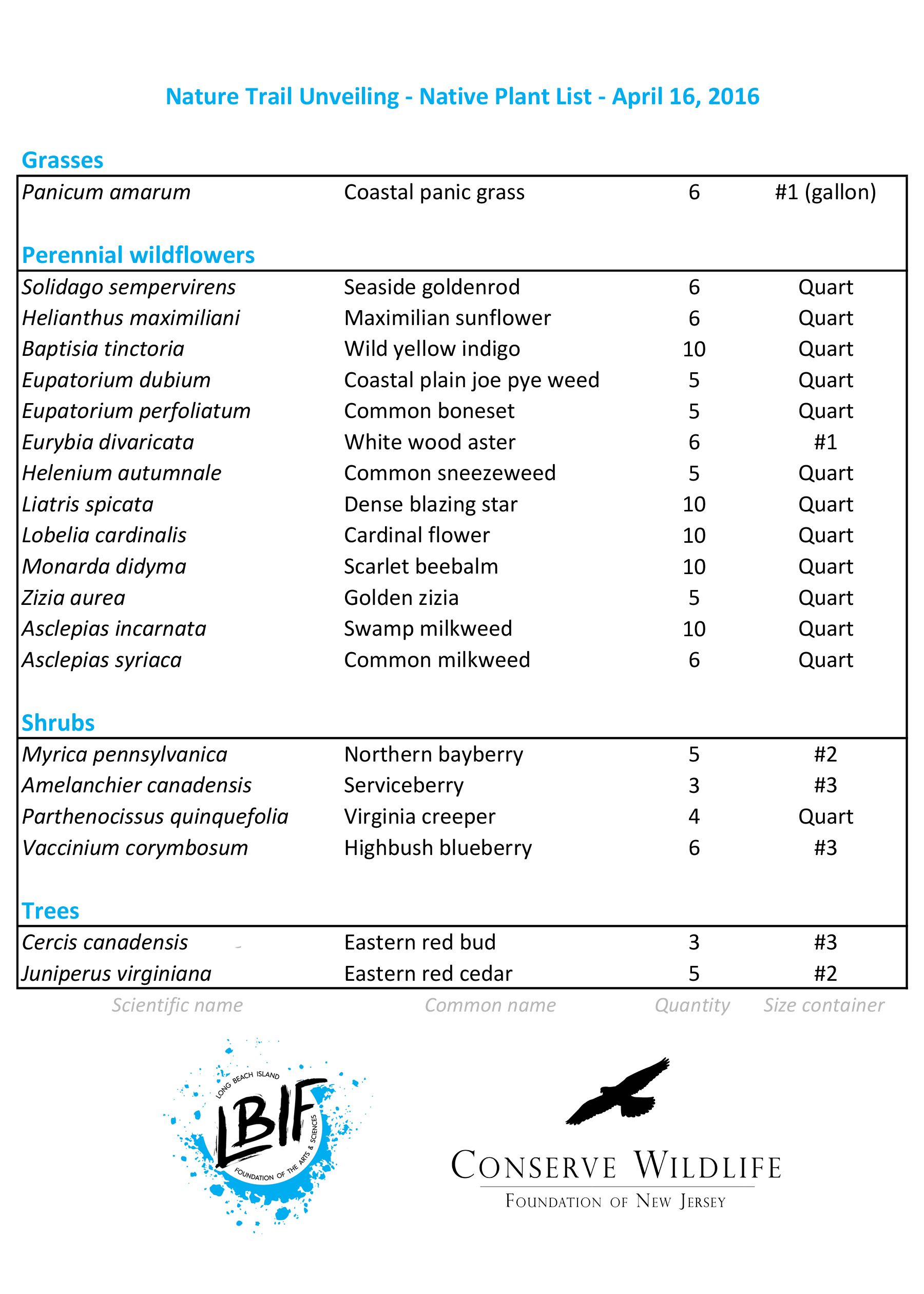
This past Saturday we “unveiled” the new Nature Trail at the Long Beach Island Foundation of the Arts & Sciences (LBIF). At the event we also conducted our first native plant sale, with lots of wildlife friendly plants, including milkweed, goldenrod, joe pye weed, bayberry, red cedar and many others. I lead guided tours along the trail to point out key features and work that we’ve done at LBIF. Our first stop was to the roof top of the Science Building, which is one of my favorite views. It provided visitors an opportunity to see what is the core foundation for our work, Barnegat Bay and some of the wildlife that we work tirelessly to protect and monitor: ospreys and northern diamondback terrapins, in particular.

Continue reading “Unveiling the Nature Trail at LBIF”

New Jersey Bald Eagle “Nacote” Sighted at Forsythe NWR

Tracking Young Bald Eagle “Nacote” throughout the Garden State

by Larissa Smith, wildlife biologist

Nacote 4/8/2016@Kelly Hunt
Nacote 4/8/2016 Photo by Kelly Hunt

On April 8th, Kelly Hunt was photographing four bald eagles at Forsythe National Wildlife Refuge (NWR), two adult birds and two immature birds. When she got home and looked at the photos she realized that one of the young birds was banded and had a transmitter. It was “Nacote” back in his home area. “Nacote” was banded and outfitted with a transmitter on May 6, 2014 at the Galloway nest. Since then we have been tracking his movements on the CWF website. These photos give a great look at what the plumage of a bald eagle going into its third year looks like. You’ll also notice that the eyes and bill haven’t yet turned yellow.

Nacote 4/8/2016@Kelly Hunt
Nacote 4/8/2016 Photo by Kelly Hunt


Forsythe NWF@ Kelly Hunt
Forsythe NWF Photo by Kelly Hunt


Learn More:


Larissa Smith is a wildlife biologist for Conserve Wildlife Foundation of New Jersey.

Update On “Jersey Girl:” A Jersey Eagle Nesting In Pennsylvania

‘Jersey Girl’ and Her Mate Rebuild Nest for the 2016 Nesting Season

by Larissa Smith, wildlife biologist

Jersey Girl, B-64, New nest 2016@ L. Oughton
‘Jersey Girl,’ B-64, New nest 2016 Photo by L. Oughton.

We continue to follow the story of “Jersey Girl” B-64. She was banded in Hopewell, Cumberland County, New Jersey in 2004 and this is the fifth season her and her mate have nested in Montgomery County, Pennsylvania. In 2015 after successfully raising three chicks, their nest collapsed due to rain and wind at the end of June, but luckily the three chicks had already fledged.


Nest observer Lind Oughton reported, “Well our great ‘Jersey Girl’ and mate have done it again. They built a brand new nest in the same tree but about 15 feet lower that the first nest. It is much more secure where it is now.” She reported incubation on February 12th and hatching around March 18th. On April 1st, she saw one chick in the nest. We will continue to follow “Jersey Girl’s” story and keep you updated.

"Jersey Girl", B-64, 2016 new nest@L. Oughton
“Jersey Girl”, B-64, 2016 new nest. Photo by L. Oughton


Learn More:


Larissa Smith is a wildlife biologist for Conserve Wildlife Foundation of New Jersey.


Restoration Work Continues Along New Jersey’s Delaware Bayshore, New Oyster Reef Built at Moores Beach

Second Annual “Shell-a-Bration” brings volunteers to strengthen coast’s resiliency and habitat

by Lindsay McNamara, Communications Manager

MooresBeachOysterReef1

Today, conservation organizations leading the efforts to restore New Jersey’s Delaware Bay beaches today organized the Second Annual “Shell-a-Bration” oyster reef building volunteer event.


Dedicated volunteers braved the elements and worked alongside American Littoral Society and Conserve Wildlife Foundation of New Jersey to establish a near-shore whelk shell bar at Moores Beach in Maurice River Township along New Jersey’s Delaware Bayshore. The shell bar was built to prevent sand loss from wind-driven waves. An approximately 200-foot oyster reef was constructed offshore to test whether the reef bars help reduce beach erosion and create calmer water for spawning horseshoe crabs.


“The Second Annual Shell-a-Bration truly celebrates the ecology, community, and culture of the Delaware Bayshore,” stated Captain Al Modjeski, Habitat Restoration Program Director, American Littoral Society. “It reinforces the connectivity between the natural and human-built bayshore communities through reef building and celebrates the significance of the Bay’s resources through restoration.”

MooresBeachOysterReef3

“There are many strategies to defend our Delaware Bayshore, but one of the best and most productive are these oyster reefs,” stated Dr. Larry Niles, a biologist with American Littoral Society and Conserve Wildlife Foundation of New Jersey. “They not only replicate a lost but important habitat on Delaware Bay — reefs once covered much of the bayshore — but they provide just enough protection to make a difference in how long our beaches persist against the unrelenting forces of nature. In a way, we are fighting nature with nature.”


Shorebirds, like the federally listed Red Knot, depend on an uninterrupted supply of horseshoe crab eggs when they stopover in Delaware Bay during their migration. In recent years, countless horseshoe crab eggs have been lost because of the devastating storms that swept away the beaches they depend on.

MooresBeachOysterReef2

The new oyster reef will attenuate waves but still allow for horseshoe crab breeding. In existing areas where crabs can breed without interruption, like creek mouths protected by sand shoals or rock jetties, egg densities can exceed ten times the egg densities on unprotected beaches.


“New Jersey’s Delaware Bayshore hosts an annual wildlife spectacle of global significance – the time-honored migration of Red Knots to reach the eggs of these ancient horseshoe crabs,” said David Wheeler, Conserve Wildlife Foundation of New Jersey Executive Director. “Red Knots fly to New Jersey’s Delaware Bay from as far away as Tierra del Fuego in South America to feed on horseshoe crab eggs. Volunteer projects like the Shell-a-bration help connect the people of New Jersey with these endangered shorebirds and the largest population of horseshoe crabs in the world.”


Last year, over 130 volunteers and veterans built the South Reeds Beach oyster at the First Annual Shell-a-Bration. Veterans Day on the Bay 2015 dedicated the South Reeds Beach oyster reef to all veterans and highlighted veteran involvement in the effort to restore New Jersey’s Delaware Bayshore. Event attendees honored their own military veterans by inscribing that special person’s name on a shell and placing that shell on “Veterans Reef.” Guests also helped study the wildlife living in this new reef with hands-on, interactive marine science activities like seining, trapping, trawling, and species identification.

Our "assembly line" of volunteers all working together to build the reef.
Our “assembly line” of volunteers all working together to build the reef.

Veterans Reef and the Moores Beach Oyster Reef are two of the many projects that American Littoral Society and Conserve Wildlife Foundation are working on to restore the ecology and economy of the Delaware Bayshore.


In the wake of Hurricane Sandy, American Littoral Society and Conserve Wildlife Foundation of New Jersey worked with the U.S. Fish and Wildlife Service, the New Jersey Division of Fish and Wildlife and the New Jersey Recovery Fund to remove 8,000 tons of debris and added 45,000 tons of sand to the beaches just before the annual spring arrival of the red knot in 2013.


Additional work after 2012 restored another mile of shoreline, including two new beaches of poor quality even before Sandy. To date, the groups have placed 85,000 cubic yards of sand and restored seven beaches along New Jersey’s Delaware Bayshore. In early 2016, groups began another phase of restoration work at Cook’s Beach and Kimble’s Beach in anticipation of the return of the horseshoe crabs and red knots in May.


The projects are being funded by National Fish and Wildlife Foundation through their Hurricane Sandy Coastal Resiliency Grants Program, and are being developed in partnership with U.S. Fish and Wildlife Service and New Jersey Division of Fish and Wildlife.


Learn More:


Lindsay McNamara is the Communications Manager for Conserve Wildlife Foundation of New Jersey.