by Emily Hofmann, Assistant Communications Manager
Todd Pover, CWF’s Beach Nesting Bird Project Manager, recently sat down with NJTV’s Mary Alice Williams to discuss piping plover conservation on the anniversary of 30 years of federal listing. Listen in to what he had to say.
by Emily Hofmann, Assistant Communications Manager
“Our work on the bayshore is not just about wildlife, it’s about people, and how keeping nature strong keeps us all strong in the face of disasters like hurricanes.”
We want to ensure that New Jersey’s Hidden Coast remains a vital part of our livelihood for generations to come.
This is the final episode to our video series, “New Jersey’s Hidden Coast.” Catch a glimpse of the Bay, the horseshoe crab at the center of the bay’s system, and the incredible relationship between horseshoe crabs and migratory birds, like the red knot. We reveal the real value of horseshoe crabs, the challenges to the ecosystem, and the potential for thriving regional economy along the bayshore. We will show Hurricane Sandy as a catalyst for decisive action and the work being done to rebuild the area for both people and wildlife.
Catch up on the previous episodes, here on our blog or on YouTube. Explore the use of “living shorelines” instead of bulkheads and the importance of marshes to the marine ecosystem. Discover the on-the-ground, grassroots efforts of the community to build oyster reeds alongside veterans. And examine the future of the Bay and the work that needs to be done to preserve our conservation successes year after year.
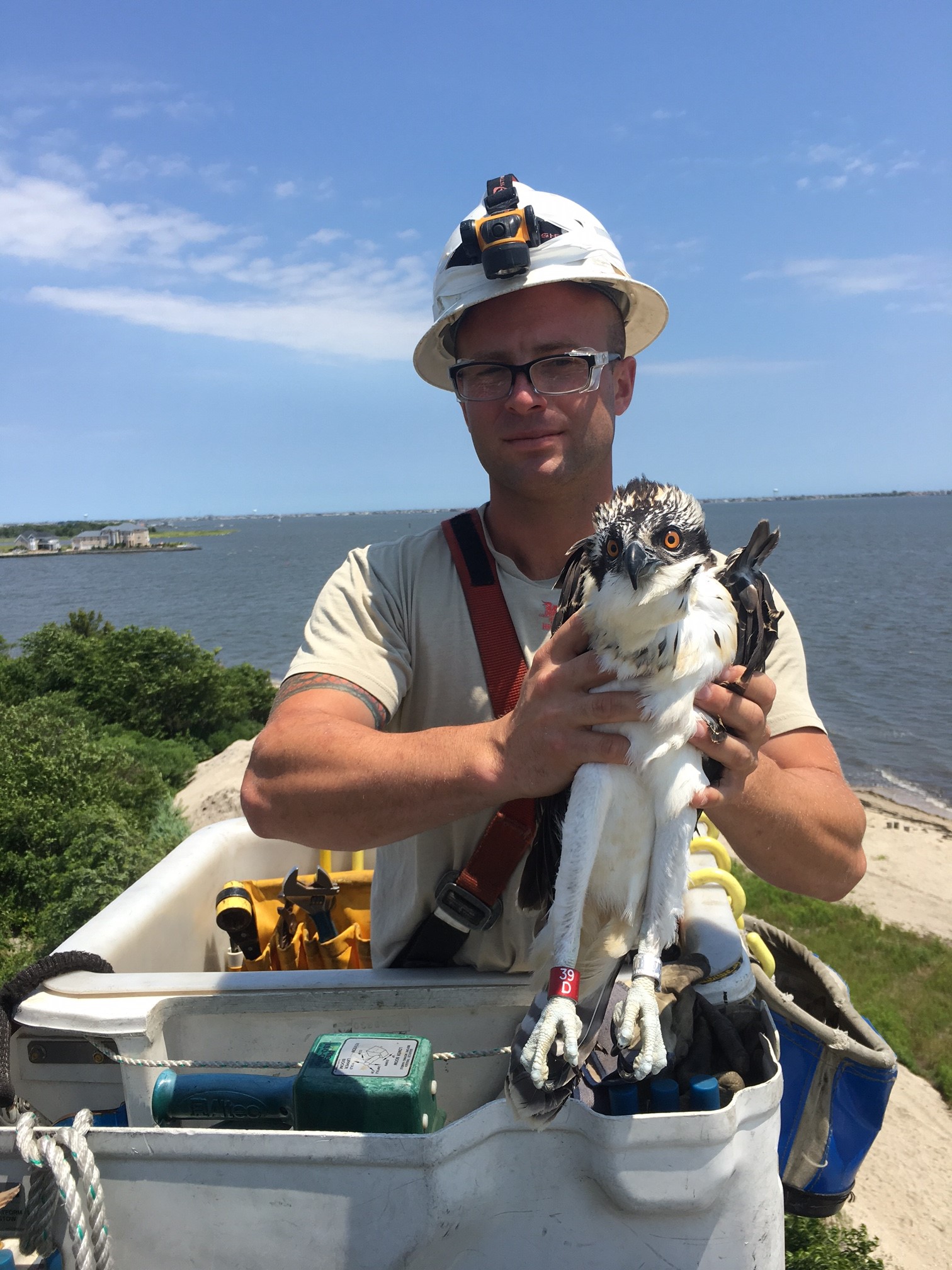
39/D being rescued on July 13, 2016. Photo by Bonni Myszka.
Ospreys are in the news again. This time it is not so pleasant news, or at least news that is hard to swallow for some, where an adult bald eagle predated a young osprey at Hog Island in Bremen, Maine. While it can be a traumatic thing to witness firsthand, it is pretty common where the range of ospreys and bald eagles overlap. We are only witnessing it because of technology. It can and has happened right here in New Jersey too. Last year, I found an adult female who had lost her wing. With no other way for that to happen (on the open saltmarsh, and her wing was gone), the only suspect is an attack by a bald eagle. As both the eagle and osprey population continue to grow, there will only be more interaction between the two species as they are competitors for food and bald eagles are opportunistic scavengers.
GETTING A CLOSE-UP LOOK AT A BEAUTIFUL BUT ENDANGERED SONGBIRD
by Kathleen Wadiak, CWF Intern
Interning for CWF allows me to take part in a variety of projects and learn from different professionals working throughout the state. One example of this is the morning I was able to learn about golden-winged warblers through a mist netting survey. Honestly, I did not know much about this little bird until we were driving to a power line right-of-way early one morning, and I was given a quick summary of why it’s causing a stir in our home state.
The golden-winged warbler (Vermivora chrysoptera) is a striking little gray bird with black eye and throat markings, sporting a bright yellow head with matching wing patches. New Jersey serves as part of its breeding grounds throughout the summer, when it migrates north from its winter habitat in Central and South America. Unfortunately, its populations have been in decline, resulting in its classification as a state endangered species.
A male golden-winged warbler. Photo by Kelly Triece.
There are a few possible reasons for the decline in golden-winged warbler populations, including a decrease in their habitat, early-successional sites which consist of shrubby and herbaceous ground cover instead of mature forest. To the golden-winged warbler’s disadvantage, much of its New Jersey forest was cut at the same time, resulting in even-aged stands that are now too old to provide the nesting sites necessary for survival. Currently, golden-winged warblers occupy regenerating clear cuts, wetlands, or utility right-of-ways in northwestern New Jersey, where they can still find the resources that they need.
In addition to habitat loss, interactions with the closely related blue-winged warbler (Vermivora cyanoptera) are impacting the golden-wings’ numbers. It is thought that as climate change causes shifts in the geographic range of both species, more overlap between the two occurs. This results in increased competition for food, nesting sites, and even mates, as the two birds are closely related.
Walking through the high grass under the powerlines, we stopped now and then to listen to birds singing and look for golden-wings. While my untrained ears had trouble differentiating between all of the different calls, a biologist with NJ Audubon confidently told us where to begin setting up each net. After the net was raised, different recordings meant to attract the warblers played while we stepped back and waited hopefully for the right birds to come.
Golden-winged warbler habitat. Photo by Kelly Triece.
It was exciting to see the first birds fly into the net and to have the opportunity to view them up close, even if they weren’t always the ones we were looking for. While we set up three nets throughout the morning, our first attempt was most successful as it resulted in the capture of one of the rare golden-winged warblers! Its banded leg told us that this wasn’t its first time in a net, and that it had been to this site in the past, a good sign for this particular stretch of habitat. Its dramatic markings and flashes of gold feathers made it a beautiful bird, and it struck me what a shame it would be if they disappeared completely from our state.
While things are tough for golden-winged warblers in New Jersey, hope is not lost as many organizations, including CWF, the Natural Resources Conservation Service, NJ Audubon, and NJ Division of Fish and Wildlife are working to keep these birds in the Garden State. Mist netting and banding the Golden-wings allow biologists to track the number and location of these warblers throughout their breeding grounds and aid in the creation of management strategy. In addition, there is an effort to educate private landowners about golden-wings and to help them manage their property in a way that attracts the birds. Hopefully, as this work continues, more land will be suited to their habitat preferences, and golden-winged warblers will return to their summer homes in New Jersey.
NEW, WEEKLY UPDATES FROM NEW JERSEY’S BEACH NESTING BIRD PROJECT TEAM
by Todd Pover, Beach Nesting Bird Project Manager
Up until now the focus of our weekly reports has been on breeding activities – for good reason as that is the main purpose of our beachnesting bird management and recovery program here in New Jersey. However, the past two weeks have been a good reminder that piping plover migration is already well under way.
The idea of “fall” migration is a bit of a misnomer for piping plovers and other shorebirds since they begin moving south for the “winter” as soon as nesting is complete. For piping plovers that can be in early July. In fact, last week we had our first report of piping plovers already back on their wintering grounds in the Bahamas. And yesterday we received word of 164 piping plovers in Ocracoke, North Carolina, many of them individuals that had bred in states further north. We know that from the bands and flags placed on the birds as part of various research projects.
Piping Plover E4, spotted by CWF staff in the Bahamas and Canada, and last week it made a stop in New Jersey during migration. Photo courtesy of Stephanie Egger.
Meanwhile, back in New Jersey we resighted our first Canadian piping plover on July 12. Then last week we had another very exciting visitor from Canada – a flagged bird with the alpha/numeric code of E4. CWF’s very own Todd Pover had spotted this bird on its wintering ground in January 2014 in Spanish Wells, Eleuthera, the Bahamas. In the spring of 2014 Todd traveled up to this bird’s breeding location at White Point Resort in Nova Scotia, Canada, where he was able to spy the bird with its mate as they started to set up their nest. Having it now show up during migration in New Jersey completed the circle.
Although Todd didn’t see it himself in New Jersey this time, there is some pretty amazing “dots being connected” with this individual bird. One of the important issues brought up by the resightings of E4 is just how connected the sites are all along the flyway. It is important that we focus on breeding success here in New Jersey, but we also play an important role in protecting shorebirds during different phases of their lives as well. Long term survival and recovery of piping plovers depends on full life cycle conservation, not just during the breeding season. And with many shorebirds moving thousands of miles annually, that is an effort that needs to reach across partners and even countries.
By Emily Hofmann, Assistant Communications Manager
Like all ecosystems, Delaware Bay is amazingly complex, and there’s no one way to fix it. Between climate change, sea level rise, and the growing risk of major storms, there’s a lot to consider.
We’ve learned that restoring healthy marsh habitat is a key component in rebuilding Delaware Bay beaches; however, we’re also trying to further strengthen bayshore beaches by building reefs – living underwater infrastructure. By creating some reef structures we can keep the sand where we’re putting it.
A new episode of our video series “New Jersey’s Hidden Coast” will air every two weeks throughout the summer! Catch a glimpse of the bay, the horseshoe crab at the center of the bay’s system, and the incredible relationship between horseshoe crabs and migratory birds, like the red knot. We will reveal the real value of horseshoe crabs, the challenges to the ecosystem, and the potential for a thriving regional economy along the Bayshore. We will show Hurricane Sandy as a catalyst for decisive action and the work being done to rebuild the area for both people and wildlife.
Over the next several weeks, we will explore the use of “living shorelines” instead of bulkheads and the central importance of marshes to the marine ecosystem. We will discover the on-the-ground, grassroots efforts of the community to build oyster reefs alongside veterans. And we will examine the future of the Bay and the work that needs to be done to preserve our conservation successes thus far.
NEW, WEEKLY UPDATES FROM NEW JERSEY’S BEACH NESTING BIRD PROJECT TEAM
by Todd Pover, Beach Nesting Bird Project Manager
Meet Bob, Avalon’s “famed” long-time breeding piping plover, easily identifiable by his color bands. Photo courtesy of Tom Reed.
Meet Bob. He is a piping plover who received this nickname while being banded by CWF Wildlife Biologist Emily Heiser in 2012 as part of a SUNY-ESF research project in New Jersey. This past weekend was a big day for Bob. Three of his chicks reached the fledgling state – this milestone of flight is the metric for a successful breeding season.
Things have not always gone so well for Bob. In 2012 his mate was killed by a predator and he couldn’t incubate their eggs alone, so the nest was abandoned and he didn’t find a new mate. In 2013 Bob and his new mate (Kelly) were down to their last remaining chick when a ghost crab snatched and dragged it down its burrow. We dug the chick out, but it died soon after in rehab. In 2014 Bob and Kelly’s chicks died quickly at the hands of an unknown predator. In 2015 a nest camera painfully showed Bob’s chicks being eaten by a fox just after they hatched and were still lying in the nest bowl.
Flash forward to this year and Bob was part of the last piping plover pair left nesting in Avalon, once a thriving breeding site with as many as eight pairs. His long-time mate Kelly left him for another male at Stone Harbor Point, but he found a new mate and finally they have met success. Given all that has happened to Bob, you can see why we are happy for him (and Emily) today!
Sadly, this five year “drama” is not an especially unusual story for piping plovers. Their existence, especially here in New Jersey, is seemingly “against all odds”. In addition to the predators, they face a multitude of threats, direct and indirect, such as human disturbance as a result of heavy recreational use of beaches, habitat loss and degradation, and flooding, to name a few. Each year CWF and a host of partners throughout coastal New Jersey mount an extensive effort to protect piping plovers and other endangered beach nesting birds such as least terns and black skimmers. Without this active protection and management these birds would probably disappear from most of our state’s beaches.
Yesterday evening, while conducting an osprey nest survey at Sedge Island Wildlife Management Area, I received a message from a local wildlife photographer about an osprey nestling that was entangled. I talked to the photographer, Rich Nicol and got detailed information about the situation, the nest, and started to formulate a plan to address the situation. After learning that the nest was on a 35-40’ high pole, I knew that I wouldn’t be able to get up there without some help. Yes – a large ladder would suffice, but it would be tricky to handle the situation (with the bird being entangled). You see, after seeing photos of the young osprey, I knew it was RTF (Ready To Fly). Ospreys fledge or take their first flight at around 7-8 weeks of age. The entangled osprey was around 7 weeks old. I knew we had to act quickly to catch the bird and untangle it before it tried to fledge. This morning I saw the photos that Rich took and it clearly showed that the young osprey had monofilament or a net around its neck… Continue reading “The Inspiring Story of Osprey 39/D”
NEW, WEEKLY UPDATES FROM NEW JERSEY’S BEACH NESTING BIRD PROJECT TEAM
by Todd Pover, Beach Nesting Bird Project Manager
One of four recently hatched “itty-bitty” piping plover chicks at Island Beach State Park. Photo courtesy of Kevin Knutsen.
So far our weekly beach nesting bird updates have focused on statewide trends, but this week we are going to feature one special pair of piping plovers.
The story actually starts in the summer 1989…Ronald Reagan had just left the White House and the Berlin Wall would fall a few months later. It was also the last time a piping plover nested on the miles of oceanfront beaches at Island Beach State Park. That all changed in May of this year, when a pair of plovers was observed exhibiting breeding behavior at the southern portion of the park close to the inlet jetty. Eventually they laid four eggs, a cage was erected around the nest to protect it from predators, and right on schedule over the July 4th weekend, four itty-bitty chicks emerged. A week later, three chicks have survived the daily battles with predators (i.e. fox, crows, gulls) and a heat wave. The story isn’t over yet, we won’t know for another 3 weeks or so if they survive to the stage where they can fly, which is our metric for success.
Regardless of the outcome, this pair being at Island Beach State Park symbolizes an interesting point in New Jersey’s conservation efforts to recover this federally threatened and state endangered species. 2016 marks the 30th anniversary of federal listing for the Atlantic coast population of piping plovers, and with it extensive management to aid recovery. Those management efforts have led to varying results in New Jersey; our population has swung from a low of 92 pairs to a high of 144 pairs, but mostly settling in around 120 pairs. We are currently in a slight upswing, but the bottom line is New Jersey is a tough place for piping plovers to successfully breed – it represents a convergence of all the significant threats the birds face.
Why did piping plovers suddenly show up at Island Beach State Park again this year? Well, we may never know for sure, but we do think Hurricane Sandy probably had a part in it. While it was wrecking destruction up and down the Jersey Coast, Hurricane Sandy was also creating the kind of sparse, open habitat where piping plovers prefer to nest. Some of that was created at Island Beach, and soon after Sandy, we noted some “prospecting” plovers at the park. Nothing came of that, but meanwhile piping plover action was heating up just a little bit south on LBI at the Holgate Unit of the Edwin B. Forsythe NWR and just across the inlet at Barnegat Light. The storm created especially good conditions for piping plovers in those locations, including a giant “overwash” at Holgate, which in turn attracted more and more plovers, which produced a “bumper crop” of young fledglings. Barnegat Light only had one remaining plover, but it produced well above average numbers of fledglings for several years in a row.
One of the newest “residents” of Island Beach State Park, an adult breeding piping plover. Photo courtesy of Kevin Knutsen.
Quick biology lesson…piping plovers exhibit very strong site fidelity, so the adults tend to come back to the same site year after year, often the same patch of beach. That includes their young, but they have to forge their own territory as existing pairs fiercely defend their established territory. This year we have seen a bump from one to four pairs in the Barnegat Inlet area and one of the new breeding birds was born last year at Holgate (we know that from bands now being placed on the birds by researchers). With Holgate reaching capacity, the returning young are looking nearby for other places to nest. The Island Beach plovers are not banded, but the banding in this area is new in our state, so they might also be young from previous successful nests at Barnegat Light.
At the moment New Jersey has high concentrations of piping plovers at Sandy Hook and the Forsythe NWR, over three-quarters of the state population occurs at these federal properties. They are performing well at these sites for now, but habitat conditions change quickly along the coast and real recovery has to happen over a wider geographic area. For any significant population rebound to occur, new sites need to be colonized, so the piping plovers at Island Beach State Park this year may be a small sign of that starting to happen.
Osprey 44/C re-sighted at Island Beach State Park!
by Ben Wurst, Habitat Program Manager
Project RedBand Osprey 44/C was re-sighted by Shayna Marchese on Island Beach State Park on July 3, 2016.
Really exciting news. For the first time this year, a (live and well) red banded osprey was re-sighted! 44/C was banded as a nestling on July 12, 2014 and photographed by Shayna Marchese on July 3, 2016 at Island Beach State Park. Young ospreys spend two years on their wintering grounds before returning to their natal areas. This is the first year that 44/C has returned to New Jersey. 44/C appears to be a male, and males have a higher level of site fidelity than females do, so they are more likely to return to the same area that they originated from. We aren’t surprised that one of our first red banded birds to be re-sighted in New Jersey was at Island Beach State Park, just outside Sedge Island Wildlife Management Area. For anyone who is not familiar with Sedge, it is the state’s most densely populated osprey colony in New Jersey. Around 30 pairs of ospreys nest at Sedge which is less than 3 square miles. Continue reading “Project RedBand Alumni Update!”