This marks the second story in Shorebird Week! Our first blog post, on Tuesday, introduced the film “A Race Against Time” and directed you to a free viewing of the film on our website. Today’s blog post, will highlight an incredible news story about a resighting of the iconic Red knot B95 on the Delaware Bay! And tomorrow’s blog post, will highlight volunteer’s incredible efforts to save stranded horseshoe crabs!
This story highlights the iconic Red knot, B95, being resighted on the Delaware Bay. B95, nicknamed Moonbird, is at least 20 years old, which makes him the oldest Red knot on record. He received his nickname because he has flown the equivalent of the distance between the earth and the moon and at least halfway back in his lifetime.
Iconic Red knot shorebird B95
One of Conserve Wildlife Foundation’s partners, Manomet Center for Conservation Science, highlights this bird in an fascinating news story about his resighting and the research efforts being done by the CWF biologist Dr. Larry Niles and Amanda Dey, senior biologist with the Endangered and Non-game Species Division of N.J. Fish and Wildlife and their team to restore the Delaware Bay.
This story marks the last of our five blog stories spotlighting New Jersey’s Diamondback Terrapin – and educating people on the research and efforts being done to protect these fascinating reptiles!
Part 1, Monday, was an introduction into the world of the Diamondback Terrapin.Part 2, Tuesday, featured CWF’s research efforts to protect the terrapins.Part 3, Wednesday, looked at great places to view these beautiful turtles .Part 4, Thursday, highlighted some important ways you can help protect the Diamondback Terrapins. Part 5, today’s post, will showcase some other important regional research being done by our partners.
Beyond New Jersey: Diamondback Terrapins across the Northeast
By Stephanie Egger, CWF Wildlife Biologist
Contributions by Don Lewis (Cape Cod Consultants), Russ Burke (Jamaica Bay Terrapin Research and Conservation), and John Wnek (Project Terrapin)
Conserving the Northern diamondback terrapin in New Jersey is vitally important to CWF and our partners. As a result, it is crucial that we work cooperatively with our partners in the Northeast for the long-term protection and sustainability of terrapins from a regional perspective.
The terrapin has been identified as a Species of Greatest Conservation Need in the Northeast States Wildlife Action Plans (WAP). The terrapin is found in eight states of the Northeast /mid-Atlantic regions and are considered Threatened in Massachusetts and Endangered in Rhode Island under State laws. In New Jersey, while the terrapin receives some protection under commercial and recreational fishing regulations, it is also considered a game species. The species has been also identified by the Northeast Partners in Amphibian and Reptile Conservation (NEPARC) as a species of regional conservation concern in the Northeast Amphibian and Reptile Species of Regional Responsibility and Conservation Concern Report as it found in ≥ 75 % of states listed in their WAPs and > 50% of northern diamondback terrapin distribution is within the Northeast Region of North America (NEPARC 2010).
Our regional partners have invested many years into the survival of this species through their conservation and research efforts below and as partners in the development of the Northeast Regional Conservation Strategy for Terrapins headed by CWF.
Don Lewis and Sue Wieber Nourse, Cape Cod Consultants for terrapins
In Wellfleet Bay on Outer Cape Cod resides the northernmost population of diamondback terrapins. Research on these elusive critters began in June 1980, and this longitudinal study has continued uninterrupted through this, its 35th season. Terrapin research and conservation in Massachusetts encompasses more than 250 miles of coastline, dozens of estuaries and hundreds of sites from the fist of Cape Cod through Buzzards Bay on the South Coast to Mount Hope Bay on the Rhode Island border. Within this expanse, there are many vestigial groups on the cusp of extirpation and a few stable populations. Intense conservation measures over the last decade and a half have reversed statewide population declines, and numbers have begun slowly, yet steadily to increase throughout the range. These measures focus on dramatically increasing the number of hatchlings entering the system through protecting nests and shepherding hatchlings from wild nests through a gauntlet of predators to the safety of their nursery salt marsh. We also strive to expand nesting habitat through uplands preservation and coastal turtle gardens. The result has been a significant, measurable increase in juvenile recruits entering these populations.
Covering this broad expanse of estuaries and beaches entails a large volunteer effort of citizen scientists augmented by hundreds of homeowners within coastal communities throughout Massachusetts. Outreach forms the cornerstone of terrapin conservation. Whether formal in classrooms or informal on beaches and in backyards, hands-on educational experiences transform bystanders into supporters. The goal of each encounter is simply to change personal pronouns from “your turtles” to “our turtles.”
When terrapin activity ends in October, staff and volunteers change into winter garb and return to now frigid Cape Cod beaches to save stranded, cold-stunned sea turtles. Each fall hundreds of sea turtles get trapped in the enormous “seine net” of Cape Cod sticking forty miles into the Atlantic Ocean, and they become too cold to survive without human intervention. Thousands of the most endangered sea turtles in the world have been recovered from Cape beaches, rehabilitated and returned back to the ocean.
Jamaica Bay, New York
Russ Burke, Hofstra University and Jamaica Bay terrapin partner
Alex Kanonik (Queen’s College) and Russell Burke (Hofstra University) run a citizen-science project focusing on the ecology of the diamondback terrapin population in Jamaica Bay, New York. Our work is built around a mark-recapture project started in 1998, and has been the basis for nine M.S. theses and numerous publications co-authored by high school students, undergraduates, and graduate students. Our early focus was on nesting ecology and nest predation, then hatchling behavior, and field tests of temperature sex determination. Currently we are investigating terrapin diets, movements and distribution in Jamaica Bay and elsewhere in New York. We also work closely with biologists at JFK airport to address their issues with terrapins on the runways.
Barnegat Bay, New Jersey
John Wnek, Marine Academy of Technology and Environmental Science and Project Terrapin
Project Terrapin, through the Marine Academy of Technology and Environmental Science, New Jersey, is conducting its 13th year of diamondback terrapin nesting research at Barnegat Bay, New Jersey. We are studying the reproductive output of terrapins throughout Barnegat Bay with an emphasis on populations at Island Beach State Park and Long Beach Island, New Jersey.
We are also studying populations by identifying critical habitat throughout the Barnegat Bay Estuary. We conduct a mark and recapture study throughout the northern Barnegat Bay region. The past two years, we have been focusing on possible impacts on nesting ecology as a result of “shifting” nesting habitats from the storm surge from post-tropical cyclone Sandy. We are also mapping nesting areas throughout the system.
Our team has a few different conservation projects, including the establishment of nesting habitats in areas where there are a high density of nesting terrapins in developed coastal communities. We also sponsor a bycatch reduction device (BRD) distribution program working with local crab pot retailers and manufacturers. To date, we’ve distributed over 20,000 BRDs throughout Ocean County, New Jersey.
We are also working with local environmental education centers and schools to promote diamondback terrapin education, with an emphasis on habitat and the importance of protecting our barrier islands. Project Terrapin has developed an education module called the Terrapin Education KIT used by informal and formal educators. Finally, we also sponsor a hatchling head start program for schools throughout the state and eastern Pennsylvania.
Our latest initiative is to assist with the protection of our barrier islands by promoting and funding coastal vegetation plantings so that the dunes and coastal habitats are better stabilized. This past year, we have reached over 6,000 people, including school students, with volunteers providing over 1100 hours. Project Terrapin works with several colleges and universities supporting both graduate and undergraduate research studies.
NEPARC. 2010. Northeast Amphibian and Reptile Species of Regional Responsibility and Conservation Concern. Northeast Partners in Amphibian and Reptile Conservation (NEPARC). Publication 2010-1.
Stephanie Egger is a Wildlife Biologist for Conserve Wildlife Foundation of NJ and Co-Chair of the Mid-Atlantic region of the Diamondback Terrapin Working Group
This story marks the fourth of five blog stories spotlighting New Jersey’s Diamondback Terrapin – and educating people on the research and efforts being done to protect these fascinating reptiles!
Part 1, Monday, was an introduction into the world of the Diamondback Terrapin.Part 2, Tuesday, featured CWF’s research efforts to protect the terrapins.Part 3, Wednesday, looked at great places to view these beautiful turtles .Part 4, today’s blog post, will highlight some important ways you can help protect the Diamondback Terrapins. Part 5, Friday, will showcase some other important regional research being done by our partners.
Steps You Can Take to Protect the Diamondback Terrapins!
by Ben Wurst, CWF Habitat Program Manager
A female terrapin pauses while crossing Great Bay Blvd in Little Egg Harbor, NJ.
We all can make a difference to help conserve northern diamondback terrapins. This beautiful species is a symbol of our coast – and now more than ever, we need to be sensitive to our incredible coastal estuary ecosystems!
Here are some ways that you can help make a difference to protect this amazing species:
Slow down, don’t tailgate, and be aware while driving in coastal areas from May through July.
If you see a terrapin on the road, pull over, put on your hazard lights and carefully help the turtle cross in the direction it is going. Please be careful and use your best judgement and do not get in front of a motor vehicle to stop them on area roads. Do not jeopardize your own safety for a turtle.
If you go crabbing and use commercial-Maryland style crab pots, use BRDs or “bycatch reduction devices” to prevent terrapins from getting trapped in them. Use line that sinks to prevent a crab pot from becoming lost. Abandoned crab pots can trap and kill a ton of marine life over time, including blue claw crabs, many species of fish, and terrapins.
Talk to others to educate them about terrapins and their role in the ecosystem. You can learn all about them in our Online Field Guide!
Volunteer with CWF to patrol roadways and take part in other volunteer actions in Southern Ocean County, Atlantic County, and Cape May County! We really need your help – so please contact us if you, your business, or your civic group is willing to help save the incredible diamondback terrapin!
Donate to CWF’s diamondback terrapin program. Any amount would help greatly! Click here and note Terrapin in the PayPal note, or you can mail a contribution to Conserve Wildlife Foundation, 501 East State Street, P.O. Box 420, Mailcode 501-03E, Trenton, NJ 08625-0420. Be sure to note Terrapin in the check’s subject line.
This story marks the second of five blog stories spotlighting New Jersey’s Diamondback Terrapin – and educating people on the research and efforts being done to protect these fascinating reptiles!
Part 1, Monday, was an introduction into the world of the Diamondback Terrapin.Part 2, today’s blog post, will feature CWF’s research efforts to protect the terrapins.Part 3, on Wednesday, will look at great places to view these beautiful turtles .Part 4, Thursday, will highlight some important ways you can help protect the Diamondback Terrapins. Part 5, Friday, will showcase some other important regional research being done by our partners.
by Stephanie Egger, CWF Wildlife Biologist
I am pleased to announce CWF was awarded a grant from the Regional Conservation Needs Program* for the development of a conservation strategy (strategy) that focuses on the conservation, management, and protection of terrapins from Massachusetts to Virginia.
Stephanie Egger, CWF wildlife biologist
For the next two years, we will be working with over 30 partners, many of whom are part of the Mid-Atlantic and Northeast regions of the Diamondback Terrapin Working Group (DTWG), assembling data and developing a strategy with the help of their years of expertise working with terrapins.
The overarching goal of the strategy is to help achieve long-term sustainability of terrapins by identifying the species current and historical populations and its habitat (known and unknown occupancy); characterizing and ranking threats; prioritizing focal areas for regional and individual state management; identifying data gaps; and reviewing the regulatory status in each state. The strategy will describe a strategic initiative for implementation of conservation actions across eight states and identify focal areas for conservation. The results of the strategy could be used to solicit additional funding for implementation for more regionally significant areas for terrapins in the future.
(c) Eric Sambol
We’ve hit the ground running for this project and will convene the partners in meetings later this year at the College of William & Mary in Virginia and Cape Cod, Massachusetts as well as visit states for more local terrapin meetings.
More information on this project can be found on the Northeast Regional Conservation Needs (RCN) Grant Program site.
*“The Northern Diamondback Terrapin (Malaclemys terrapin terrapin) in the Northeastern United States: A Regional Conservation Strategy” is supported by State Wildlife Grant funding awarded through the RCN Program. The RCN Program joins thirteen northeast states, the District of Columbia, and the U.S. Fish and Wildlife Service in a partnership to address landscape-scale, regional wildlife conservation issues. Progress on these regional issues is achieved through combining resources, leveraging funds, and prioritizing conservation actions identified in the State Wildlife Action Plans. See RCNGrants.org for more information.
Stephanie Egger is a Wildlife Biologist for Conserve Wildlife Foundation of NJ and Co-Chair of the Mid-Atlantic region of the Diamondback Terrapin Working Group
Join us on this fascinating journey into the world of the Diamondback Terrapin
Last week, I drove slowly down a road with no buildings or homes on either side, with only vast salt marsh as far as the eye could see. Over the course of the roughly 10-mile round trip, I passed maybe four other cars. But there was another kind of traveler that I found in abundance – 22 diamondback terrapins crossing the road on the way out, and another 18 of these gorgeous turtles on the way back (although I’m sure I saw some of them twice)!
Amazingly enough, this was a drive along the New Jersey coast in June. If you haven’t guessed it, I was on Great Bay Boulevard in Little Egg Harbor. And if you haven’t been there, now is the time to go – it is a true wildlife spectacle that you have to see to believe.
New Jersey’s coast is filled with wonders during the summer months – wonders that go beyond its crowded beaches, boardwalks, and traffic jams! Believe it or not, the coast still has plenty of nature to be found, often in total seclusion. And diamondback terrapins offer as amazing a wildlife story as any.
So today we kick off Terrapin Week! Read our first installment below for an up-close look at the terrapin’s habitat, appearance, range and status. Then stay tuned for a brand new story each day this week by our terrapin biologists Ben Wurst and Stephanie Egger, with topics including our biologists’ research projects, how our volunteers are making a difference, terrapins across the East Coast, and New Jersey locations where you have the best chance of seeing terrapins in the wild!
David Wheeler
Executive Director, Conserve Wildlife Foundation of NJ
Meet the Terrapin
by Stephanie Feigin, CWF Program Coordinator
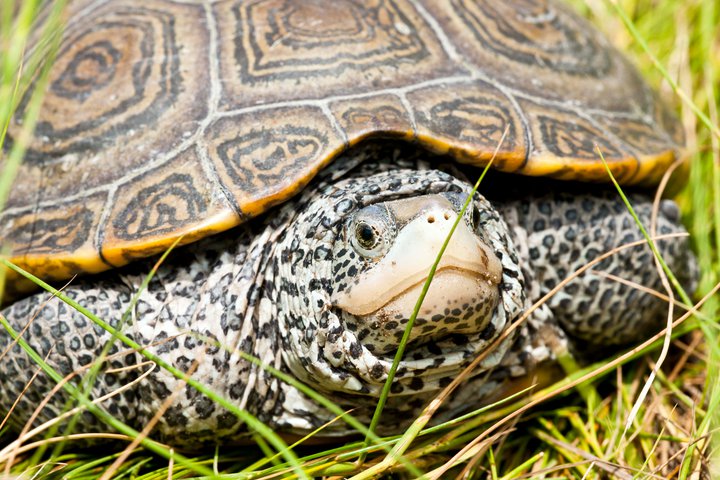
Northern diamondback terrapins(Malaclemys terrapin terrapin) are native to New Jersey and inhabit the many miles of coastal salt marshes and estuaries along the Atlantic Coast and Delaware Bay. They exclusively inhabit coastal salt marshes, estuaries, tidal creeks and ditches with brackish water (a mix of both salt and freshwater) which is bordered byspartinagrass. They are the only turtle species in the world that is specially adapted to spend its entire life in this type of water.
The northern diamondback terrapin is a medium-sized turtle that varies in length from only 4 to 5.5” in males to 6 to 9” in females. Terrapins have a gray, brown, or blackcarapace(top of shell) and a lighterplastron(bottom of shell), which is a greenish-yellow. The skin is light to dark gray with black spots and other dark markings. Both sexes have a light colored upper mandible. They are named for their diamond shaped pattern on their carapace. Adult terrapins primarily eat mollusks and crustaceans, including snails, fiddler crabs, and mussels. They also eat blue crabs, green crabs, marine worms, fish, and carrion.
Terrapins are cold-blooded, or ectothermic. Theyhibernateduring the winter and bury themselves at the bottom of or in the banks of creeks and ditches. Studies have shown that terrapins also exhibit a high level of site fidelity or they return to the same territoryevery year, some even occupy the same small creeks year after year. Terrapins have a very small home range, from Cape Cod, Massachusetts to Cape Hatteras, North Carolina.
Female Northern Diamondback terrapin (c) Jonathan Carlucci
In 2001, a status review of reptiles in New Jersey recommended that the Northern diamondback terrapin be listed as a species ofspecial concernin New Jersey. The listing as special concern “warrants special attention because of some evidence of decline” (NJ ENSP-Species Status Listing) and little is known about their actual population status in New Jersey. However, terrapins are still harvested for food in New Jersey and the total harvested annually is not known. Since Terrapins are still considered a “Game” species subject to harvest, the Special Concern designation was never officially applied to the species and will not be until they are re-classified as a “Non-game” species.
Major threats to the health of the population include; habitatloss, mortality from being drowned in crab traps, and road mortality. Each year hundreds of terrapins are killed by motor vehicles throughout their range and here in New Jersey. The Conserve Wildlife Foundation (CWF) and their biologists are working hard to protect these incredible reptiles with their many conservation efforts. We are asking you to “Be Terrapin Aware” while driving along roads in New Jersey’s coastal region, and stay tuned for more posts during Terrapin Week about our efforts to protect these turtles!
Three nestlings produced at the Osprey Cam nest are banded for future tracking!
by Ben Wurst, Habitat Program Manager
In the late afternoon of June 24, 2014, I kicked off the 2014 Osprey Nesting Surveys by banding the three nestings at the Osprey Cam nest. I was joined by Ann Marie Mason Morrison, with Friends of Forsythe NWR, our founding partner with the Osprey Cam, and two U.S. Fish and Wildlife Service interns, Jessie and Kirsten who helped bring out all the equipment needed to the nest (two 20′ ladders).
This is one of the most difficult nests to reach in all of New Jersey! It either takes a boat (at high tide) or two 20′ ladders (at low tide) to cross a 15′ wide ditch on the coastal salt marsh. Anyone who has crossed the ditch can attest to how difficult it is. Now you can watch and see what when into banding these three nestlings. A portion of the video was cut when I was attempting to repair the sound at the camera equipment box. At the same time the nest was cleaned of harmful plastic debris that the birds used as nesting material. A total of 3 balloons and a plastic bag were removed from the nest. The three young were banded with USGS bird bands (1088-04358,59 & 60) for future tracking. Check out a photo that I got of “the runt.” Enjoy!
Cape May, New Jersey-Conserve Wildlife Foundation (CWF) in partnership with NJDEP, Mosquito Control, Atlantic City Electric and USFWS recently completed construction of a series of vernal pools in Cape May, NJ. This is the second complex in a series of pools along the “spine” of the Peninsula to create sustainable vernal-pool habitat above anticipated sea-level rise.
Completed vernal pool along Atlantic City Electric right-of-way (c) Karena DiLeo
These pools will also create a migration corridor for assemblages of amphibians, reptiles, and invertebrates to increase meta-population dynamics and allow species to move northward off the Peninsula.
Following excavation of the pools, CWF, USFWS, and Atlantic City Electric held a volunteer
Atlantic City Electric and USFWS volunteers planting native shrubs (c) Wayne Russell
planting day to plant native shrubs along the pools to enhance habitat and stabilize berms. Native shrubs including: buttonbush, low-bush blueberry, inkberry holly, sweet pepper bush, and beach plum were generously donated by Atlantic City Electric.
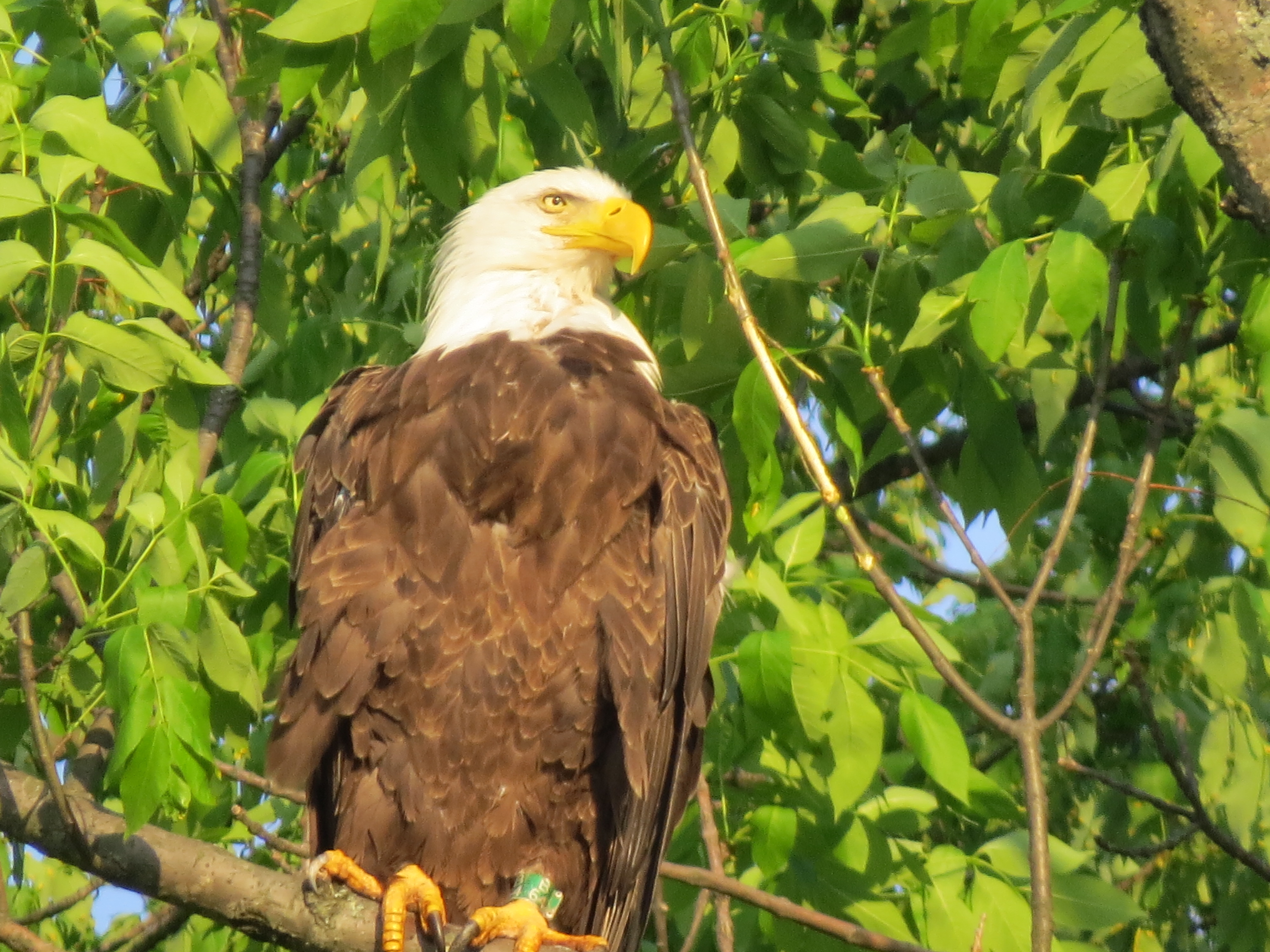
Each year biologists with the NJ ENSP & CWF band chicks at eagle nests though out NJ. Each chick gets a green (NJ) band on one leg and a silver federal band on the other. The Green band indicates that the bird was banded in NJ and the letter over the number combination is recorded so we know where and when. There are at least 20 pairs of eagles nesting in NJ where at least one of the adults is a NJ banded bird. Over the past few years we’ve gotten reports of NJ birds seen in other states and if we’re lucky (and someone has a really good camera) the green band can be read.
We recently heard from Linda Oughton who lives in PA. She has a pair of eagles nesting near her home and was able to get a photo of the perched female with green band B/64. She was able to tell us that this pair has been nesting for the past three years near her development in Montgomery County and raised and fledged four young for two of those years. They were active this season and had two chicks, which unfortunately didn’t survive due to the severe winter weather. Before nesting in this tree they nested for three years at another location where they raised seven young. The banded eagle is a female which is known because she is larger than her mate (female eagles are larger than the males).
B-64 with two chicks raised and fledged in 2013 @ L. Oughton
B/64 was one of three chicks banded in 2004 at the Hopewell West nest which is located in Cumberland County along the Cohansey River. Linda has named B/64 “Jersey Girl” and she keeps everyone in the development where she lives informed about the nest. No doubt that this former NJ bird is well loved and protected.
This week the annual nesting season of northern diamondback terrapins began. Females leave protection of our coastal estuaries to seek out suitable nest sites, course gravel and sand, which is often along roadsides. These individuals often cross roads to get to these nest sites. Please be courteous of terrapins and slow down, leave a greater following distance, and help a terrapin cross when you see one on the road.